A new roof that leaks usually has an installation problem, not bad shingles: flashing or a pipe boot not sealed right, nails in the wrong spot, or a valley or underlayment shortcut. Call the company that installed it first. Its workmanship warranty should cover the fix. Shingle warranties cover factory defects and exclude installation mistakes.
By Josh Hildebrand, owner of Coastline Roofing · Florida license CCC1331076 ·
You paid for a new roof so you could stop thinking about leaks, and now there's a stain on the ceiling. Here's what usually causes it, what each warranty really covers, and how to get the right company back out to fix it.
Usually one detail went on wrong where the roof meets a wall, pipe, vent or valley. Bad nailing, bad decking and shingles that haven't sealed yet round out the list.
Flashing at walls and chimneys
At a wall or chimney, metal flashing has to be layered in with the shingles. GAF's instructions run step flashing 5 inches over the shingle and 5 inches up the wall. InterNACHI, the home inspectors' association, warns that flashing installed incorrectly may leak right away. See wall and chimney leaks.
Pipe boots and roof vents
Every pipe, vent and skylight is a hole through the new roof that needs its own flashing. InterNACHI calls vents that rely on sealant alone to keep water out an improper installation. More on vent pipe leaks.
Nails placed or driven wrong
Shingle nails belong in the maker's nailing area, driven flush. GAF's instructions warn that raised nails keep shingles from sealing. See what raised and popped nails mean.
Valley and underlayment shortcuts
A valley carries the water from two slopes, so shingle makers call for a waterproof lining down it and no nails within 6 inches of its center. Read why valleys leak.
Bad decking left in place
The deck is the plywood under the shingles. ARMA, the asphalt roofing manufacturers' trade group, says rotten, warped or damaged boards must be replaced before new shingles go on, and that deck movement can distort or damage the roofing above it.
Shingles that haven't sealed yet
A strip of sealant bonds each shingle to the one below once sun and heat activate it. Until then, the Insurance Institute for Business & Home Safety (IBHS) says, wind can lift unsealed shingles and water can seep underneath. How long that takes depends on sun and heat.
Shingles or installation
Is it the shingles or the installation?
On a new roof, it's usually the installation. A shingle warranty covers defects in how the shingle was made. GAF's and Atlas's standard warranties both exclude damage caused by improper installation, and neither pays for flashing or metal work.
NRCA, the national roofing contractors' association, draws the same line: the manufacturer's warranty "covers defects in the manufacture of the roof covering material," and the contractor's warranty covers workmanship.
Who covers what when a new shingle roof leaks
What went wrong
Standard shingle warranty (GAF, Atlas)
Who to call first
A defect in the shingle itself
Covered, on the warranty's terms
Your roofer, and the manufacturer in writing
Flashing, pipe boots, metal work
Not covered. Both leave flashing and metal work out.
Your roofer
Nails placed or driven wrong
Excluded when improper installation caused the damage
Your roofer
A deck that moved or sagged
Atlas excludes damage from deck distortion or failure
Your roofer
Shingles that never sealed
GAF: not a manufacturing defect if heat was lacking. Atlas: pays a reasonable cost to hand seal properly installed shingles that fail to self-seal, if told within the first year.
Your roofer
Water damage inside, including mold
GAF excludes damage to the inside of the building
Your roofer, then ask your insurer what your policy covers
GAF's warranty stays in effect after a bad install but excludes the damage it caused, and Atlas warns that ignoring its instructions may end any warranty. Either way, the leak goes back to the installer.
Workmanship warranty
What should my roofer's workmanship warranty cover?
The installation itself: flashing, pipe boots, nailing, valleys and every other detail the crew put together. It should be in writing and say how long it lasts and who to call.
NRCA says many contractors offer one or two years of coverage, "however, there is no industry standard." So read the paper, and look for:
How long it lasts, for repairs and for replacements.
Whether flashing and pipe boots are named.
How to report a problem, and to whom.
Whether water damage inside is covered, or only the roof.
What voids it, and whether it transfers if you sell.
Some makers offer upgraded warranties that add workmanship coverage, but only through contractors in their own programs. Owens Corning's Platinum Protection covers "any defective installation" that causes leaks. Even GAF's Golden Pledge sample puts installation errors found in the first two years on the installer to repair.
Here's how we answer
Every roof replacement we do carries a 5-year workmanship warranty, and repairs carry 1 year unless your contract notes otherwise. Manufacturer warranties on shingle, metal and tile pass through to you in full. For the rest, see what to ask a roofer before you hire one.
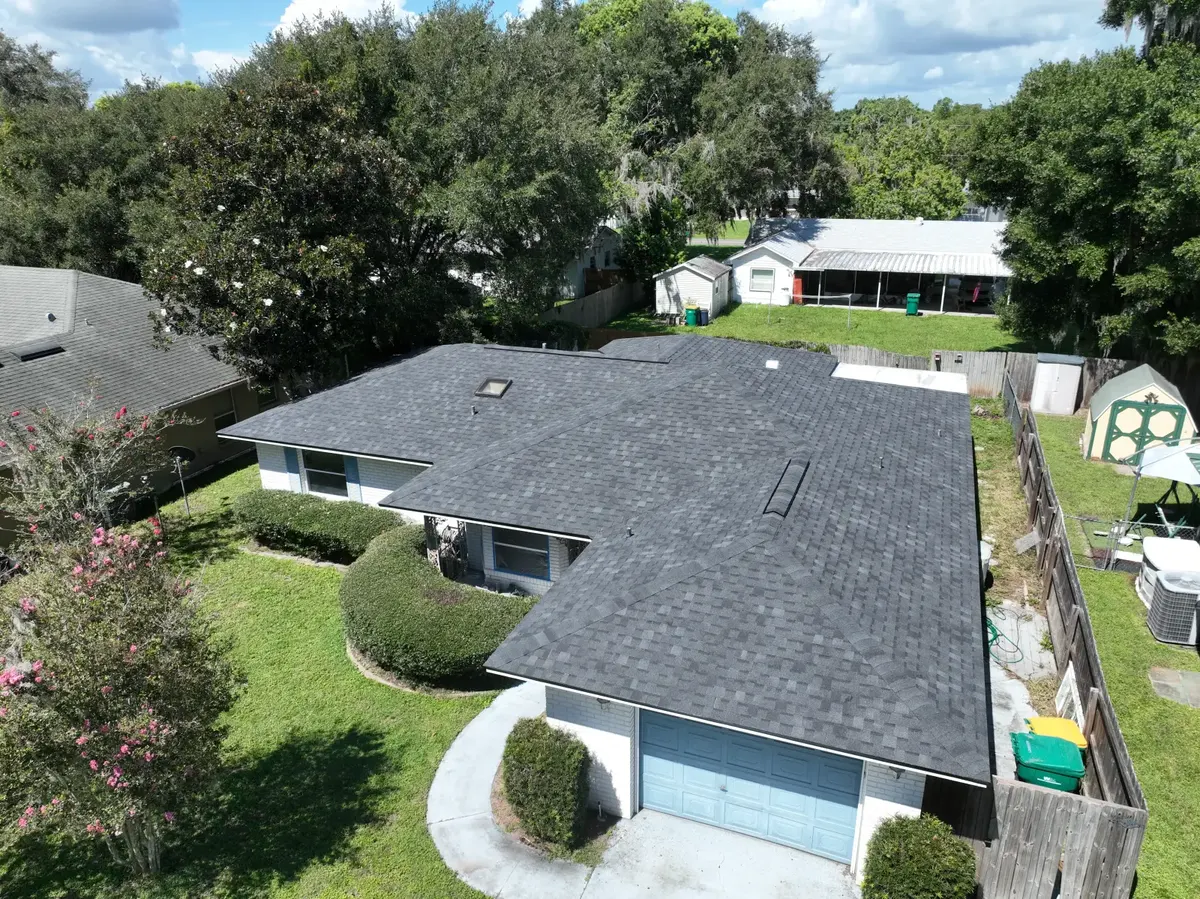
A completed shingle roof replacement, seen from the drone. August 2024.
Your first call
Who do I call first, my roofer or my insurance company?
Your roofer, meaning the company that installed it. A leak from how the roof went on is what the workmanship warranty is for. Call your insurer too if a storm hit first or the inside of the house is damaged.
Photograph the stain and anything wet. Note the date, the weather and where the water shows up.
Call the installer, then put it in writing
Follow the call with a text or email the same day, with photos and your install date, so you have a dated record.
Suspect the shingles? Tell the maker yourself
GAF's warranty says notice to your contractor is not notice to GAF, and you must notify GAF within 30 days after you notice a problem. Check your own warranty's rules.
If the installer won't respond
Chapter 558 of the Florida Statutes sets a notice step before most lawsuits over a construction defect. Under section 558.004, the homeowner generally serves written notice on the contractor at least 60 days before suing, describing each defect in reasonable detail. The contractor may inspect within 30 days and must answer in writing within 45 days, for example with an offer to repair, a payment offer or a dispute. The process applies unless you and the contractor agreed in writing to opt out (section 558.005). We're a roofing contractor, not a lawyer, public adjuster or insurance agent, so read your own contract and policy and ask a licensed attorney about your situation.
Workmanship or storm
How can I tell workmanship problems from storm damage?
Start with timing and location. In our experience, a leak in ordinary rain soon after the install, at a wall, pipe, skylight or valley, usually traces back to the installation. One that starts right after a storm, with shingles missing or torn, points to the storm.
Clues that point to the installation
It started in the first rains after the install and keeps coming back in one spot.
The water shows up below a wall, chimney, pipe, skylight or valley.
No storm has come through since the roof went on.
Clues that point to a storm
It began during or right after high wind, hail or a named storm.
Shingles are missing or torn, or pieces are in the yard.
GAF's storm-damage bulletin adds damage that isn't always visible: cracks where wind blew shingles back, loosened seals and granule loss.
These are field clues, not proof. GAF's warranty makes the same split: it excludes hail and winds over the listed speed as acts of nature, and separately excludes damage from improper installation. Some leaks are both, when a storm finds a weak detail. More on storm damage you can't see from the ground.
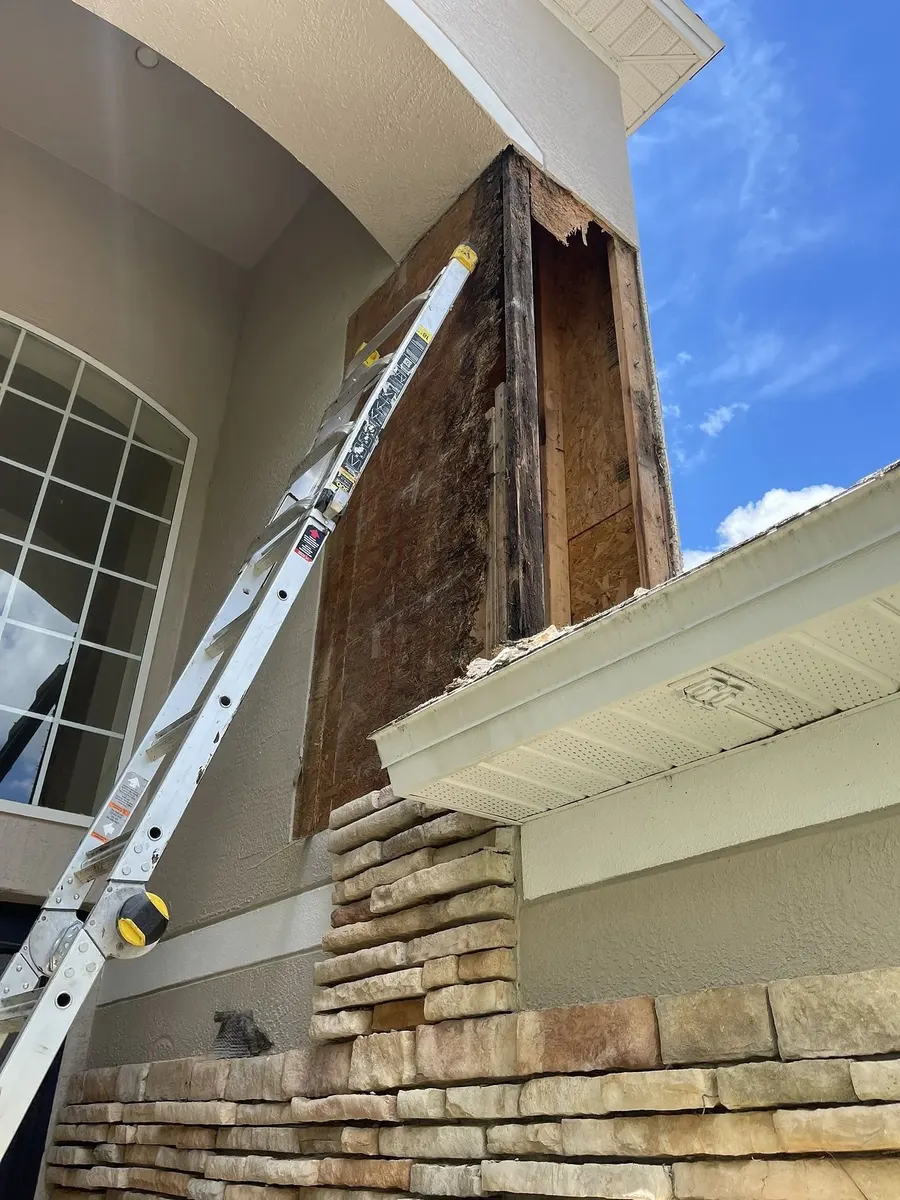
A water-damaged roof edge and wall, opened up to trace where a leak was getting in.
Second opinion
What if my roofer won't come back?
Get a second opinion with photos, check the roofer's license, and keep every request in writing. A second roofer's photo report shows what's wrong, whichever way you go next.
We repair roofs other companies installed. Freedrone-assisted roof inspections come with a written photo report you keep, and no trip or diagnostic fee. We'll tell you plainly what we find, even when the leak isn't the installer's fault. For a first look, text photos to (941) 345-0072.
Then check the roofer's license record, which shows whether it's current and links to complaints. Here's how to check a Florida roofing license. The state licensing department (DBPR) takes complaints, but says it cannot represent you in civil matters to recover fees paid. Before you hire the next roofer, learn the signs a roofer isn't being straight with you.
The state recovery fund isn't a leak fund
Florida's Homeowners' Construction Recovery Fund pays only after a court judgment, arbitration award or state licensing board restitution order for certain violations, like abandoning a job or financial misconduct that harms the customer, and only once any warranty, bond or insurance is used up (sections 489.141 and 489.129(1)). Poor workmanship alone isn't on that list, so in our reading it generally won't pay for a leak.
Reviews
Homeowners on repairs, second opinions and warranties
★★★★★
"They came out and repaired the leaky patio roof that another company installed. ... The roofer said it was poor installation of the patio roof by the Aluminum company and showed me pictures. There were at least 2 inch gaps. The roofers fixed the problem."
Anne P.Patio roof leak repair, Florida Gulf Coast
★★★★★
"Had another company put on a new roof and after inspection several issues with the work were obvious. Called in Coastline and within a week they had a crew of guys come make needed repairs."
Dan H.Repairs after another company's install, Florida Gulf Coast
★★★★★
"They gave an honest price when everyone else was high from being so busy after the hurricane. We had all new decking and fascia redone. ... They also provided me with a 5-year workmanship guarantee where everyone else provided one year."
Rolando B.Roof replacement after a hurricane, Florida Gulf Coast
Is it normal for a new roof to leak a little at first?
No. A roof shouldn't let water in at any age. New shingles are more exposed to wind until they seal, so have the installer check them now rather than wait.
How long do new shingles take to seal?
There's no fixed number of days, because sun and heat do the work. CertainTeed says cool weather and dust can delay sealing, and shingles still unsealed after a reasonable time may need hand sealing. GAF's warranty excludes damage from skipping hand sealing on a cold-weather install.
Does one leak mean the whole new roof was installed wrong?
Not necessarily. One flashing or pipe boot done wrong can leak on an otherwise sound roof, and fixing that detail may be all it needs. Problems on several slopes point to how the whole roof went on, and that calls for a closer look.
Should I check that my new roof's permit was closed out?
Yes. Florida law generally requires a building permit to repair or alter a building (Florida Statutes section 553.79(1)(a)), and in Manatee County the final roof inspection comes once the roof is 100% complete. Ask your roofer for the permit number and check that it passed final.
Free drone-assisted inspection with a written photo report you keep. No trip fee, no diagnostic fee, and we'll tell you plainly whether it's workmanship, a storm or something else.