
★★★★★
"Josh and his crews are top notch, on time and professional. Will definitely be recommending them to the people I know. Thank you Coastline roofing for the great work."Kyle M.Parrish Fire Department roof, Manatee County, FL
Use the state's license search at MyFloridaLicense.com. Search by the roofer's name or license number, open the record, and check three things: the license type is a roofing contractor license, the status reads Current, Active, and the business listed matches the company on your contract. Certified roofing licenses start with CCC. Practice on ours: CCC1331076.
Anyone can paint "licensed and insured" on a truck. The state's record shows whether it's true, who holds the license, and where that roofer is allowed to work. Here's how to read one, with our own license as the example.
The Construction Industry Licensing Board does, as part of the Florida Department of Business and Professional Regulation (DBPR). Roofing contractors are one of the license types the board oversees, and DBPR runs the public license search.
State law sets it up this way. Florida Statutes section 489.107(1) creates the board "within the department," section 489.105(2) says the department is DBPR, and section 489.107(4)(b) puts "the roofing contractor" in the board's Division II. DBPR describes the board as "responsible for licensing and regulating the construction industry."
The same law defines the job. Under section 489.105(3)(e), a roofing contractor's services are "unlimited in the roofing trade," covering the install, maintenance, repair, alteration, extension or design of all kinds of roofing, waterproofing and coating. In plain words, the license covers a leak repair as much as a full tear-off.
Where the roofer can work. A certified roofing contractor can take jobs anywhere in Florida. A registered roofing contractor can work only where they hold a local city or county license, plus neighboring areas that accept it.
Section 489.105(8) says a certified contractor is "allowed to contract in any jurisdiction in the state without being required to fulfill the competency requirements of that jurisdiction." Section 489.105(10) says registered contractors met the requirements of a local jurisdiction and "may contract only in such jurisdictions." DBPR's FAQ puts it more simply: a registered contractor "may only practice contracting in that county or city, along with any adjoining locales that will accept your registration."
| Certified | Registered | |
|---|---|---|
| License number starts with | CCC | RC |
| Where they can work | Anywhere in Florida | The city or county of their local license, plus neighboring areas that accept it |
| Renews by | August 31 of even-numbered years | August 31 of odd-numbered years |
| In the state's license search | Yes | Yes |
The prefixes above are what DBPR's own records show, but the License Type line is what counts. If a registered roofer's local license is from a different county than your house, ask how it covers your job before you sign.
Go to MyFloridaLicense.com, choose Verify a Licensee, and search by license number or name. Open the record, then read the license type, status, expiration date and business name.
On MyFloridaLicense.com, choose Verify a Licensee, or go straight to DBPR's license search page. This is the state's own record, not a review website.
It's the most exact search, and the number should already be on the roofer's estimate and contract (state law requires it, more on that below). No number? Search by name instead. The page can also search by city or county, or by license type.
Click the name in the results to open the full license record. Make sure it's the person or company you're dealing with, not one with a similar name.
The record lists Name, DBA Name (the business name), License Type, Rank, License Number, Status, Licensure Date, Expires and Special Qualifications, along with a main address and county.
The record has links to view related license information and to view license complaints. Open both before you sign anything.
Screenshot or print the page, with the date. If a problem comes up later, you'll have what the record said when you hired the roofer.
Here's ours. When we checked on September 22, 2026, DBPR's record for license CCC1331076 read Certified Roofing Contractor, Current, Active, expiring 08/31/2028, with Coastline Roofing Company, LLC listed as the business.
| Field | What ours shows | What to look for on any roofer's record |
|---|---|---|
| License Type | Certified Roofing Contractor | Certified or Registered Roofing Contractor |
| License Number | CCC1331076 | The same number that's on your estimate and contract |
| Status | Current, Active | Exactly "Current, Active." If it says anything else, ask why before you sign. |
| Licensure Date | 12/05/2016 | How long the license has been held |
| Expires | 08/31/2028 | A date after your job will be finished |
| Name | HILDEBRAND, JOSH | The person who holds the license. On ours, that's Josh, Coastline's owner. |
| DBA Name | COASTLINE ROOFING COMPANY, LLC. | The company name on your contract |
| Special Qualifications | Construction Business | Extra notes DBPR adds. The DBA line is the one that names the company. |
Open our license record on the DBPR website, or type the number into the search and follow the steps above. Then do the same with the number on your own estimate and hold the record next to the contract. The license type, status and company name should all line up.
Match the business name, make sure the number is on your paperwork, look at the expiration date and the complaint link, then check insurance, which the license record doesn't show.
A business can do roofing only through a licensed "qualifying agent" (section 489.119(3)(a)), and DBPR's FAQ says the qualified business is listed on that license. If the company on your contract isn't on the record, ask which license it works under and look that one up.
Section 489.119(5)(b) says the license number "shall appear in each offer of services, business proposal, bid, contract, or advertisement, regardless of medium." Check that the number printed on your paperwork is the one you looked up.
Licenses renew every 2 years (section 489.115(4)(a)). Certified contractors renew by August 31 of even-numbered years and registered contractors by August 31 of odd-numbered years. If your job is set to start near that date, look the license up again first.
The record has a View License Complaint link. Open it and read what DBPR lists, and ask the roofer about anything you find there.
When a license is issued and at every renewal, the contractor must attest to public liability and property damage insurance (section 489.115(5)(a)). For roofers, DBPR's minimums are $100,000 in public liability and $25,000 in property damage. The record doesn't list the policy, so ask for proof of insurance with current dates.
In construction, Florida's workers' comp law applies to any employer with one or more employees (section 440.02). Search the company by name on the Division of Workers' Compensation's Proof of Coverage database. Some company officers file exemptions instead, and those have their own search.
Don't hire them, and report it to DBPR. Contracting without a Florida license is a crime, and a more serious one while a state of emergency is in effect.
Section 489.127(1)(f) bars anyone from acting as a contractor, or advertising as one, "without being duly registered or certified." A first offense is a first-degree misdemeanor under section 489.127(2)(a), and a repeat offense is a third-degree felony under (2)(b). Under (2)(c), doing it during a state of emergency declared by the Governor is a third-degree felony, even the first time.
To report it, use DBPR's file-a-complaint page, which takes complaints "against a licensee or an individual you suspect of performing Unlicensed Activity," or call DBPR's unlicensed activity hotline at 1-866-532-1440. Keep the business card, estimate and any texts.
One limit to know: DBPR says it "cannot represent you in civil matters to recover fees paid." We're a roofing contractor, not a lawyer, so if you've already paid someone without a license, talk to an attorney about getting that money back. The tactics that usually come before an unlicensed job are covered in how to spot a roofing scam after a Florida storm.
No. A current license is the minimum, not a reason to sign. It tells you the state allows this contractor to do roofing, not whether the price is fair or the work is good.
Once the license checks out, interview the roofer. Our list of questions to ask before you hire a roofer covers the estimate, the deposit, the permit and the warranties. For warning signs in how a roofer talks and sells, read seven red flags of a dishonest roofer.
You're welcome to start with us. Our license is CCC1331076, and we carry general liability and workers' comp on every crew. Look us up, then book a free drone-assisted roof inspection with a written photo report you keep.
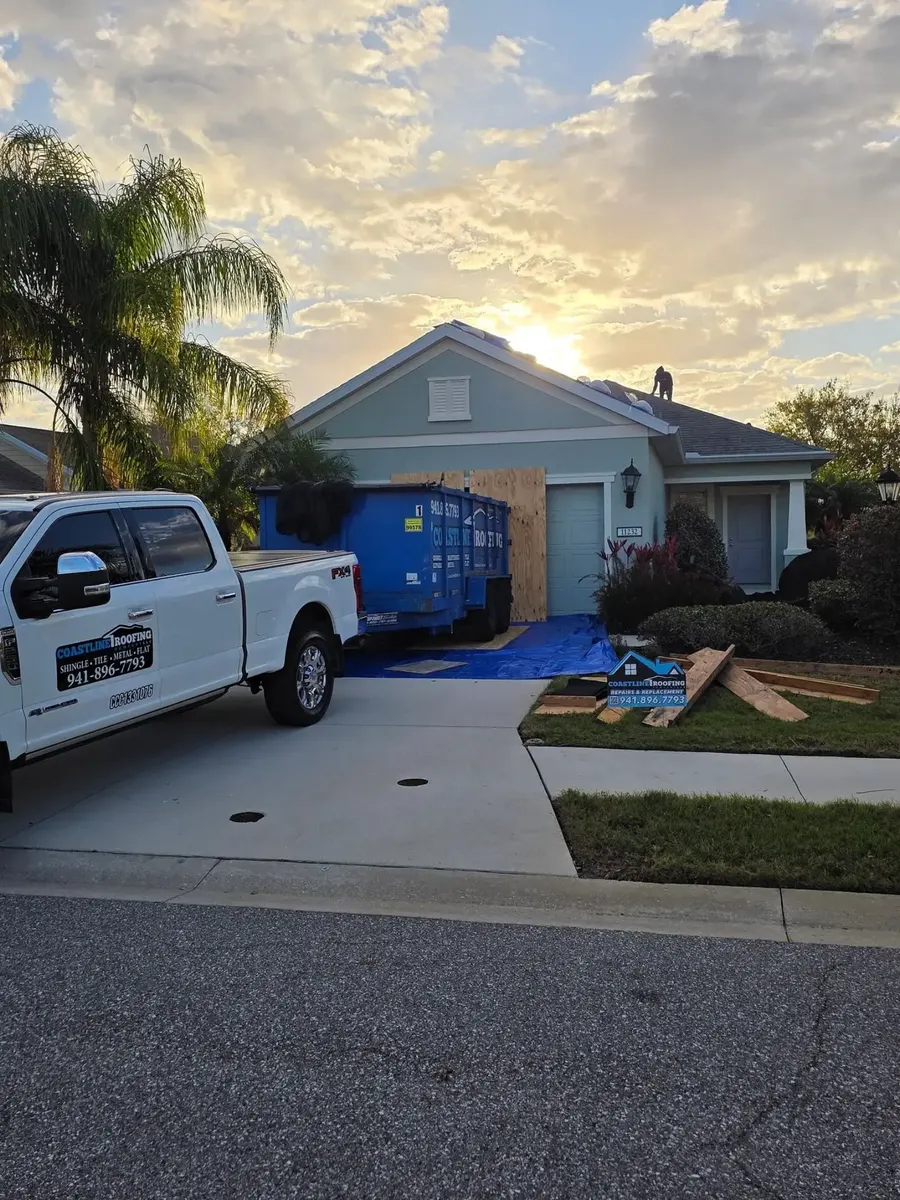
"Josh and his crews are top notch, on time and professional. Will definitely be recommending them to the people I know. Thank you Coastline roofing for the great work."Kyle M.Parrish Fire Department roof, Manatee County, FL
"I can't say enough good things about Coastline Roofing. They provided excellent service at every level, from the rep who came out to get things started, to the office manager, to the crew manager."René B.Roofing customer, Florida Gulf Coast
"From start to finish, the experience was absolutely amazing. The team arrived on time, worked with great attention to detail, and made sure everything was done perfectly. Their professionalism, honesty, and hard work really stood out."William R.Roofing project (Facebook review)
Not without a Florida license. Section 489.127(1)(f) bars acting as a contractor here without being "duly registered or certified." Ask for their Florida license number and look it up like any other. If they don't have one, they can't contract for your roof.
Wait. A pending application isn't a license, and the law bars contracting without one. Hold off on signing or paying until the record shows up in the state's search as Current, Active.
No to both. Under section 440.02, up to three officers of a corporation, each owning at least 10 percent of the stock, can elect to be exempt, and the Division of Workers' Compensation says LLC members can be exempt under the same limits. The notice required under section 440.05 says the exemption "is NOT a license issued by the Department of Business and Professional Regulation." You can look exemptions up on the Division's exemption search.
Yes, anywhere we work. Ours is a certified license, and section 489.105(8) lets a certified contractor work in any jurisdiction in the state. We serve Manatee County, South Pinellas, South Hillsborough and Sarasota County communities, including Anna Maria Island and Longboat Key.
Check license CCC1331076 on the state's search, then get a free, drone-assisted inspection with a written photo report you keep. No trip fee, no diagnostic fee.
Leave your name and number. We typically call back the same day during business hours. Consent to texts is not required.