
★★★★★
"They go the extra mile to get what their customers need or want. Chimney caps, skylight, they handle it all."Chimney F.Roof repair, Florida Gulf Coast
Valleys leak because they carry the runoff from two slopes through one narrow channel. Leaves and twigs dam that water, valley metal corrodes, the lining underneath fails, or the shingles were nailed or trimmed too close to the center. Florida downpours find those weak spots fast. Most valley leaks are a targeted repair, not a new roof.
A leak where two rooflines meet can look like a big problem, and someone may tell you the whole roof has to go. Usually it doesn't. Below: what goes wrong in a valley, what the Florida code and the shingle makers require, and how a proper repair works.
A valley is the inside corner where two sloping sections of roof meet. Rain from both slopes drains into it and runs down it to the roof edge.
Any roof with an L-shape, a bump-out or a dormer has them. There are two families, open and closed, usually easy to tell apart from the ground.
| Valley type | What you see | How it's built |
|---|---|---|
| Open (metal) | Bare metal down the center | Shingles stop 2 to 6 inches short of the center on each side, so the metal carries the water. |
| Closed-cut | Shingles with a straight cut line | Shingles from one slope run across the valley. Shingles from the other lap over them, trimmed about 2 inches from the center. |
| Woven | Shingles crossing from both sides | Shingles from both slopes interlace across the valley. |
A closed valley still has a lining under the shingles. You just can't see it. Every valley type leans on that hidden layer when water gets past the surface.
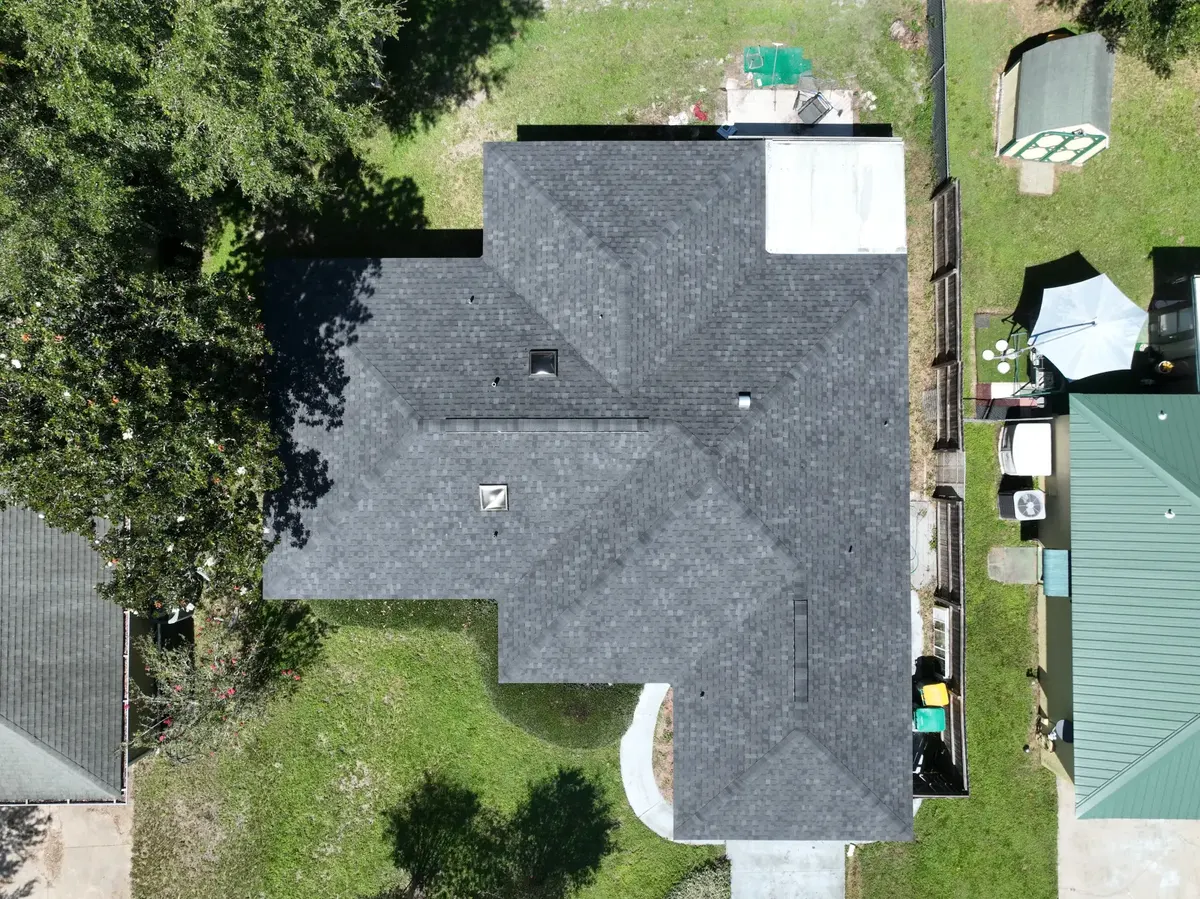
A valley takes the runoff from two slopes, right where the roof covering is broken by the change in direction. Any flaw along that line gets tested by more water than anywhere else on the roof.
Leaves and twigs collect in valleys, especially under trees. The National Park Service lists debris in gutters and valleys as a problem to watch for, and says to sweep leaves out of valleys.
GAF's instructions warn that because of the extreme water volume in valleys, nails near the center can leak. GAF, Owens Corning, CertainTeed and Atlas all say to keep nails at least 6 inches from the centerline.
In a closed-cut valley, the overlapping shingles are trimmed 2 inches back from center and their corners clipped to keep water in the valley center. Get it wrong and you risk what InterNACHI (the home inspectors' association) calls cross-wash: water running across the valley and up under the far slope's shingles.
InterNACHI notes that metal flashing eventually corrodes and leaks, and badly installed metal may leak right away. The Park Service says to check for deteriorated flashing where roof areas meet.
The lining is the backup when water gets past the surface. Owens Corning, CertainTeed and Atlas call for a 36-inch waterproof liner centered in the valley; GAF, a full-width roll of its leak barrier. Skimp on it and less stands between the water and the deck.
In a woven valley, shingles from both slopes bend across the joint. InterNACHI warns that heavier shingles, such as laminated ones, may not bend well across the valley and can fail early by cracking.
A lot, and fast. NOAA estimates that about 2 inches of rain in one hour happens on average about once a year in Sarasota and Bradenton, and about 3 inches in an hour about once every 10 years. The valley carries that rain off both slopes that feed it.
| How often, on average | In 1 hour | In 24 hours |
|---|---|---|
| About once a year | 2.03 inches | 4.17 inches |
| About once every 10 years | 3.07 inches | 6.88 inches |
| About once every 100 years | 4.24 inches | 11.9 inches |
Downtown Bradenton is nearly the same (2.00 and 3.00 inches in an hour). In the peak five minutes of a storm Sarasota sees about once every two years, rain falls at a rate of 7.76 inches an hour.
The stream also grows as it runs downhill. GAF builds that into its open valleys: the gap between the shingles starts at 6 inches at the top and widens 1/8 inch per foot toward the eaves to handle the increasing water volume.
More water in one channel means a deeper, faster stream. A nail hole or thin spot that stays dry in a light shower can sit under running water in a downpour.
A lining under every valley, installed before the shingles and following the shingle maker's instructions. Open metal valleys need metal at least 16 inches wide. A closed valley lined with roll roofing or peel-and-stick needs at least 36 inches.
The rule is Section R905.2.8.2 of the Florida Building Code, Residential, 8th edition (2023), as transcribed by the Florida Roofing and Sheet Metal Contractors Association (FRSA). For shingle roofs it allows:
The Florida Building Commission lists that 36-inch minimum for peel-and-stick in closed valleys as a 2023 change. Manatee County's roof inspection sheet tells contractors to leave valleys exposed for inspection, so the inspector sees the work before it's covered.
The code says valley linings go in according to the manufacturer's instructions, so the stricter spec governs. GAF calls for open-valley metal at least 20 inches wide and 24 gauge or heavier. Atlas calls for at least 16 inches of copper or equivalent on Pinnacle Pristine, our default shingle. On any quote, ask which valley type is included and whose spec it follows.
Tile roofs follow a different book. The code points to the FRSA-TRI Florida High Wind Concrete and Clay Roof Tile Installation Manual, 7th edition. It calls for valley metal at least 16 inches wide (24 inches of flat metal before bending) with a raised center rib, at least 1 inch high on open valleys and 2 1/2 inches on closed ones. Tiles are cut at an angle: at least 2 inches back from center on an open valley, meeting in the middle on a closed one.
By fixing the valley, not the stain: clear it, lift the shingles or tiles along it, replace damaged metal or lining, and lay the covering back to the maker's spec.
Water can enter well uphill of the stain (see how to trace where a roof leak starts). Once the valley is confirmed as the source:
A drone-assisted inspection shows the whole valley from above. The findings go into a written photo report you keep, with a line-by-line estimate.
Debris comes out first, since it may be the whole cause. A clean valley is when holes and corrosion in the metal are easiest to spot.
The lining goes in before the shingles, so reaching a torn liner or corroded metal means lifting the shingles or tiles along the valley and replacing what failed.
Nails at least 6 inches from center, the overlapping shingles trimmed 2 inches back, corners clipped, all per that shingle maker's instructions. On tile, the tiles are reset along the new metal.
A single misplaced nail or a clog means a small fix. Metal corroded along its run, or a liner failed in several places, means rebuilding the valley top to bottom, since patching one spot leaves the rest waiting to leak. Either way, a leaking valley is rarely a reason to replace an otherwise sound roof.
Leaks at walls, chimneys and pipe boots are a different repair, covered in why roofs leak at flashing. Valley repairs carry our 1-year workmanship warranty unless the contract says otherwise, and there's no deposit on repairs.
Keep them clear, keep branches back, and have them checked after big storms. Do the looking from the ground and leave anything on the roof to a roofer.
From the yard or an upstairs window, look for:
The Park Service suggests checking roof drainage every six months, before and after the wet season; on the Gulf Coast, add a look after any named storm. Trim branches that hang over the roof so fewer leaves reach the valleys.
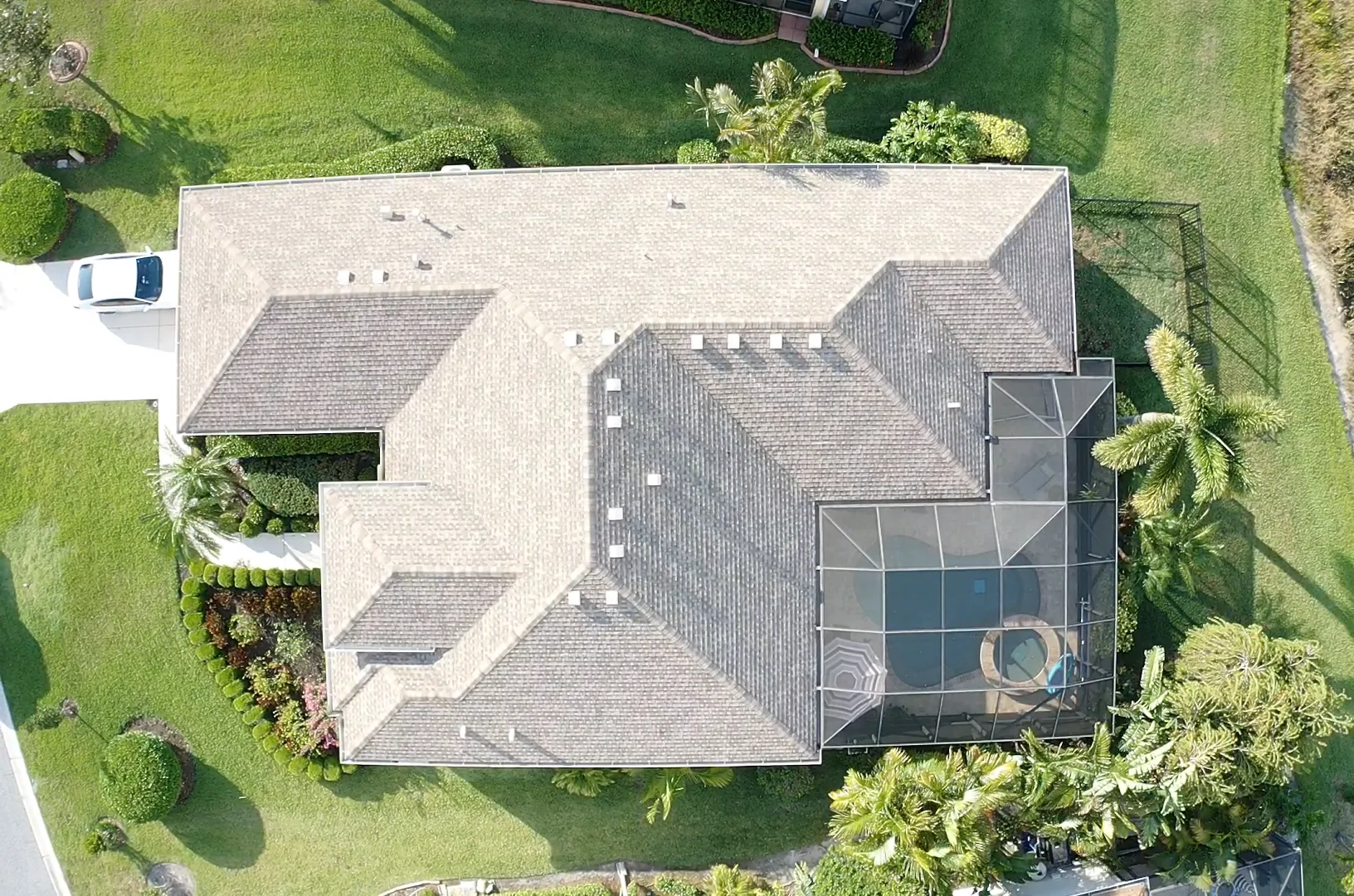
Our roof inspection is Free and drone-assisted, with a written photo report. If a valley needs work, our roof repair service handles it, and on active leaks we respond the same day. You can also text a photo of the ceiling stain to (941) 345-0072.
"They go the extra mile to get what their customers need or want. Chimney caps, skylight, they handle it all."Chimney F.Roof repair, Florida Gulf Coast
"Coastline did a great job. Very prompt and professional. Thanks."Philip J.Roofing customer, Florida Gulf Coast
"Coastline Roofing Company was awesome. They made the process so easy, they were on time and fast and exceeded my expectations."Dave C.Roofing customer, Florida Gulf Coast
Both are accepted, and the shingle makers don't agree on a favorite. CertainTeed prefers closed-cut valleys on its Landmark shingles; Owens Corning accepts woven and metal valleys. InterNACHI says open valleys carry away debris more readily than closed ones, which helps under big trees.
No. InterNACHI says woven valleys should never be installed on a roof with a pitch under 4:12, meaning less than 4 inches of rise for every 12 inches across. Some shingle lines skip them entirely: GAF's Timberline instructions describe only open and closed-cut valleys.
Start with the roofer who installed it. A valley built wrong is a workmanship problem, which is what an installer's workmanship warranty is for. Every Coastline replacement carries a 5-year workmanship warranty. More in why a new roof leaks.
Yes. We repair tile flashing and cracked tiles without a full tear-off, and when the tile is sound but the underlayment beneath it has failed, we can re-underlay it. Broken tiles too? See when a cracking tile roof can be repaired.
Free drone-assisted inspection with a written photo report you keep. No trip fee, no diagnostic fee, and if a targeted valley repair will do the job, we'll say so.
Leave your name and number. We typically call back the same day during business hours. Consent to texts is not required.