BRADENTON, FL & MANATEE COUNTY

Solar Attic Fan Installation in Bradenton, FL

Florida attics hit 130 to 160 degrees on summer afternoons. That heat bakes your shingles from underneath and forces your AC to run all day to keep the house livable. A solar attic fan vents that heat using the sun, lowers attic temperatures by 20 to 40 degrees, and extends shingle life without adding a cent to your electric bill. Installed in one visit on shingle, metal, or tile roofs across Manatee, South Pinellas, and Sarasota counties.

Installed price From $1,800 installed
Solar attic fan installed on a shingle roof in Manatee County, FL
Licensed & InsuredFlorida CCC1331076
4.7 stars57 Google reviews
Zero running costSolar-powered, free to operate
One visitInstalled same day
Why Florida attics need help

Your attic is the hottest part of your house, and it is costing you money.

A Florida attic in July is not a passive space. It is a sealed oven sitting directly above your living areas. Sun hits the shingles, the shingle surface heats to 160 degrees, that heat radiates down through the roof deck, and the trapped air in the attic climbs to 140 or 150 degrees by mid-afternoon. From the moment that heat builds up, two things start working against you at the same time.

First, your AC starts losing the battle. The ceiling of every room directly below the attic is now sitting under a thermal mass that is 50 to 70 degrees hotter than the air you are trying to cool. Your air handler runs longer, your compressor cycles more often, and your electric bill in August looks nothing like your bill in March. Many Manatee County homes spend more on cooling between June and September than they do on the rest of the year combined.

Second, the shingles themselves get cooked from the wrong side. Florida shingle manufacturers test for top-side UV and weather exposure, but the underside heat is what quietly shortens the actual service life. Asphalt binder breaks down faster, the mat can begin to delaminate, and granule adhesion weakens. A shingle roof over a properly ventilated attic performs closer to its rated service life. A roof over a sealed, heat-trapped attic degrades ahead of schedule from the inside out.

The fix is mechanical, not a bigger AC

The standard fix homeowners reach for is more AC. Bigger system, longer runs, extra cold-air pulls. That does not address the source. It just spends more electricity to fight a heat load that should not be there in the first place. The actual fix is to move the hot air out of the attic so the heat load on the ceiling and the underside of the shingles goes down. That is what a solar attic fan does. It mechanically moves the hot air out of the attic when the sun is hitting the roof, which is exactly the window when you need it most. The fan is powered by an integrated solar panel, so it costs nothing to run.

Why this works specifically in Florida

Solar attic fans work everywhere, but they earn their cost back fastest in places with long, hot, sunny cooling seasons. Florida runs a cooling season that is effectively eight months long. Solar production is high almost every day from March through October. Florida homes with proper soffit intake ventilation respond especially well, because the fan can pull cool outside air in through the soffits while pushing hot air out through the new roof vent. That airflow loop is what drops the attic temperature 20 to 40 degrees in real-world installs.

What's included

What's in a Coastline solar attic fan install

1

Free roof and attic inspection first

Before you commit to anything, we come out, measure your attic square footage, check your existing intake and exhaust ventilation, look at your current attic temperature, and confirm whether a solar attic fan is actually the right solution for your home. Some attics need one fan. Some need two. Some have ventilation problems that should be fixed before adding a fan. You get the answer in writing before you spend a dollar.

2

High-output solar attic fan unit

We install 30-watt solar attic fans with a 24V variable-speed brushless DC motor and adjustable solar panel. The fan includes a built-in thermostat that activates automatically at 85°F and shuts off at 70°F, and a humidity sensor that activates at 75% relative humidity and shuts off at 60%. That means the fan manages itself: no switch, no manual controls, runs when the attic needs it and stops when it does not. The unit is Florida Windstorm Certified and carries a lifetime manufacturer warranty, which is passed through to you in full.

3

Code-compliant flashing for your roof type

The mounting flange is integrated with the proper flashing for your roof. On shingle, the flange is woven into the shingle field with overlapping courses above and step flashing where it meets a slope change. On metal, the unit is flashed into the rib pattern with butyl tape and self-sealing screws. On tile, a flashing pan is custom-formed to integrate with the tile profile. Every install meets Florida Building Code for roof penetrations.

4

Sealed attic-side opening

The interior side of the roof penetration is cut clean, sealed against the underlayment, and the attic-side mounting is secured and inspected before the crew leaves. A solar attic fan that pulls air past a leaky seal is pulling conditioned air out of the house instead of trapped attic heat. We seal it correctly so the airflow path is attic to outside, not house to outside.

5

Solar panel orientation optimized

The solar panel on the fan housing is angled toward the south-facing portion of the sky so it picks up the longest, strongest solar production window during peak cooling season. A south-facing panel typically delivers 25 to 40 percent more solar output over a Florida summer compared to a poorly-oriented unit. This matters because more solar output means faster fan speeds during the hottest part of the day.

6

No electrician, no permit hassle

The solar panel is part of the fan unit. There is no wiring to your home, no breaker panel work, and no separate electrical permit. Most municipalities in Manatee and Sarasota counties treat a solar attic fan install as a standard roof penetration under the roofing scope, which we handle as part of the install. You do not need to coordinate with an electrician or a separate trade.

7

Written photo report on completion

Every Coastline install ends with a written photo report: roof penetration cut, flashing seated, fan mounted, sealant lines visible, attic-side opening clean and sealed, and the solar panel oriented. The report serves as proof of professional install for any future home sale, insurance question, or warranty claim.

8

Lifetime manufacturer warranty plus Coastline's 5-year workmanship warranty

The fan and motor carry a lifetime manufacturer warranty, passed through to you in full. On top of that, the install itself is backed by Coastline's 5-year workmanship warranty. If a flashing joint leaks, if the unit shifts, if anything fails on our install in five years, we come back and fix it. No fine print.

Zero Monthly Cost

The sun powers it. You pay nothing to run it.

A solar attic fan has no wiring to your home and no connection to the grid. The integrated solar panel converts sunlight directly into the electricity the motor needs. When the sun is on your roof, the fan runs. When the sun goes down, the fan stops. There is no meter, no switch, no monthly bill.

Monthly electric cost
$0
FL Windstorm Certified
Yes
Workmanship warranty
5 years

The fan runs hardest at the exact moment you need it most: peak solar production in the middle of the afternoon, when attic heat is at its worst and your AC is working hardest. That alignment means the fan is most active during the hours that do the most damage to your cooling bill and your shingles. Compare that to a powered attic fan wired to your electrical panel, which runs on grid electricity and adds to your bill every month during cooling season. The solar version does the same job for free.

Works on every roof type

Installed on shingle, metal, and tile across the Gulf Coast.

The fan unit is the same on every install. The flashing approach is different. Here is what each install looks like.

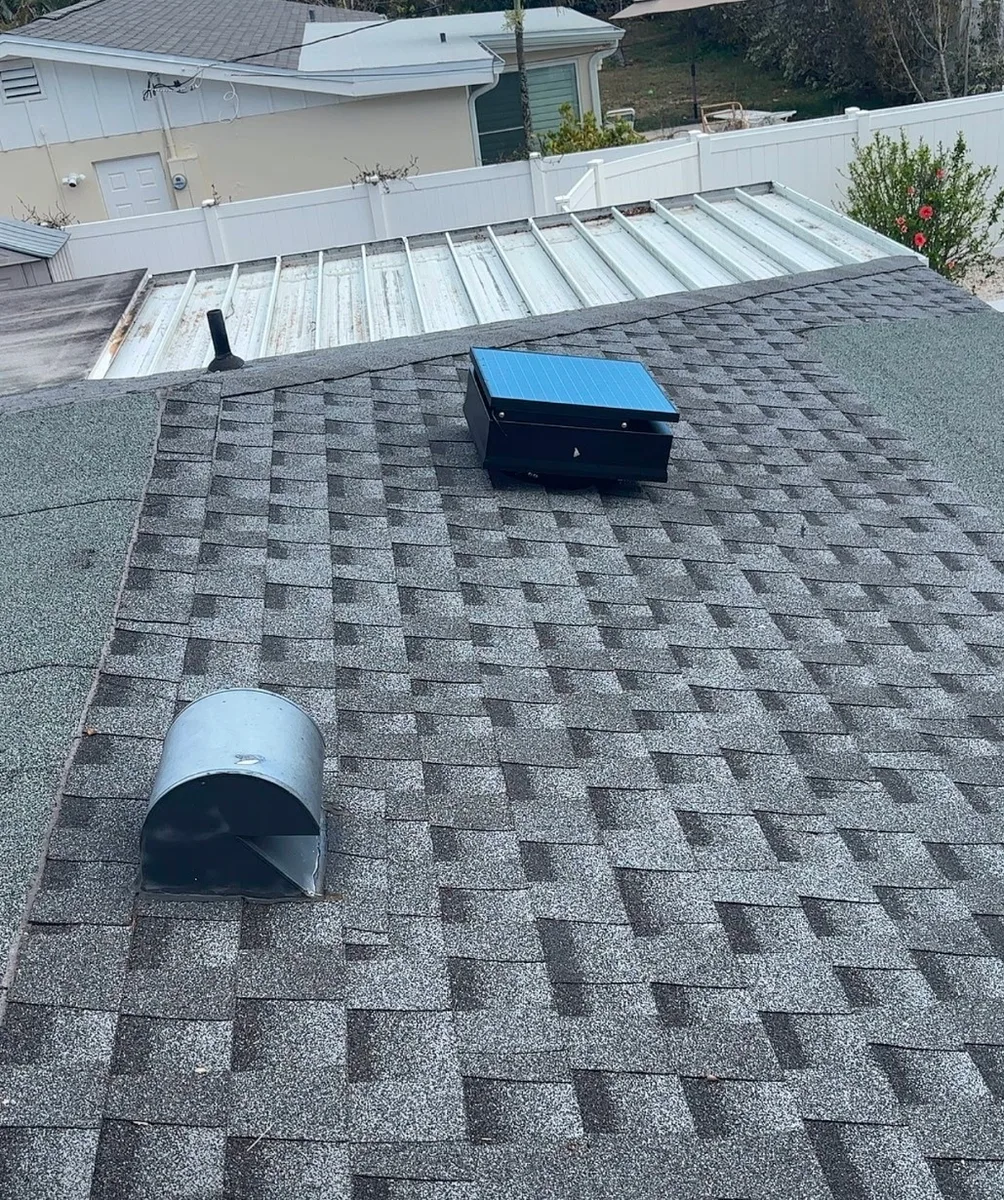
Solar attic fan recently installed on a shingle roof in Sarasota, FL

Shingle Roofs

Solar fan recently installed on a shingle roof in Sarasota, FL. Mounting flange woven into the shingle field with overlapping courses above the unit. Old mushroom-style turbine vent visible on the lower portion of the roof, replaced by the new solar fan as the primary attic exhaust point. Starting at $1,800 installed.

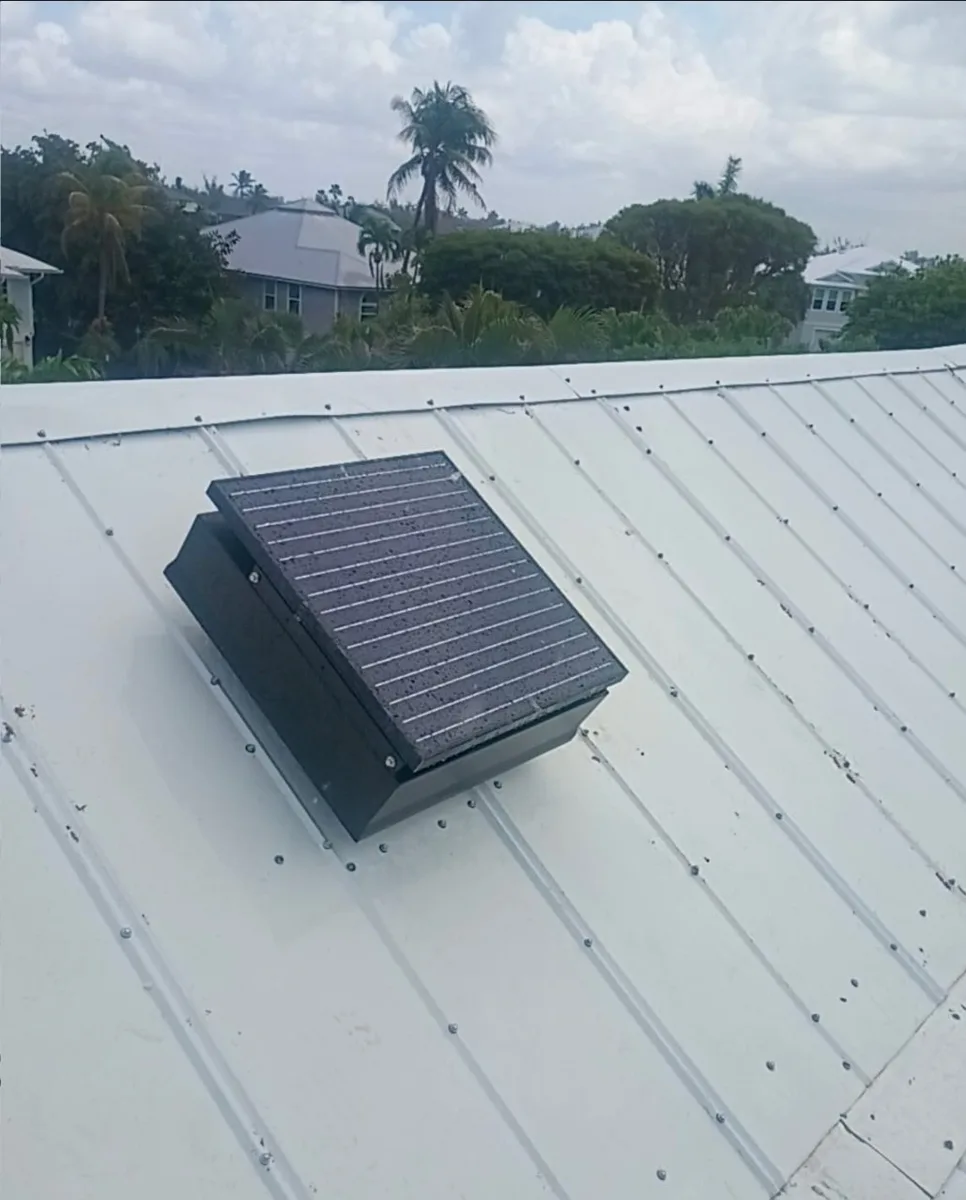
Solar attic fan installed on a standing-seam metal roof in Sanibel Island, FL

Metal Roofs

Solar fan installed on a standing-seam metal roof in Sanibel Island, FL. Unit is flashed into the rib pattern with butyl tape and self-sealing screws. Metal installs require additional labor because each rib pattern is custom, which is why the install is quoted after a free roof inspection.

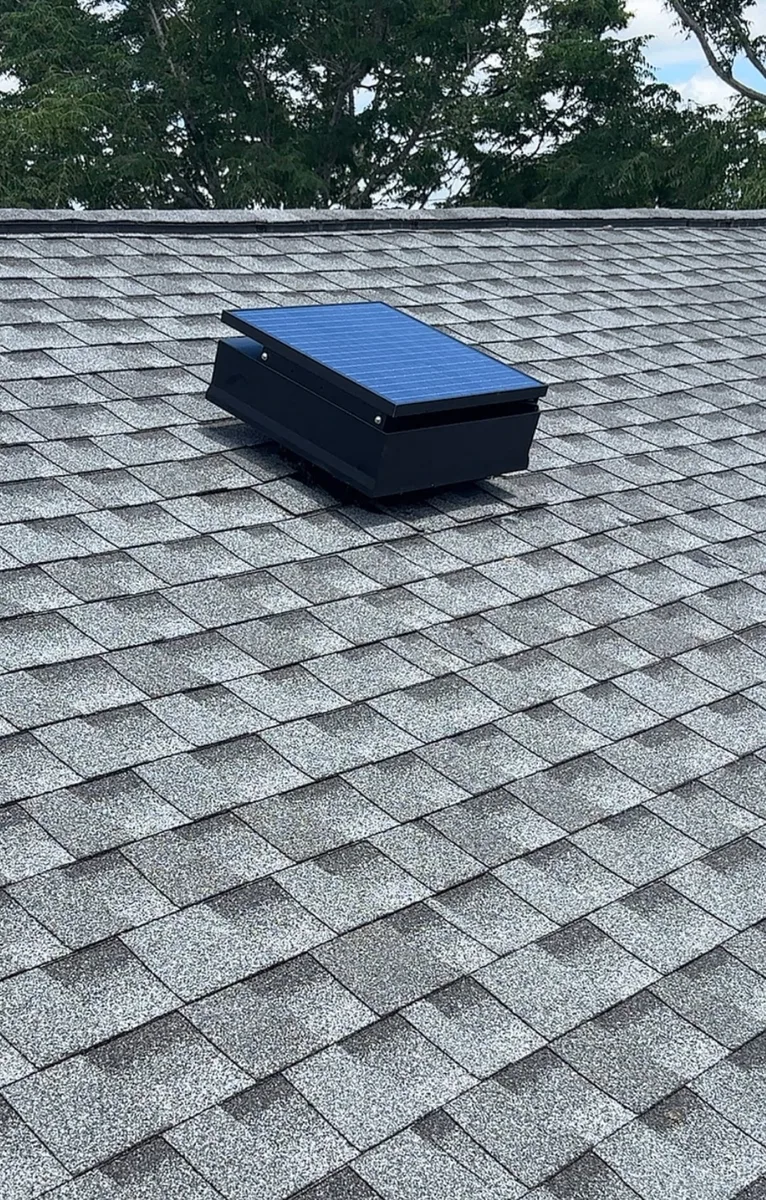
High-output solar attic fan with bright blue solar panel installed on a Manatee County shingle roof

Tile Roofs

We install solar attic fans on concrete and clay tile roofs across Manatee and Sarasota counties. A custom flashing pan is formed to integrate with the tile profile so the install is leak-proof under storm conditions. Quoted after a free roof inspection.

Pricing

Solar attic fan installed pricing

  • Shingle roof install From $1,800 installed
  • Metal roof install (standing seam or exposed-fastener) Quoted after free inspection
  • Tile roof install (concrete or clay) Quoted after free inspection
  • Old solar fan replacement Quoted after free inspection

Shingle installs start at $1,800 because the flashing is straightforward and the labor time is predictable. Metal and tile installs add labor for custom flashing work, which is why we quote those after a free roof inspection rather than publishing a single number. There is no trip fee, no diagnostic fee, and no commitment from the inspection itself.

The installed price includes the fan, the flashing, the install, the photo report, and our 5-year workmanship warranty. The fan costs nothing to operate once installed since it runs entirely on solar power.

Get my installed price
How it works

Four steps from first call to a cooler attic

  1. 01

    Call or text to schedule

    Call (941) 896-7793 or text your address to (941) 345-0072. We confirm your roof type and rough attic size so we can scope the visit before we drive out.

  2. 02

    Free roof and attic inspection

    We look at the roof, measure the attic, check your existing intake and exhaust ventilation, and confirm whether a solar attic fan is the right call. Most inspections take 20 to 30 minutes on site.

  3. 03

    Written quote, then install

    You get the install price in writing. Shingle installs run $1,800. Metal and tile are quoted after the inspection. Once you approve, the install happens in a single visit, usually 2 to 4 hours start to finish.

  4. 04

    Photo report and tax credit invoice

    Photo report sent to you the same day with every step of the install documented. Paid invoice itemizes equipment and labor for your records and any future warranty or insurance questions.

Reviews

What Manatee County homeowners say about Coastline

★★★★★
"Josh was especially amazing. He was professional, patient, and took the time to explain everything clearly so I felt comfortable and informed throughout the entire process. You can tell he genuinely cares about his customers and takes pride in his work."
Madison T. Manatee County, FL
★★★★★
"Loved how Josh used his drone to identify cracked and slipped roof tiles and sent us the photos. Photos also taken of completed work."
Felicity K. Florida Gulf Coast
★★★★★
"Josh and his team installed our 3,800 sqft two-story peak roof in just 3 days. Not one nail hit the lawn. He helped pick the color, walked us through every step. My family is so pleased."
Faith E. Florida Gulf Coast
FAQ

Common questions about solar attic fan installation

How much does a solar attic fan cost installed?

Solar attic fan installs start at $1,800 on a typical shingle roof in Bradenton, Palmetto, Sarasota, and the surrounding Manatee County area. Metal and tile installs are quoted after a free roof and attic inspection because the flashing approach is different. The price includes the fan, all flashing, the install, and a written photo report on completion.

Is there a federal tax credit for solar attic fans?

Not for installations completed after December 31, 2025. The Residential Clean Energy Credit under IRC Section 25D was repealed for new property by the One Big Beautiful Bill Act, signed into law July 4, 2025. Installations completed in 2025 or earlier may have qualified, and any unused credit from those years can be carried forward under rules that were not repealed. For any installation in 2026 or later, no federal tax credit applies. We recommend speaking with your tax preparer about your specific situation.

Will the install leak?

No. The mounting flange is integrated with proper flashing on every install: stepped or woven into the shingle field on a shingle roof, sealed to the rib pattern on a metal roof, and bedded with code-compliant flashing on tile. Every solar attic fan install is documented with a photo report so you can see exactly how the flashing was set. Every install is backed by our 5-year workmanship warranty.

Does it work on metal and tile roofs, or only shingle?

We install solar attic fans on all three: shingle, metal (standing seam and exposed-fastener), and concrete or clay tile. The fan unit is the same. The flashing approach is different on each. Metal installs require the unit to be flashed into the rib pattern with butyl tape and self-sealing screws. Tile installs require a flashing pan that integrates with the tile profile. Both add labor compared to a shingle install, which is why metal and tile installs are quoted after a free inspection.

How many solar attic fans does my Florida home need?

Most standard Florida single-family homes need one fan. Larger homes, homes with complex multi-peak rooflines, or homes with poor existing intake ventilation may need two. Our free attic inspection measures the actual attic square footage, checks your existing soffit NFA (net free area), and gives you the right number in writing before any work happens. We do not push extra fans on jobs that do not need them.

How loud is a solar attic fan?

Quiet. Modern solar attic fans use brushless DC motors that run smoothly at variable speeds. From inside the home you generally do not hear it running. If you stand directly next to the fan on the roof, it is roughly the volume of a desk fan on a medium setting. Coastline does not install loud or low-quality units.

Do I need an electrician?

No. The solar panel is integrated into the fan unit itself, so there is no wiring to your home, no breaker panel work, and no electrician required. The fan only runs when the sun is on the panel, which is exactly when your attic needs the most help. No monthly electricity cost.

Can you replace a dead solar attic fan I already have?

Yes. We replace old or failed solar attic fans regularly. The most common failure point is the motor bearings, which typically last 10 to 15 years. If the existing fan is in the right location on the roof, we usually pull the old unit, inspect and reseal the existing roof opening, and set the new fan with fresh flashing. The replacement is quoted the same way as a new install: free inspection, then a written price before any work happens.

What kind of warranty do I get?

You get two warranties. The fan and motor carry a lifetime manufacturer warranty, which is passed through to you in full. On top of that, Coastline's 5-year workmanship warranty covers the install itself: flashing, sealing, mounting, and the roof penetration. If anything fails on our install in five years, we come back and fix it.

Install a solar attic fan in Bradenton, FL

Starting at $1,800 installed on shingle. Solar-powered, zero monthly cost. Quieter, cooler attic. Longer shingle life. Lower AC runtime. One visit.

Call Text