How Do I Know If My Roof Has Storm Damage I Can't See From the Ground?
Often you can't. Wind can loosen the seal under shingles that still lie flat, crack them where it bent them back, and strip granules. Tile usually shows its damage, but its underlayment and fastening need a roofer's check. An inspection after a hurricane tells you, and Florida law gives you one year from landfall to report a claim.
By Josh Hildebrand, owner of Coastline Roofing · Florida license CCC1331076 ·
Your roof came through the storm looking the way it did before, and nothing is dripping. That's good news, but it isn't proof. Some storm damage only shows itself in the next storm, and by then the claim window for this one may be running short.
Mostly damage in and under the roof covering: loose seals, small cracks and bare spots, loose vents and flashing, and on tile roofs, the fastening and underlayment.
Shingles that came unstuck
A strip of adhesive glues each shingle to the one below. GAF's storm damage bulletin counts a loosened seal as latent, or hidden, damage. From the ground, an unsealed shingle looks like any other.
Cracks where wind bent shingles back
GAF also lists surface cracks, "especially if high winds blew the shingles back," and exposed fiberglass mat that "may or may not be immediately visible."
Granule loss
Granules are the sand-like coating on a shingle. GAF counts granule loss "at points of impact or caused by stresses the shingles endure" as storm damage.
Tile fastening and underlayment
Tile industry guidance says broken tile is usually easy to see. What hides is whether each tile is still fastened well, and whether a broken piece let water and sun reach the underlayment below.
Loose vents and flashing
FEMA says ridge vents, off-ridge vents and turbines "often are poorly attached" and can bend or come loose in hurricanes. ARMA, the asphalt roofing makers' group, calls flashings "the most vulnerable points."
Water under the covering
IBHS, an insurance industry research lab, says "wind can lift unsealed shingles, and water can seep underneath the shingle." ARMA says flashing leaks show up as water stains on the underside of the roof deck, which a roofer checks from the attic.
Why it hides
Why does a roof look fine after a storm but still have damage?
Because what holds a shingle down in high wind is a strip of adhesive you can't see. If that bond lets go, the shingle can lie flat and look normal, and the next strong wind has an edge to get under.
IBHS says: "The most important factor affecting high-wind performance for self-sealing asphalt shingles is the strength of the seal between shingles." The seal comes from a heat-activated strip put on at the factory.
Seals also let go with age. University of Florida researchers pressed up on every shingle edge on 27 aged Florida roofs. Roofs 7 to 20 years old had significantly more partly unsealed shingles than roofs 6 or younger. On roofs that showed a pattern of unsealing, it ran from under 1% of shingles on a six-year-old roof to over 79% on a 20-year-old one. The authors concluded that partial unsealing "may be the root cause of observed wind damage of field shingles." They found it by hand, not by eye.
Tile roofs hide it underneath
The Tile Roofing Industry Alliance (TRI) says tile damage "is typically visible to the naked eye," and broken tiles "rarely occur as a result of wind exposure"; debris and hail do most of the breaking. Its brief on high winds says wind that lifts the front end of a tile more than 2 inches would likely keep lifting it until it failed, and it notes the code standards don't support prying tiles up to test them. TRI "strongly recommends" a qualified roofing contractor check the underlayment before any tile repair. For how that layer ages, see what a cracked tile does and doesn't mean.
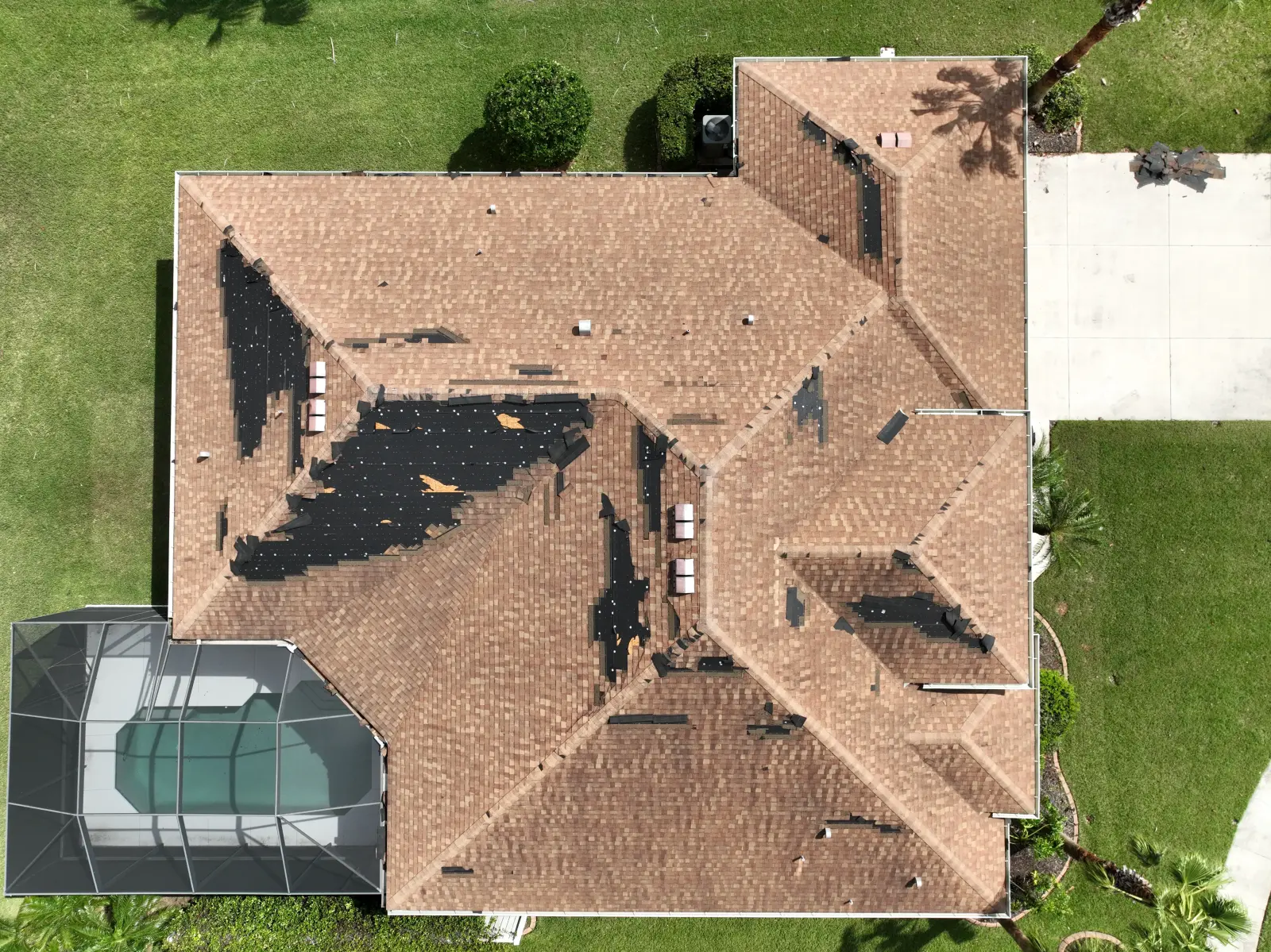
A hurricane-damaged tile roof from the air, October 2024. Missing tile is easy to see; the underlayment under the tile is not.
From the ground
Where can I look for clues without going on the roof?
From the yard, the driveway and inside the house. Stay off the roof and off ladders: ARMA says plainly that homeowners "should not climb onto their roofs."
Pieces in the yard. Bits of shingle, tile, vent or flashing mean something up there moved.
The downspouts. Granules wash down with the rain, so check where each one empties.
Binoculars from the driveway. Look for crooked shingles or tiles, gaps in a row, and bent vents.
Ceilings. New stains on ceilings or the tops of walls.
Photos and dates. Take photos from the ground and write down the storm's name and date.
A storm-damaged roof is no place for a homeowner, and neither is a ladder. Keep clear of downed power lines, which ARMA also warns about. The attic check is the roofer's job too.
No leak yet
Is a roof inspection after a storm worth it if nothing is leaking?
Yes, after a named storm. A dry ceiling doesn't rule out loose seals, cracked shingles or a bent vent, and an inspection records what the storm did while your claim window is still open.
GAF describes the harm of a loosened seal as "the potential for future shingle blow-off." You find it now, or the next storm finds it.
The other reason is paperwork: Florida's claim clock starts on the storm's date, not the day you notice a stain. A dated photo report is worth having even if the roof came through fine.
How long do I have to file a roof claim after a storm in Florida?
One year from the date of loss to give your insurer notice of a new or reopened claim, and 18 months for a supplemental claim, under Florida Statutes section 627.70132(2). For a hurricane, the date of loss is the day it made landfall.
Section 627.70132(3) sets the date of loss for weather claims as "the date that the hurricane made landfall or the tornado, windstorm, severe rain, or other weather-related event is verified by the National Oceanic and Atmospheric Administration." Damage you find months later is still on the clock that started at landfall.
Before SB 2-A in 2022, those limits were 2 and 3 years, according to Florida's Insurance Consumer Advocate.
Florida claim deadlines after a storm
What happens
Deadline
Florida Statutes
You give notice of a new or reopened claim
Within 1 year after the date of loss
627.70132(2)
You give notice of a supplemental claim
Within 18 months after the date of loss
627.70132(2)
Your insurer acknowledges your communication
Within 7 calendar days
627.70131(1)(a)
Your insurer pays or denies the claim
Within 60 days after it receives notice
627.70131(7)(a)
The insurer's deadlines have an exception for delays beyond its control. We're a roofing contractor, not a lawyer, public adjuster or insurance agent, so read your own policy and ask a licensed professional about your situation. Our walkthrough of a Florida roof insurance claim covers what comes next.
Next steps
What happens if the inspection finds storm damage?
You get the photos and a written estimate, line by line. If anything is open to the rain, we can tarp it first. Filing a claim is your call; we document the damage and work alongside your adjuster.
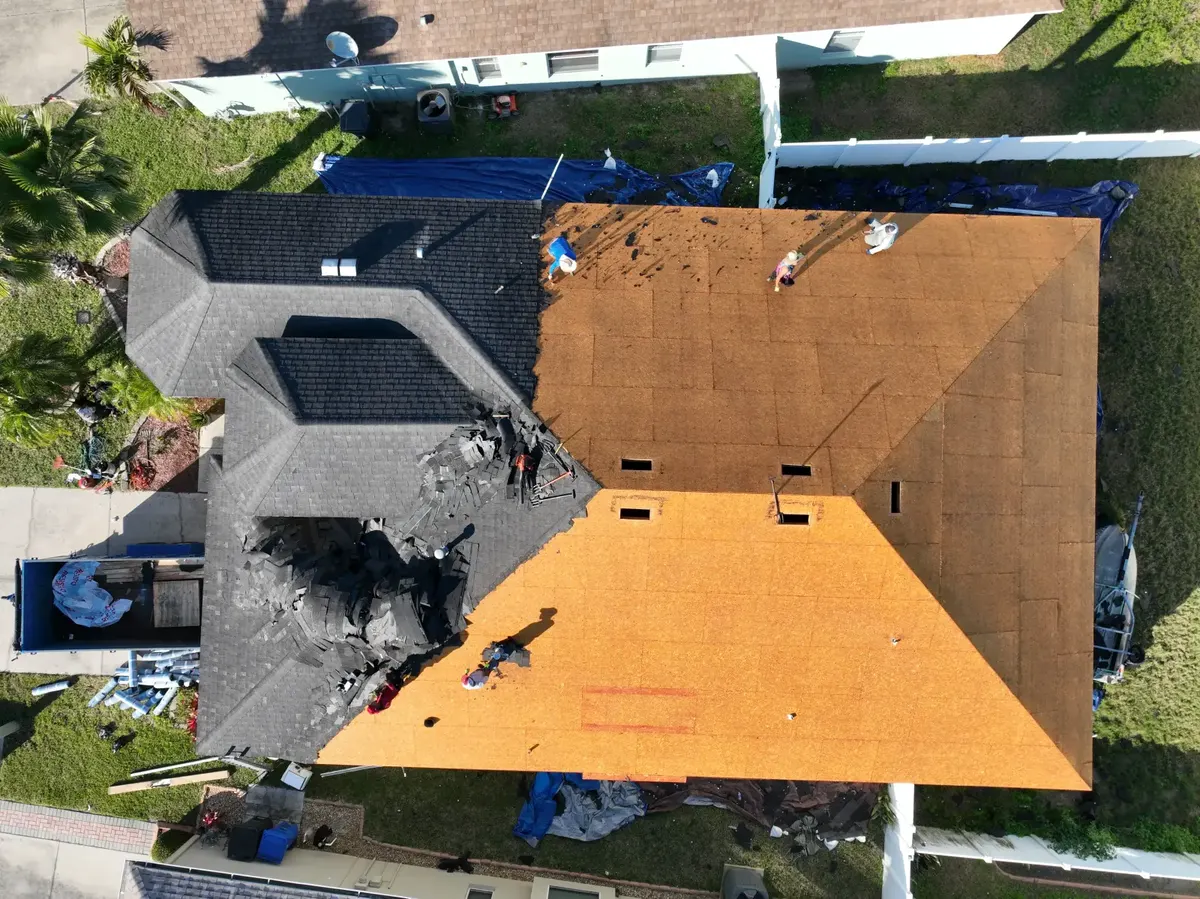
A storm-damaged shingle roof partly torn off to the deck after Hurricane Ian, January 2023.
See what we saw
The written photo report shows what we found, and the photos are yours to keep.
Stop the water first, if needed
We offer 24/7 emergency tarping. Florida's Department of Financial Services tells policyholders to make emergency repairs, "such as placing a tarp on your roof," and to photograph before and after. Leave the tarp to us; for indoor steps while you wait, see how to contain a roof leak until help arrives.
Repair where a repair will hold
Hidden damage doesn't automatically mean a new roof. ARMA says shingles damaged by high winds can be resealed, and GAF recommends hand-sealing shingles whose seal broke in extreme wind if they have no other damage. When damage is confined to one slope, GAF says replacing just that plane "may be possible." Repairs carry our 1-year workmanship warranty unless the contract notes otherwise.
Replace only when the roof calls for it
If the damage runs across the roof, the estimate says so, with photos to back it. Replacements carry our 5-year workmanship warranty.
Your claim stays yours
We work alongside your adjuster. We're not a public adjuster or an insurance agent, and we don't use Assignment of Benefits agreements.
"Coastline did a great job re-roofing our home. Then serious flying debris from both Hurricanes Ian and later Milton damaged the shingles twice. Each time, company owner Josh sent out a skilled crew to do repairs. We are happy that our roof still looks brand new."
Jim S.Storm damage repairs after Ian and Milton, Florida Gulf Coast
★★★★★
"We had a roof put on several years ago and were very pleased. Then Milton managed to tear off a few shingles. We called, sent pictures, and had to leave town due to a death in the family. Coastline came out, took care of it, and even used the same type shingle."
Andy J.Storm repair after Hurricane Milton, Florida Gulf Coast
★★★★★
"Great company. Quick response and excellent customer service. My roof is beautiful. Thank you Coastline Roofing. I would recommend you to anyone needing a new roof or roof repairs."
Much of it. A drone gets close-up photos of every slope without anyone walking a storm-damaged roof. A camera can't tell whether a shingle's seal still holds, or what the underlayment under tile looks like. Those take a trained roofer on the roof, never the homeowner.
Is a newer roof less likely to have hidden storm damage?
Generally, yes. After Hurricane Michael, IBHS found newer shingle roofs held up better than older ones nearby, and the Florida survey found fewer unsealed shingles on younger roofs. The exception is a roof whose shingles haven't sealed yet: IBHS says that until they do, wind and rain pose a risk.
What if I find more damage after my claim is paid?
That's a supplemental claim: more damage from the same peril after the insurer has adjusted the claim. Section 627.70132 gives you 18 months from the date of loss to give notice. Asking to reopen a closed claim for more costs on damage you already reported is a reopened claim, with the 1-year limit.
Will my shingle warranty cover storm damage?
Don't count on it. GAF's storm damage bulletin says failures from storm-related granule loss are "beyond the scope of the GAF Shingle & Accessory Limited Warranty." Other makers set their own terms, so read the one for your shingle.