
★★★★★
"They did a good job on the repair so I would definitely recommend them."Duke H.Roof repair, Florida Gulf Coast
A nail pop is a roofing nail that has backed up out of the deck, lifting the shingle above it. One or two are a small repair. A raised nail can wear through that shingle and keep it from sealing, inviting leaks and wind damage. Many pops on a newer roof point to how it was nailed.
Maybe you spotted a bump under a shingle, or an inspector wrote "nail pops" in a report. It sounds minor, and a pop or two usually is. The real questions are what a raised nail does to the shingle over it, and what a roof full of them says about the install.
It's a roofing nail that has worked its way back up out of the wood deck. Each nail sits under the next row of shingles, so a raised one pushes up on the shingle covering it.
Every asphalt shingle is held by nails driven through a band near its top and into the plywood deck. The next row laps over those nails, and a strip of adhesive seals each row down to the one below. The nail heads should sit flush, never cut into the shingle, and never show on the finished roof. InterNACHI, the home inspectors' association, describes nail pops as the spots where fasteners have backed out. You usually notice them as:
They're small, so from the yard you may only see a shingle that looks a little lifted.
Most trace back to how the nail was driven or where it landed. Wood decking that moves underneath plays a part too.
A nail left standing a little high keeps the shingle over it from lying flat. GAF's installation instructions say nails must be driven flush, and warn that raised ones can back out.
ARMA, the asphalt roofing manufacturers' group, says nails must not be underdriven, overdriven or driven crookedly. InterNACHI says overdriven nails cut into the shingle and lower its wind resistance, and angled nails cause the same problem.
The Florida Building Code, Residential (2023), Section R905.2.5, calls for nails that reach at least 3/4 inch into the deck, or all the way through a thinner one. InterNACHI's inspection manual names short nails as a cause of nail pops.
ARMA says not to drive nails into knot holes, cracks or spaces in the deck, where there's little solid wood to grip. Nails set above the adhesive strip, called high-nailing, are improper installation per InterNACHI.
ARMA says the pressure on air-powered nail guns should be adjusted as roof temperatures change, so nails aren't driven too deep or too shallow. It links a badly adjusted tool to raised tabs and blow-offs.
Wood panels grow as they take on moisture from humid air or rain, which is why APA, the engineered wood association, calls for a 1/8 inch gap at panel edges. ARMA warns that deck wood that isn't properly conditioned can move and distort the roofing on top.
They can, over time. A raised nail keeps the shingle over it from sealing and can wear a hole through it, and a nail that ends up exposed can rust and let water in around it.
A pop caught early is a small fix. One that's ignored can let water reach the plywood, and a slow leak nobody sees is how decking rots. See damage to the roof deck under your shingles for what that looks like.
Start with what to do right now when your roof is leaking. Nail pops are only one way in: see why roofs leak at the flashing and why roof valleys leak.
The bad nail is set properly or pulled and replaced by a new one nearby, the old hole is sealed, and any shingle with an exposed nail is replaced. A dab of caulk over the nail head is not a repair.
Whatever raised one nail may have raised others nearby, so a good repair looks past the one bump you noticed.
If a nail was simply left a little high, ARMA says it can be tapped down. If it's crooked, overdriven or has worked loose, ARMA's fix is to pull it, fill the old hole with asphalt roof cement, and drive a new nail nearby.
GAF's bulletin on exposed nails says to remove any shingle with exposed nails in it and replace it with a new one.
Adhesive that has been pulled apart may not stick again on its own. For shingles nailed too high, InterNACHI's guidance is to re-nail them correctly and hand-seal them.
GAF's bulletin says roof cement or caulk over an exposed nail is not considered a permanent repair. It also does nothing about why the nail backed out.
Please leave this to a roofer. It means walking the roof, and that isn't a job for a ladder and a hammer. Our repairs carry a 1-year workmanship warranty unless the contract notes otherwise, and there's no deposit on repairs.
When pops show up across a roof that's only a few years old, look at the nailing first. No one publishes a number of pops that proves a bad install, but InterNACHI ties nail pops to nailing that wasn't done to the manufacturer's specifications.
Florida's building code sets the floor, and the shingle maker's instructions set the rest.
| The rule | What it says | Where it comes from |
|---|---|---|
| Nail type | Galvanized steel, stainless steel, aluminum or copper roofing nails, with at least a 12-gauge shank and a 3/8 inch head. | Florida Building Code, Residential, R905.2.5 |
| Nail length | Long enough to pass through the roofing and at least 3/4 inch into the deck, or all the way through a thinner deck. | Florida Building Code, Residential, R905.2.5 |
| Nail count | At least 4 per strip shingle (2 per individual shingle), or more if the manufacturer requires it. | Florida Building Code, Residential, R905.2.6 |
| Placement | In the manufacturer's nailing area. Atlas: 7 inches up from the bottom edge, about 1 inch in from each side. GAF: about 6 7/8 inches from the bottom. | Atlas, GAF |
| How it's driven | Straight, with the head flush to the shingle. Not cutting into it, and not exposed on the finished roof. | Atlas, GAF, ARMA |
Nailing mistakes also fall outside shingle warranties. GAF's warranty excludes damage caused by improper fastening, and the re-roofing section of Atlas's Pinnacle Pristine instructions says incorrectly placed nails will void the wind coverage. We're a roofing contractor, not a lawyer, so read your own warranty for its exact terms.
So a newer roof covered in pops is a workmanship question first. Call the company that installed it and pull out their workmanship warranty. (Ours runs 5 years on every replacement.) If it's also leaking, read why a new roof leaks. Shingles curling or dishing across a whole slope, rather than bumping up over single nails, are a different problem: see what curling and cupping shingles mean.
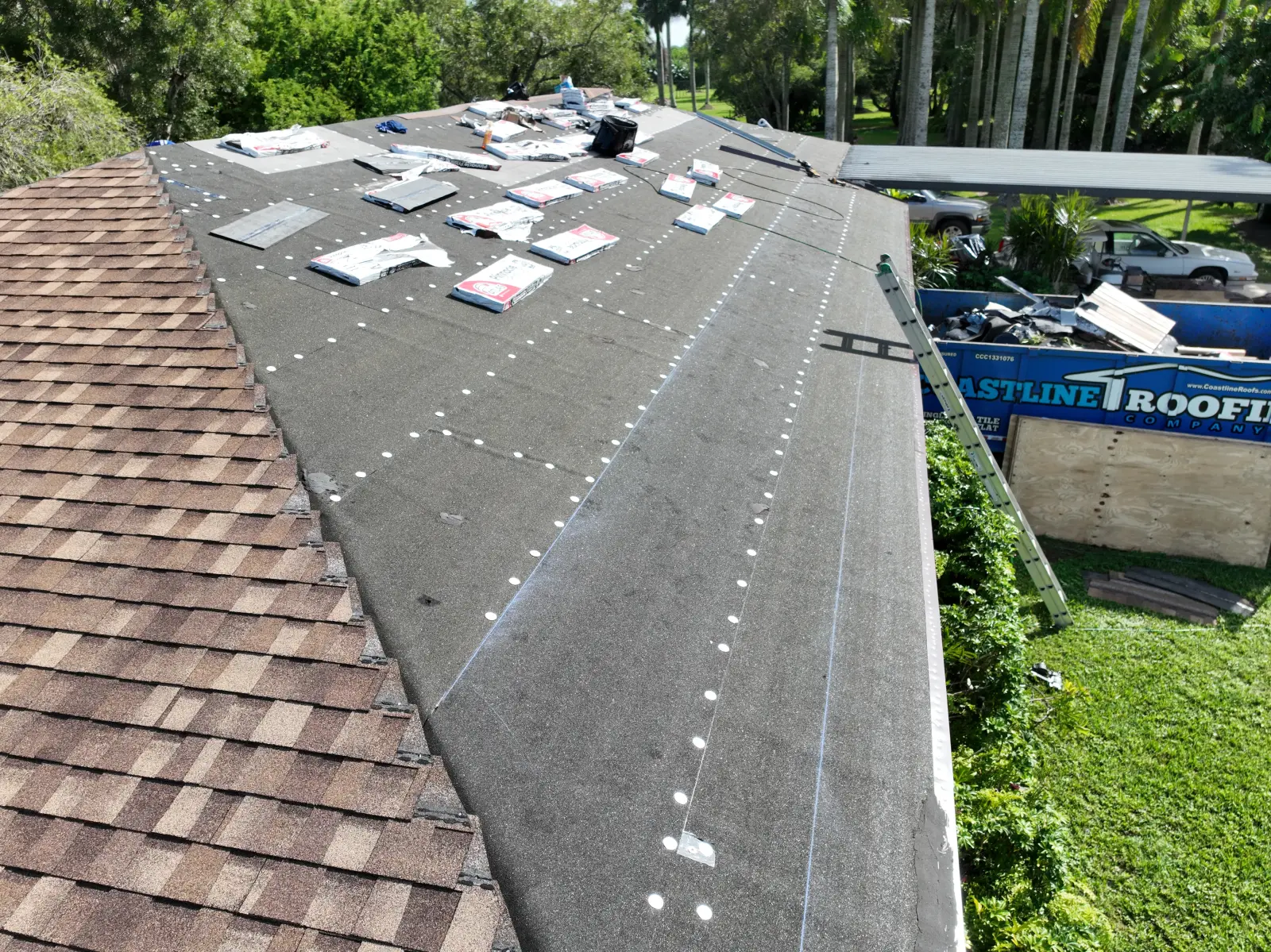
Worry enough to get them looked at before storm season. A shingle held up by a raised nail can't seal down, and ARMA lists sealing failures and blow-offs among the results of a badly adjusted nail gun.
We know of no published nail-pop rates for Florida, and the causes above apply everywhere. The Florida difference is the wind, and a shingle that isn't sealed down is the one you don't want going into a storm. Get it checked if pops are spreading or a shingle went missing in the last storm. For one or two pops on a sound roof, a repair is the answer, and we'll say so.
Book a drone-assisted roof inspection, see how our roof repair service works, or text a photo from the yard to (941) 345-0072.
"They did a good job on the repair so I would definitely recommend them."Duke H.Roof repair, Florida Gulf Coast
"Good communication and did a great job."Rick R.Roofing customer, Florida Gulf Coast
"Highly recommend. Great communication. Great quality of work and very personable. Easy to work with. Will use again for home renovations."Justin S.Roofing customer, Florida Gulf Coast
Please don't climb up to try. ARMA says a nail simply left high can be tapped down, but hammering down a nail that worked its way out doesn't change whatever pushed it out. The lasting fix is a new nail in a new spot, and that's a roofer's job.
No. Section R905.2.6 of the Florida Building Code, Residential, sets the minimum at four per strip shingle, or more if the manufacturer requires it. Six-nail patterns come from manufacturers: GAF needs six nails plus its starter strips for top wind coverage on shingles that aren't LayerLock-labeled, and Atlas calls for six on steep slopes. Atlas warrants our default Pinnacle Pristine to 130 mph with four.
The nail has more material to pass through before it reaches the deck. The code requires nails long enough to get through the roofing and still sink 3/4 inch into the deck, and InterNACHI lists short fasteners as a common problem on roof-overs, ridge caps and ridge vents.
Not by themselves. A handful of pops on a roof that's otherwise in good shape is a repair. Replacement only comes up when pops are one sign among several on an older roof, or the deck under them has gone soft. Our photo report shows you what we found either way.
On a dry, calm day, look from the yard for bumps under shingles or a shingle that sits higher than its neighbors. You won't catch everything from the ground, which is where drone photos come in.
Free drone-assisted inspection with a written photo report you keep. No trip fee, no diagnostic fee, and if a small repair will do it, that's what we'll quote.
Leave your name and number. We typically call back the same day during business hours. Consent to texts is not required.