
★★★★★
"I really lucked out. My inspection and resolution was performed all in the same day. I'm grateful."Sekina F.Same-day inspection and repair, Florida Gulf Coast
Stay away from the fixture and its switch. If you can reach the breaker panel from a dry spot, turn the power off. If getting there means stepping in water or touching anything wet, don't go; call an electrician. Smoke or flames: get out and call 911. Then catch the water from a distance and call a roofer.
Water and electricity in the same spot can hurt you, not just your ceiling. Handle the power first, the water second and the roof third. Here's how, in that order.
Power first, water second. Stay away from the fixture, and turn the power off only if you can reach the breaker panel from a dry spot. If you can't, call an electrician.
Don't touch the light, the fan, its wall switch, or any wet outlet or cord. Don't flip the switch to test it. Keep kids and pets out of the room.
If you can reach the breaker panel on a dry floor, with dry hands, touching nothing wet, switch off the breaker for that room, or the main if you're not sure which one it is. The CDC says to turn off the main if you can do it "from a dry location."
If getting there means stepping in water or touching anything wet, don't go near it. Call an electrician instead. The CDC agrees: if you'd have to enter standing water, "call an electrician to turn it off."
If you see smoke, flames or sparks, or smell something burning, get everyone out and call 911 from outside. That's our advice. For any fire, the U.S. Fire Administration's rule is "Get out fast and stay out."
Put buckets under drips that land away from the fixture, never under a fixture that could still have power. Then call about the roof.
Because the water is touching electrical parts. A wet fixture, switch or outlet can shock you, and water inside wiring can cause trouble long after the dripping stops.
We haven't found a safety agency guide written just for a leaking light fixture, but their water-and-electricity guidance, mostly written for floods, applies here. Ready.gov: "Do not touch electrical equipment if it is wet or if you are standing in water." The American Red Cross adds why: "because you could get electrocuted." And Duke Energy says never to touch a circuit breaker "with wet hands, or while standing on a wet or damp surface."
The danger outlasts the drip. The Electrical Safety Foundation (ESFI) says water "can cause hidden damage, corrosion, and shock or fire risks," and that returning power to water-damaged equipment without a proper evaluation "could result in an electrical fire, shock, electrocution, or further damage." Its rule of thumb: "When in doubt, keep your distance and call a qualified electrician."
Whenever water has reached a light, fan, switch or outlet, and always before the power goes back on. The electrician handles the wiring; we handle the roof.
The CDC: "Have an electrician check the house's electrical system before turning the power on again." ESFI adds that "any equipment exposed to water must be inspected by qualified professionals before being returned to service."
NFPA safety tips say to call a qualified electrician for breakers that keep tripping, flickering lights, warm or discolored outlets, or a tingling feeling when you touch an appliance.
Florida licenses electrical contractors under Part II of chapter 489 of the Florida Statutes, and section 489.531 makes contracting without that license a first-degree misdemeanor. Check any electrician on the state license search.
We're a roofing contractor, license CCC1331076. We don't open fixtures, test wiring or say when the power can go back on. We find and stop the leak.
Water that gets past the roof runs along the wood above your ceiling until it finds a way down. A hole cut for a light or fan is an easy one, even when the roof opening is feet away.
Florida's Division of Emergency Management notes in its Hurricane Retrofit Guide that water usually shows first at drywall seams, and "another place is at recessed lights or other holes in the drywall ceiling."
So the fixture shows where the water came out, not where it got in. The real opening may be a cracked pipe boot, lifted shingles, failed flashing or a damaged roof edge, somewhere up the slope. Our guide on how a roof leak gets traced back to where it starts explains the process, and if there's a brown ring around the light, read what a ceiling water stain can tell you.
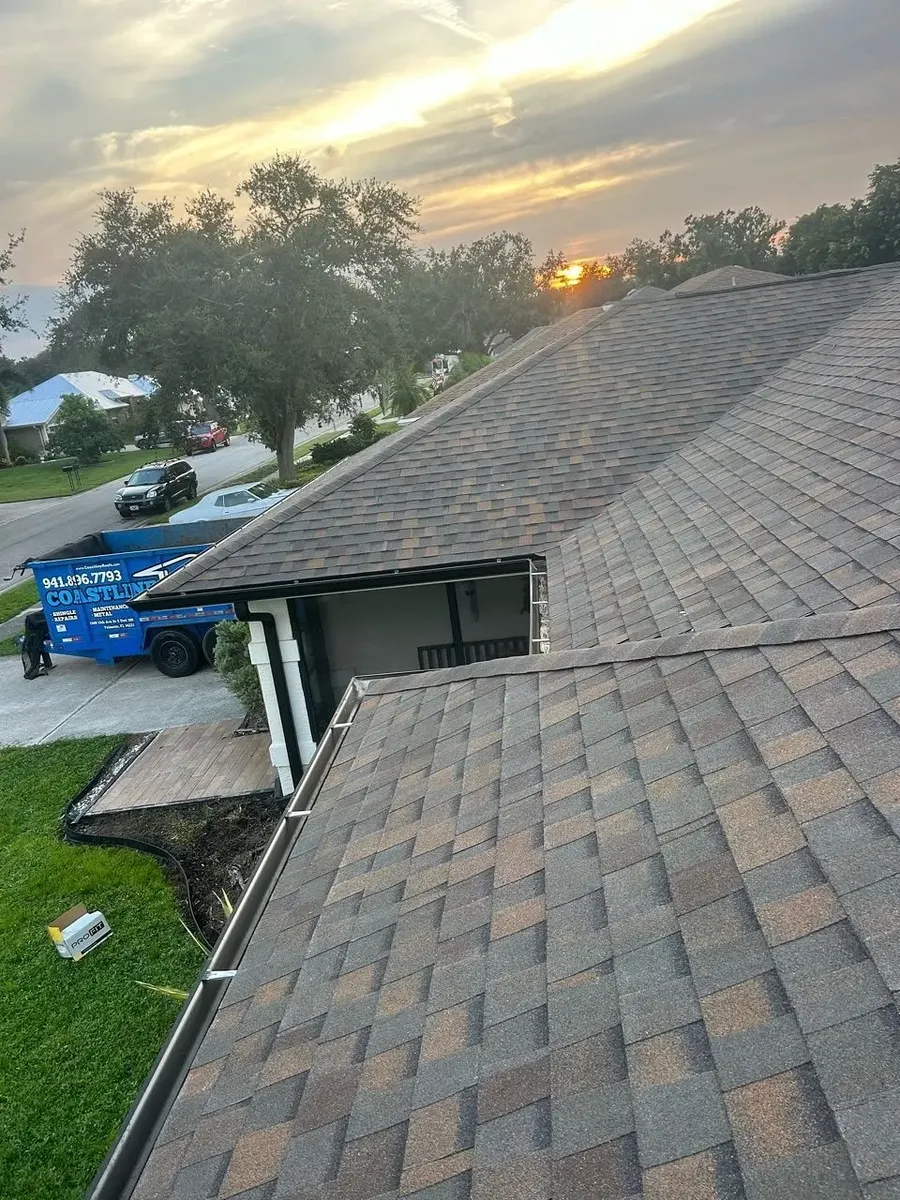
Work around the fixture, never under it. Catch the drips you can reach safely, move what you can, and take photos before you clean up.
The Red Cross says a sagging ceiling means it got wet, which makes it heavy and dangerous. If the bulge is at or near a light or fan, don't poke it, drain it or stand under it. That caution is ours, not the Red Cross's: that water is next to the fixture's wiring. If the ceiling is sagging badly or cracking, keep everyone out of the room. For a bulge well away from any fixture, see how to slow a roof leak until help arrives.
We respond the same day on active leaks, and emergency tarping runs 24/7. Across Manatee, South Pinellas and South Hillsborough, the tarp goes on the same day in most cases. The permanent repair follows.
Text photos of the ceiling to (941) 345-0072. We answer every call we can, and if we miss it we call you back the same day.
Our crew covers the damaged area to keep more rain out.
Our drone-assisted roof inspection is Free, with a written photo report showing where the water gets in. No trip fee, no diagnostic fee.
A written, line-by-line estimate comes first. No deposit on repairs, and a 1-year workmanship warranty unless the contract notes otherwise.
See our roof leak repair service and how our 24/7 tarping crews work.
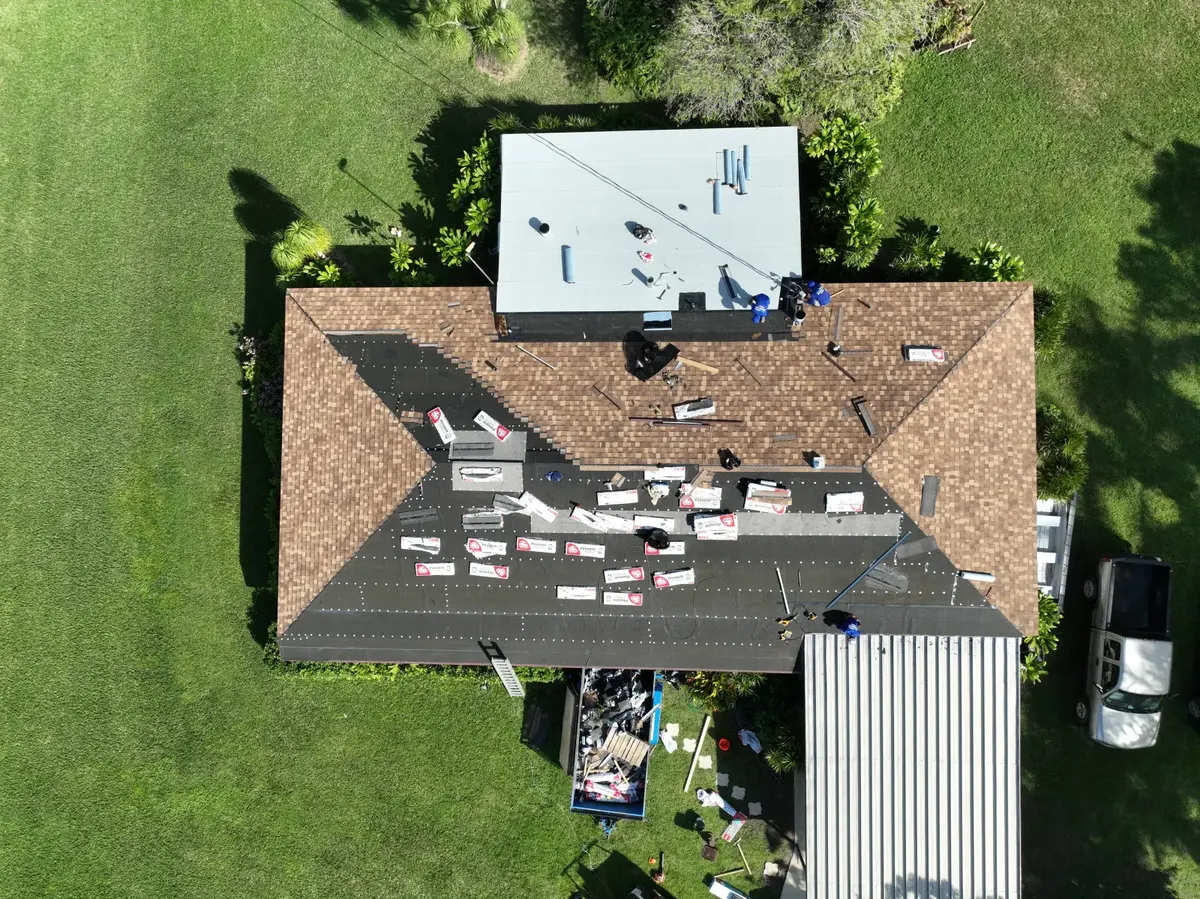
"I really lucked out. My inspection and resolution was performed all in the same day. I'm grateful."Sekina F.Same-day inspection and repair, Florida Gulf Coast
"Russell from Coastline roofing was amazing. He worked with me to get my dad's roof installed super fast. I called him just looking for a quote and he had it done same day and the roof done within two weeks. Amazing company. Professional, fast, and very understanding and kind."Amanda N.Roof installation, Florida Gulf Coast
"Wonderful to work with this company very good people and professional."Paul P.Roofing customer, Florida Gulf Coast
Not until an electrician has checked it. ESFI says "any water-damaged equipment even if thoroughly dried will pose serious long-term safety and fire risk if not properly reconditioned." Don't open, drain or dry the fixture yourself.
No, leave it off. With water in a fixture, a tripped breaker is a warning sign, and resetting it sends power back to wet equipment before anyone has checked it. Never touch the panel with wet hands or from a wet floor.
Treat it the same way. Don't touch the fan, its pull chain or the wall switch, and don't turn it on with the remote. Cut power only from a dry spot, and have an electrician check it before it runs again.
Yes. It can also come from an attic AC condensate line or plumbing on the floor above. If the dripping started with rain, think roof. If it happens on dry days too, a plumber or your AC company may be the right call. The electrical steps are the same either way.
Stay clear of the fixture and let an electrician handle the wiring. We'll stop the water at the roof, with a free inspection and a written photo report. No trip fee, no diagnostic fee.
Leave your name and number. We typically call back the same day during business hours. Consent to texts is not required.