Does My Insurer Have to Match My Existing Tile or Shingle in Florida?
Sometimes. Under Florida Statutes section 626.9744(2), when replaced items don't match in quality, color, or size, your insurer must make reasonable repairs or replacement in adjoining areas. But that's a default your policy can change, the law never mentions roofs, and the insurer may weigh cost. It doesn't promise a whole new roof.
By Josh Hildebrand, owner of Coastline Roofing · Florida license CCC1331076 ·
The adjuster wants to swap a few tiles or patch a few rows of shingles, and you can already tell the new pieces won't look like the rest of the roof. You may have read that Florida insurers have to replace the whole roof. The law doesn't say that, and your own policy matters more than most people think.
What does matching mean on a roof insurance claim?
It's whether the new shingles or tiles in a repair will look like the rest of your roof. If they won't, the dispute is over how much of the undamaged roof around them gets replaced too.
A storm pulls shingles off one slope or cracks a run of tiles, and the adjuster writes a repair for the damaged pieces only. Sometimes that's the right call. The trouble starts when the new material won't blend in: a shingle color that's no longer sold, or a tile that's the right shape but the wrong shade.
Florida's statute names three ways replaced items can fail to match: quality, color, and size. A color mismatch alone won't make a roof leak. But you'll see it every day, and so will a buyer someday.
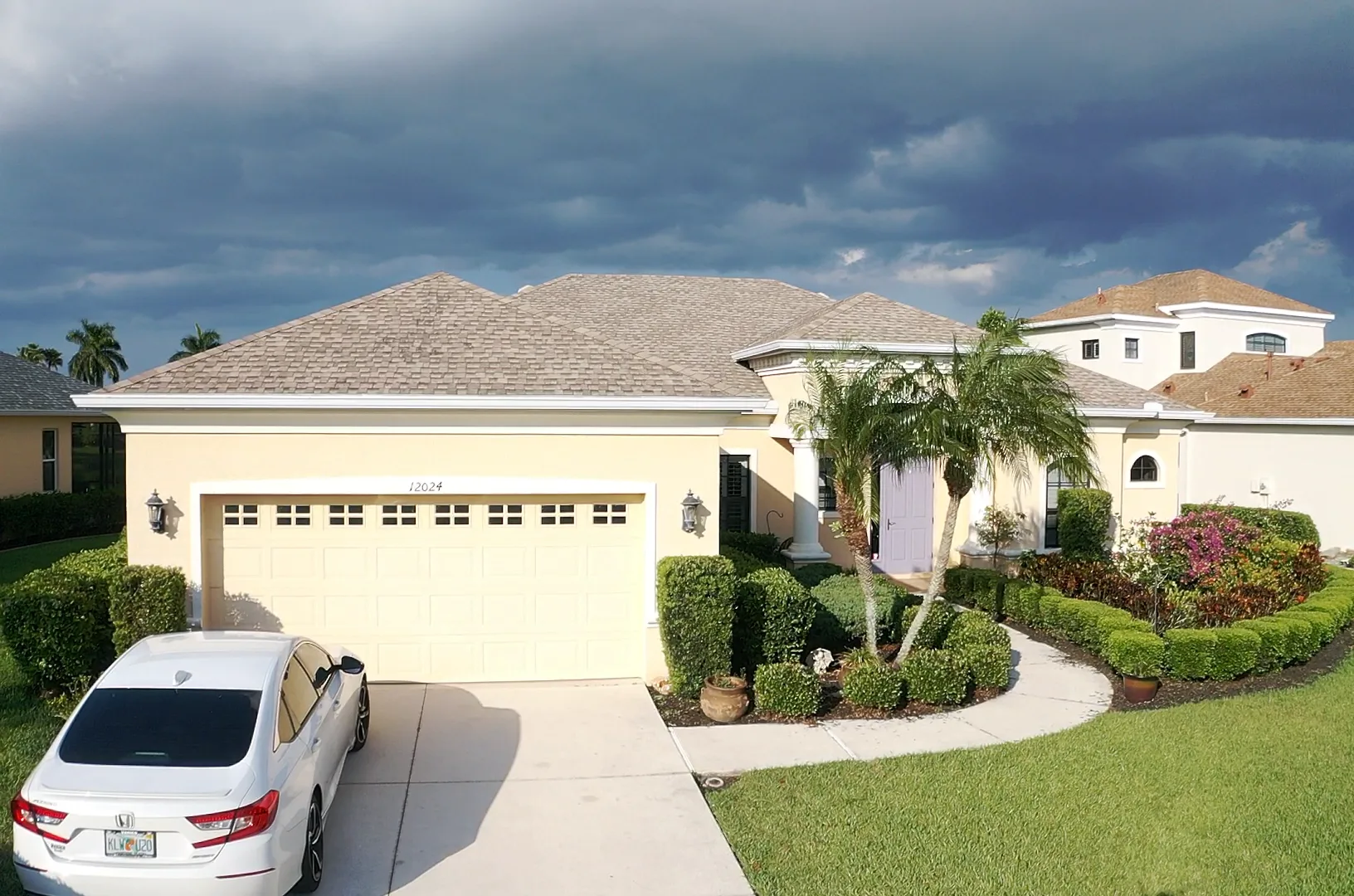
A concrete tile roof on a Florida home, seen from the ground. The ground view is where a mismatched patch tends to show.
The statute
What does Florida's matching law actually say?
Florida Statutes section 626.9744(2) says that when replaced items don't match in quality, color, or size, the insurer must make reasonable repairs or replacement in adjoining areas. It's a default rule for homeowner's policies that settle on repair or replacement cost, and your policy can say otherwise.
The section opens: "Unless otherwise provided by the policy, when a homeowner's insurance policy provides for the adjustment and settlement of first-party losses based on repair or replacement cost, the following requirements apply." A first-party loss is your own claim on your own policy.
Subsection (2), word for word
"When a loss requires replacement of items and the replaced items do not match in quality, color, or size, the insurer shall make reasonable repairs or replacement of items in adjoining areas. In determining the extent of the repairs or replacement of items in adjoining areas, the insurer may consider the cost of repairing or replacing the undamaged portions of the property, the degree of uniformity that can be achieved without such cost, the remaining useful life of the undamaged portion, and other relevant factors."
Three things stand out:
It asks for "reasonable" repair or replacement in "adjoining areas," the areas next to the damage. It doesn't say the whole roof.
It lets the insurer weigh cost, how close a match it can get without that cost, and the remaining life of the undamaged part.
The words roof, tile, and shingle never appear.
Subsection (1) adds: "The insured may not be required to pay for betterment required by ordinance or code except for the applicable deductible, unless specifically excluded or limited by the policy." Betterment here means an upgrade the building code requires, so check what your policy says about code upgrades.
What changed
Did Florida's recent insurance reforms change roof matching?
No. Section 626.9744 hasn't been amended since 2004. What differs from one homeowner to the next is the policy, because the statute lets a policy set its own matching terms.
Its history note lists just two laws, both from 2004 (chapters 2004-370 and 2004-390). The 2022 reform laws added an optional separate roof deductible, in Florida Statutes section 627.701(10), and roof-age rules, in section 627.7011(5). None of them touched matching.
A 2026 bill did try. Senate Bill 1268 would have rewritten subsection (2) with wording about a "reasonably uniform appearance." It died in the Senate Banking and Insurance committee on March 13, 2026. If you see that phrase online, it came from the bill, not the law.
The bigger variable is your policy. The statute's opening words let a policy set its own matching terms, and those terms can sit in an endorsement, an added page that changes the main policy. Read yours for anything about matching or uniformity.
Whole roof or patch
Does my insurer have to replace the whole roof if the new shingles or tile won't match?
Not automatically. The law asks for reasonable repair or replacement in adjoining areas, weighed against cost, how close a match is possible, and the roof's remaining life. A bigger replacement can be the reasonable answer on some claims, but the statute doesn't promise one.
Section 626.9744 doesn't say an insurer never has to replace a whole roof, and it doesn't promise one either. And matching is not the 25% rule. They answer different questions.
The matching law and the 25% rule side by side
Question
Matching law
25% roof rule
Where it's written
Florida Statutes section 626.9744(2)
Florida Building Code, Existing Building, Section 706.1.1, with an exception in Florida Statutes section 553.844(5)
Kind of rule
Insurance claim settlement, and your policy can change it
Building code for roof work
What it decides
How far the insurer's repair or replacement reaches into adjoining areas
Whether the whole roof or roof section must meet current code
Mentions matching
Yes
No
Under Section 706.1.1 of the Florida Building Code, Existing Building (8th edition, 2023), if more than 25 percent of a roof or roof section is repaired, replaced or recovered in any 12-month period, the roof covering on the whole roof or section has to be brought up to current code. Section 553.844(5) carves out roofs built, repaired or replaced under the 2007 code or later: for those, only the part being worked on has to. Our breakdown of the 25% roof rule has the rest.
In practice
How does matching play out on tile and shingle repairs?
On tile, it's usually color and shape. On shingles, it's whether the same product is still sold. Either way, good photos help most.
Tile color shifts with age
Concrete tile can lighten as it weathers. One Florida tile maker's brochure says the color "can change over time and may appear lighter" than at installation. A brand new tile in the same color can still stand out.
Tile shape and size
Tile comes in flat and curved profiles and different sizes, and a replacement has to be the same shape to lay in with its neighbors. See our guide to cracked and slipped tiles for when a few tiles are all you need.
Shingle lines change
Shingle makers change colors and retire product lines. If yours is gone, everyone is working from the closest shingle still sold, and that's when matching comes up.
Weathered shingles
Even the same shingle can look different next to one that's had years of Gulf Coast sun. A daylight photo of the new one held against the old shows it best.
What to photograph
The damaged area, the closest replacement available, and the undamaged roof around it, including wide shots from the ground. Keep the original files with their dates.
What we bring
Our free roof inspection is drone-assisted and comes with a written photo report you keep. We document the damage and the roof around it, write the estimate line by line, and work alongside your adjuster. Text photos to (941) 345-0072.
The bigger picture
When is a full roof replacement the better answer anyway?
When damage is spread across the roof, the roof is near the end of its life, or what's under the tile is failing. Then a matching argument over a few tiles or shingles won't fix the real problem.
The statute lets the insurer weigh "the remaining useful life of the undamaged portion," and that cuts both ways. On a newer roof, a patch that won't match stays in view for years. On an old one, the rest of the roof may be close to done anyway.
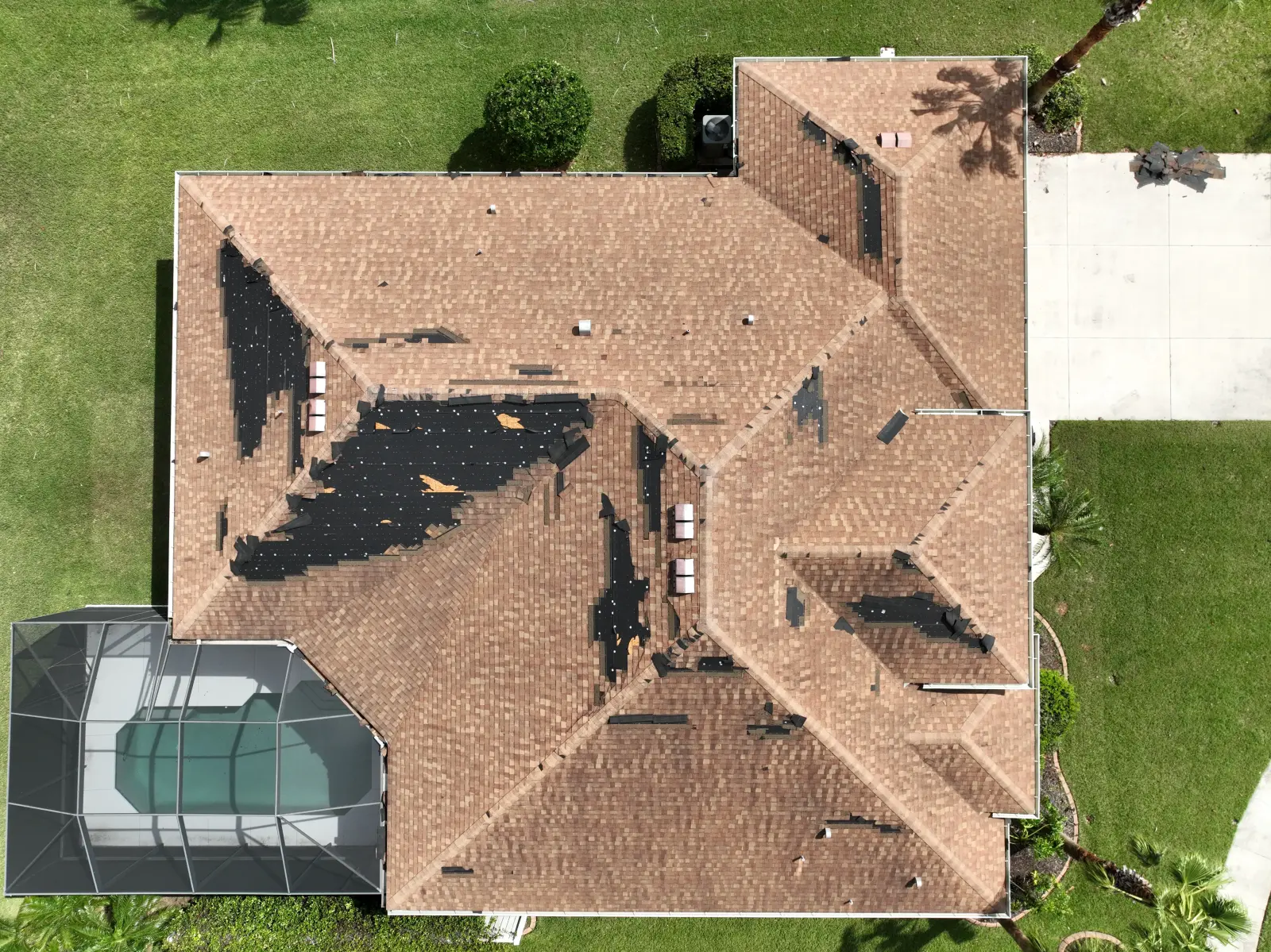
Cracked and displaced tiles on a storm-damaged tile roof, Florida Gulf Coast, October 2024.
Signs we look for before recommending more than a repair:
Damage on several slopes, not one corner.
A roof that was already showing its age before the storm.
On tile, worn-out underlayment (the waterproof layer under the tile), even where the tiles look fine.
An older roof where the repair would cross the 25% rule.
If your roof has good years left and the damage sits in one spot, a careful repair is often the better money, and we'll say so. Not sure? Start with these signs a roof needs replacing.
Next steps
What can I do if the adjuster's patch won't match?
Read your policy's matching terms, ask the insurer in writing how it applied the statute's factors, and back it up with photos. If you're still stuck, call the state's consumer helpline or a licensed professional.
Read your policy
Check how it settles roof losses and read the endorsements for anything about matching. Not sure which settlement type you have? See how ACV and RCV settlements differ.
Ask in writing
Ask the adjuster how the section 626.9744(2) factors were applied: the cost of replacing undamaged parts, how close a match is possible without it, and the remaining life of the undamaged roof.
For questions about how your claim is being handled, the Florida Chief Financial Officer's helpline is 1-877-693-5236 (1-877-MY-FL-CFO), 8 AM to 5 PM Eastern, weekdays.
Get advice on your claim
A licensed public adjuster or an attorney can advise you on your policy and your claim.
One plain note: Coastline is a roofing contractor, not a lawyer, public adjuster, or insurance agent. Read your own policy, and ask a licensed professional for advice on your situation.
Reviews
Homeowners on storm repairs that fit the rest of the roof
★★★★★
"We had a roof put on several years ago and were very pleased. Then Milton managed to tear off a few shingles... Coastline came out, took care of it, and even used the same type shingle."
Andy J.Storm repair after Hurricane Milton, Florida Gulf Coast
★★★★★
"Very quick and professional. We only had one problem which was my grandma's roof and they also check the ceiling for any leaks. Thank you Coastline."
Christian P.Roof repair, Florida Gulf Coast
★★★★★
"Great company. Quick response and excellent customer service. My roof is beautiful. Thank you Coastline Roofing. I would recommend you to anyone needing a new roof or roof repairs."
Does Florida law limit matching to the damaged slope?
Section 626.9744 doesn't. It talks about "adjoining areas," not slopes. If your insurer points to a slope limit, ask which part of your policy it comes from.
Is the roof payment schedule in my policy part of the matching law?
No. Section 626.9744 doesn't mention payment schedules, and neither do the roof deductible and claim payment laws, sections 627.701 and 627.7011. A payment schedule comes from your policy's own terms, so read that part closely and ask your agent how it pays on a partial roof loss.
Will a roof deductible apply to a small matching repair?
Not the separate roof deductible, if the loss needs repair of less than half the roof. Under section 627.701(10)(a)5., an optional separate roof deductible doesn't apply to a roof loss requiring repair of less than 50 percent of the roof, or to a roof loss from a hurricane. Our roof deductible explainer covers the rest.
Does the insurer guarantee the repair?
Not under the matching law. Section 626.9744(3) says the section doesn't make the insurer "a warrantor of the repairs." Warranties come from whoever does the work and from the material maker. On our repairs, that's a 1-year workmanship warranty unless the contract says otherwise, plus manufacturer warranties passed through in full.