My Commercial Roof Has Storm Damage. Who Do I Call for Emergency Dry-In?
Call a commercial roofer for emergency dry-in now, and keep everyone off the roof and out from under sagging ceilings or standing water overhead. From inside, move inventory and records away from leaks, photograph everything, and notify your insurer. Coastline does 24/7 emergency tarping, same day in most cases, then plans the permanent repair around your business.
By Josh Hildebrand, owner of Coastline Roofing · Florida license CCC1331076 ·
Water is coming into the building, and you have staff, customers and stock to think about. Handle it in this order: people first, then what's inside, then the roof, which is a job for a trained crew.
What should I do first when a storm damages my commercial roof?
Get people safe, protect what's inside from indoors, and call a roofing crew. Nobody from your business should go on the roof.
Keep everyone off the roof
That includes employees, tenants and vendors. The National Roofing Contractors Association (NRCA) urges business owners to assess storm damage from ground level and leave repairs to a professional roofing contractor.
Clear people out from under the damage
The Red Cross warns that a sagging ceiling has gotten wet, which makes it heavy and dangerous. Keep people out from under it and out of any area below standing water on the roof. If a ceiling is sagging badly or cracking, keep everyone out of the room. Our own advice: stay away from light fixtures, fans and wiring near the wet area.
Treat wet electrical equipment as live
Don't touch anything electrical that's wet, or while you're standing in water. The CDC says to shut off the main power only if you can reach it from a dry location. If getting to the panel means standing in water or touching anything wet, stay away and call a licensed electrician. If you see smoke or flame, get everyone out and call 911.
Move stock and records out of the drip path
Work only where the floor is dry, nothing electrical is wet and no ceiling sags overhead. Cover what you can't move with plastic sheeting.
Call for emergency dry-in
Call us any time at (941) 896-7793. We offer 24/7 emergency tarping, same day in most cases across Manatee, South Pinellas and South Hillsborough.
Photograph everything, then report the claim
Take photos and video of ceilings, water, stock and equipment before cleanup, from inside, and from the ground once the storm has passed. Then contact your insurer and your agent.
Emergency dry-in
What is emergency dry-in on a commercial flat roof?
It's temporary protection that keeps water out of the building until the permanent repair. It protects what's inside and helps keep your business open.
A roof-wind expert writing in NRCA's Professional Roofing magazine says a professional roofing contractor should do this work. On a low-slope roof it usually means:
Reattaching or removing loose flashing and rooftop equipment.
Clearing debris from drains, scuppers and conductor heads (the boxes that feed downspouts).
Securing torn membrane with mechanical fasteners or ballast, or adhering a temporary membrane over the damage.
Making sure the temporary roof drains, so water can't pond and overload the structure.
Over an open hole, a tarp is the short-term patch Triple-I (the Insurance Information Institute) describes for businesses.
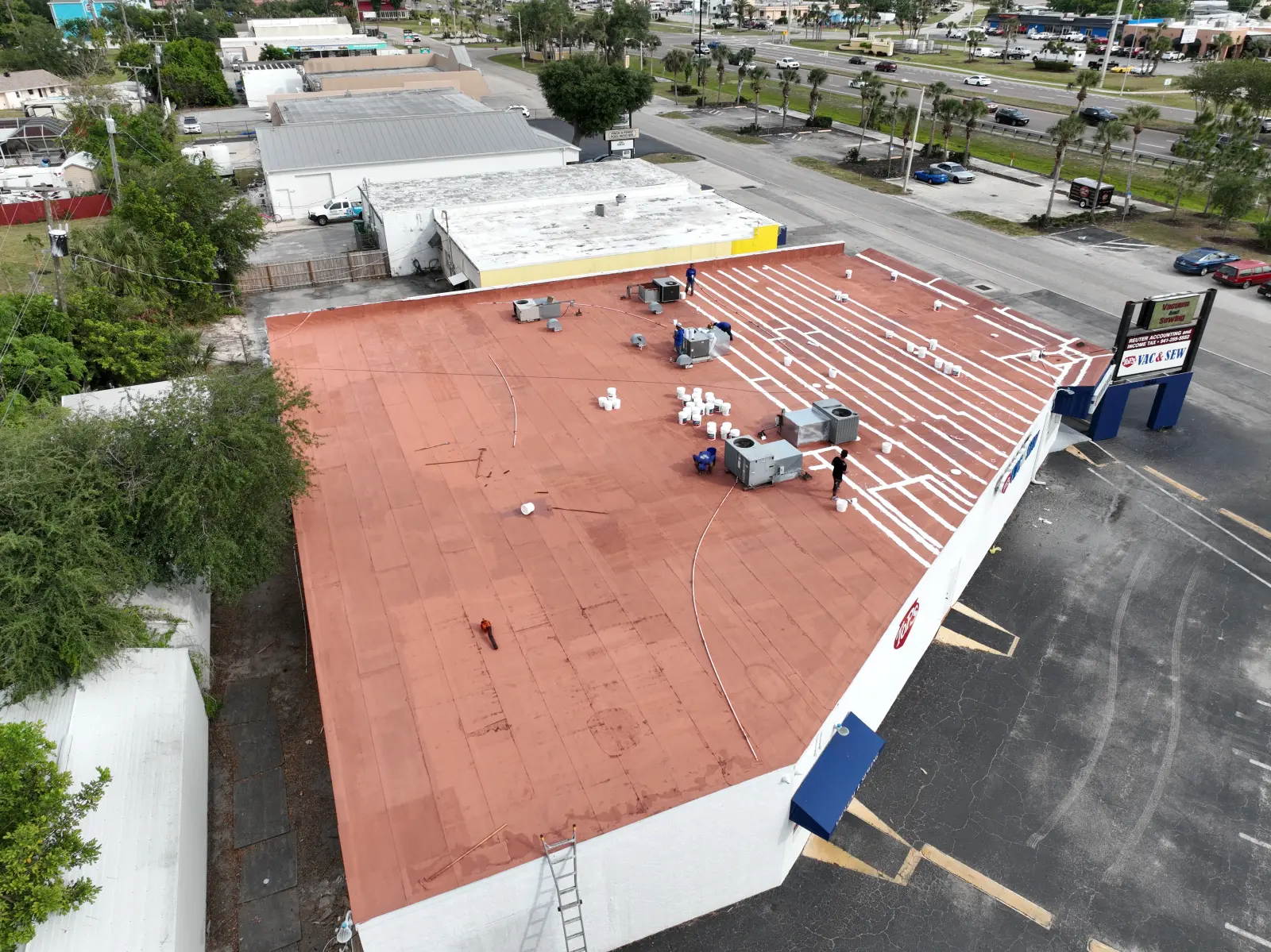
Aerial view of a commercial flat roof, April 2024.
Standing water
Why is standing water on a flat roof dangerous after a storm?
Because water is heavy. One inch of water over 100 square feet weighs about 520 pounds, and if storm debris clogs the drains, the load keeps building. FM Global warns that too much rain load can bend structural members and cause partial or total collapse.
What rainwater weighs on a flat roof
Water on the roof
Approximate weight
1 inch over 100 sq ft
About 520 pounds
1 inch over 1,000 sq ft
About 5,200 pounds
2 inches over 1,000 sq ft
About 10,400 pounds
Those numbers use FM Global's roof-load figure: 5.2 pounds per square foot for each inch of water.
Drains are the weak point. FM notes they can be blocked by debris before the rain even starts, and says to inspect roofs and drains after storms. On a damaged roof, that's a job for a roofing crew.
Keep people out from under ponding
If water is standing on the roof, keep people out of the area below it until a crew has checked it.
A storm-damaged roof hasn't been checked for strength, and its edges, skylights and openings are fall hazards. OSHA says not to let employees work on top of a damaged roof until its strength and structural integrity have been determined.
OSHA doesn't ban every roof visit, but the work takes fall protection and training:
Your employees: under 29 CFR 1910.28, workers on an unprotected edge, or at a hole or skylight, 4 feet or more above a lower level must be protected from falling. Within 6 feet of a low-slope roof's edge, that means a guardrail, safety net, travel restraint or personal fall arrest system. Section 1910.30 adds training rules.
Roofing crews: 29 CFR 1926.501(b)(10) requires fall protection for roofing work on low-slope roofs with edges 6 feet or more above a lower level: guardrails, safety nets, personal fall arrest, or a warning line paired with one of those or a safety monitor.
The Professional Roofing article adds what can be waiting after a storm: live electrical conductors, openings where roof deck or rooftop equipment blew off, and broken gas lines. Leave it to a roofing crew. Ours carry general liability and workers' comp coverage.
Your claim
How do I document storm damage for a commercial insurance claim?
Photograph first, save every receipt, keep your business records, and report the claim right away.
An inventory of what's damaged
Triple-I says to list damaged or destroyed items and give your insurer a copy. If equipment needs urgent repair, save the damaged parts in case the adjuster wants to see them.
Receipts for emergency work
Keep every receipt for tarping, dry-in and cleanup. Triple-I notes that payments for temporary repairs are part of the total settlement.
Business income records
If you close or relocate, you may file a business income and extra expense claim. Florida's Department of Financial Services says income, profit and utility records, photos and extra-expense receipts help you get an accurate amount.
Report it now, not later
Florida Statutes section 627.70132(2) bars a new or reopened claim unless notice is given to the insurer within 1 year after the date of loss (18 months for a supplemental claim). It covers any property insurance defined in section 624.604, not just homeowners policies. Many commercial policies require prompt notice, so report right away.
Our drone photo report
We document the roof damage with drone-assisted photos and a written photo report, sent straight to you for your adjuster. We work alongside the adjuster and don't use Assignment of Benefits agreements.
Read your own policy
Coastline is a roofing contractor, not a lawyer, public adjuster or insurance agent. Read your own policy, and ask a licensed professional for advice on your situation.
Temporary vs permanent
How do you keep my business running during storm repairs?
In two stages. Emergency dry-in stops the water now. The permanent repair comes after your adjuster has seen the damage, scheduled around your hours with early starts, weekends or a phased install.
Temporary protection is not the fix. The Professional Roofing article calls temporarily securing a wind-damaged roof challenging, partly for lack of design criteria, and recommends monitoring it. Triple-I advises against extensive permanent repairs until the claims adjuster has assessed the damage.
For the permanent work, we install 60-mil heat-welded TPO and modified bitumen, repair and replace built-up roofs, and install metal and coating systems. On an older built-up roof with a sound base, a modified bitumen or TPO overlay can avoid a full tear-off. If a section repair is enough, we'll say so.
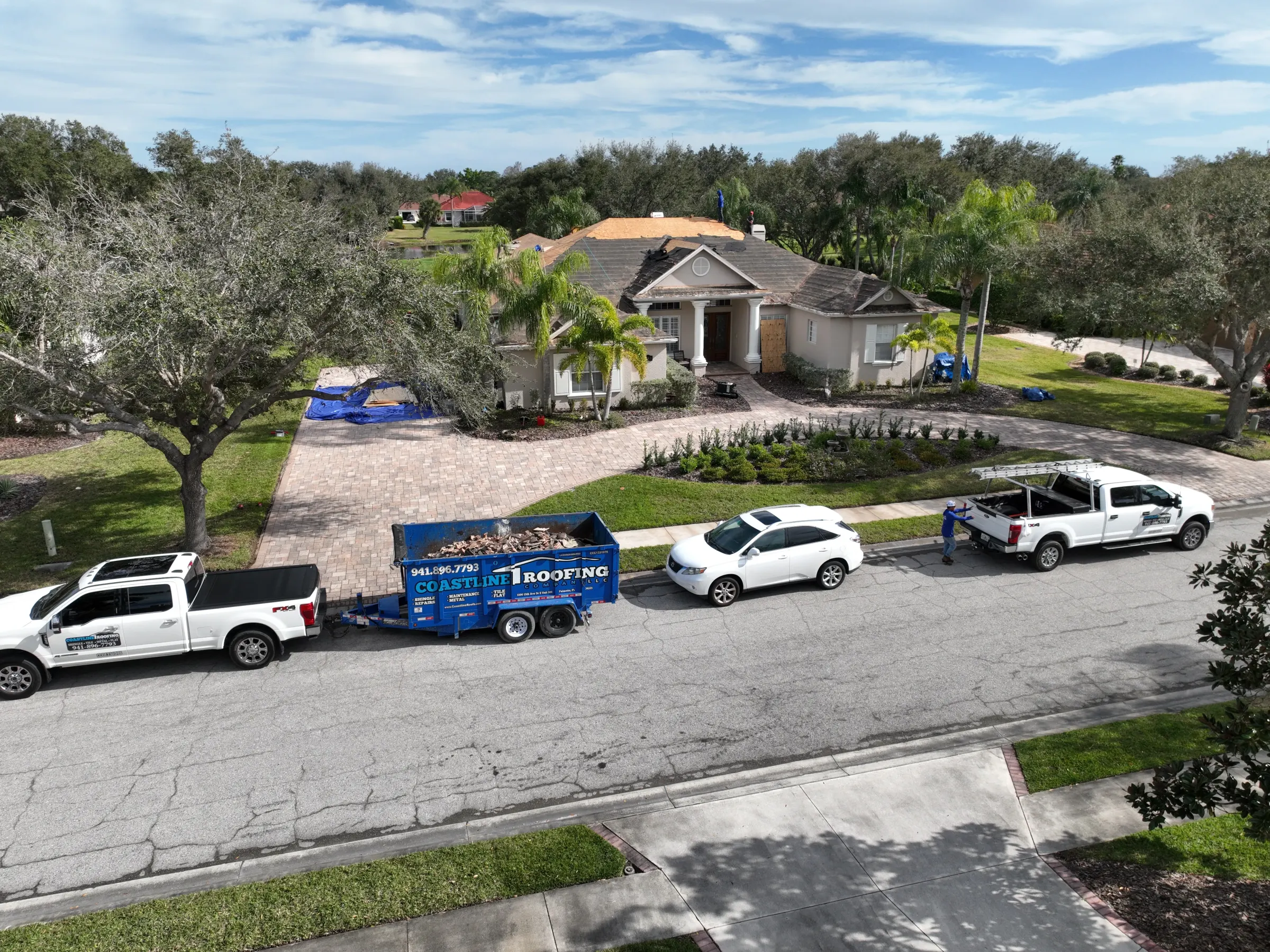
Coastline Roofing trucks and equipment staged at a job.
Reviews
From a fire station roof to repairs after Hurricane Ian
★★★★★
"Josh and his crews are ... on time and professional. Will definitely be recommending them to the people I know. Thank you Coastline roofing for the great work. -Parrish Fire Department"
Kyle M.Parrish Fire Department roof, Manatee County
★★★★★
"Received new roofing. Coastline was able to start my work within a week after Ian. Very professional and great quality work. Work was complete in less than a week."
Anthony S.Roof replacement after Hurricane Ian, Florida Gulf Coast
★★★★★
"After a recent storm, I was worried about the extent of the damage, but their team quickly assessed the situation and provided a comprehensive repair plan. They were transparent about the costs and kept me informed throughout the process."
Does insurance pay for emergency dry-in on a commercial roof?
Often, but your policy decides. Triple-I tells business owners to protect the property from further damage and save receipts, and notes that temporary repair payments are part of the total settlement.
Can Operation Blue Roof cover my business?
No. After Hurricane Milton, the free Blue Roof program, run by the U.S. Army Corps of Engineers for FEMA, was open only to primary residences or permanently occupied rentals, and flat and metal roofs didn't qualify.
What if the roof looks fine from the parking lot?
It can still have loose flashing or clogged drains. Our roof inspection is Free, drone-assisted, and comes with a written photo report. Our page on storm damage you can't see from the ground explains what to look for.
My home roof is leaking too. What should I do there?
The same rule applies: stay off the roof. Our guide to slowing a home roof leak until help arrives covers safe indoor steps, and our 24/7 emergency tarping covers homes too.
Storm-damaged commercial roof? Call now for same-day dry-in
We offer 24/7 emergency tarping, same day in most cases across Manatee, South Pinellas and South Hillsborough. If we miss your call, we call you back the same day. The inspection and written photo report are free, with no trip or diagnostic fee.