What Is the Best Roofing Material for a Florida Home?
There's no winner, only a best fit. Architectural shingles are the best value for most Florida homes. Standing-seam metal goes the longest between reroofs and, with the right panel, handles salt air best. Concrete or clay tile has the classic Florida look, but it's heavy and costs more. Budget, how long you'll stay, and distance to salt water decide it.
By Josh Hildebrand, owner of Coastline Roofing · Florida license CCC1331076 ·
The wrong choice either pays for decades of roof you'll never use or has you pricing another roof in 15 years. Each material's Gulf Coast track record is laid out below, with a quick way to match one to your house.
How do shingle, metal, and tile compare in Florida?
Shingle costs the least and wears out first. Standing-seam metal is the lightest and lasts about 30 to 50 years. Tile can outlast the house, but it's the heaviest, and the layer under it still needs replacing along the way.
Florida roof materials compared. Weights are per square (100 sq ft).
What matters
Architectural shingle
Standing-seam metal
Concrete tile
Clay tile
Realistic Florida life
15 to 22 years
30 to 50 years
Tile 40 to 50+ years; the underlayment under it, about 20 to 25 in our experience
Weight per square
About 210 to 225 lb for a common line; some asphalt up to 425 lb
85 to 120 lb (steel)
770 to 970 lb
800 lb (flat) to 1,345 lb (barrel)
Upfront cost
Lowest
Typically 2 to 3 times shingle
Well above shingle; switching may add framing work
Wind
Class F or Class H meets code across our area
Fasteners are the weak spot
Attachment matters; FEMA found mortar-set tile easier to damage
Salt air
Metal nails and flashing corrode
Aluminum suits salt air; many steel warranties exclude the coast
Metal clips, fasteners and flashing corrode
Cooling, white vs. dark gray shingle
4% less
White metal: 23% less
White tile 17 to 20% less; terra cotta only 3%
Look
Layered, many colors
Vertical seams
Color can lighten
Glazed clay holds color
What wears out first
The shingles
Exposed trim fasteners (spec them stainless)
The underlayment, not the tile
Over the life of one metal roof, a shingle roof here usually gets replaced at least once. And one square of clay barrel tile can outweigh ten squares of steel standing seam.
Asphalt shingles
Are asphalt shingles a good choice for a Florida home?
Yes, for most homes. A good architectural shingle has the lowest upfront cost, meets Florida's wind rules when it carries the right rating, and lasts about 15 to 22 years here.
Architectural shingles are the thick, layered kind. The older flat 3-tab style runs about 12 to 15 years here, and some basic 3-tab lines are only warranted for 60 mph winds.
Look for ASTM D3161 Class F (a fan test) or ASTM D7158 Class H (an uplift test) on the wrapper. Florida's code accepts either one at design wind speeds up to 194 mph. Sarasota County's map puts homes at 150 or 160 mph, well under that.
National charts list about 30 years for architectural shingles. InterNACHI, which publishes one of them, adds that hot climates drastically reduce asphalt shingle life. That's why we plan on 15 to 22.
For the black algae streaks that thrive in our warm, humid weather, the asphalt roofing trade group recommends shingles with copper granules. Our default, the Atlas Pinnacle Pristine, has copper-containing granules and carries both wind ratings. We are not a certified Atlas installer.
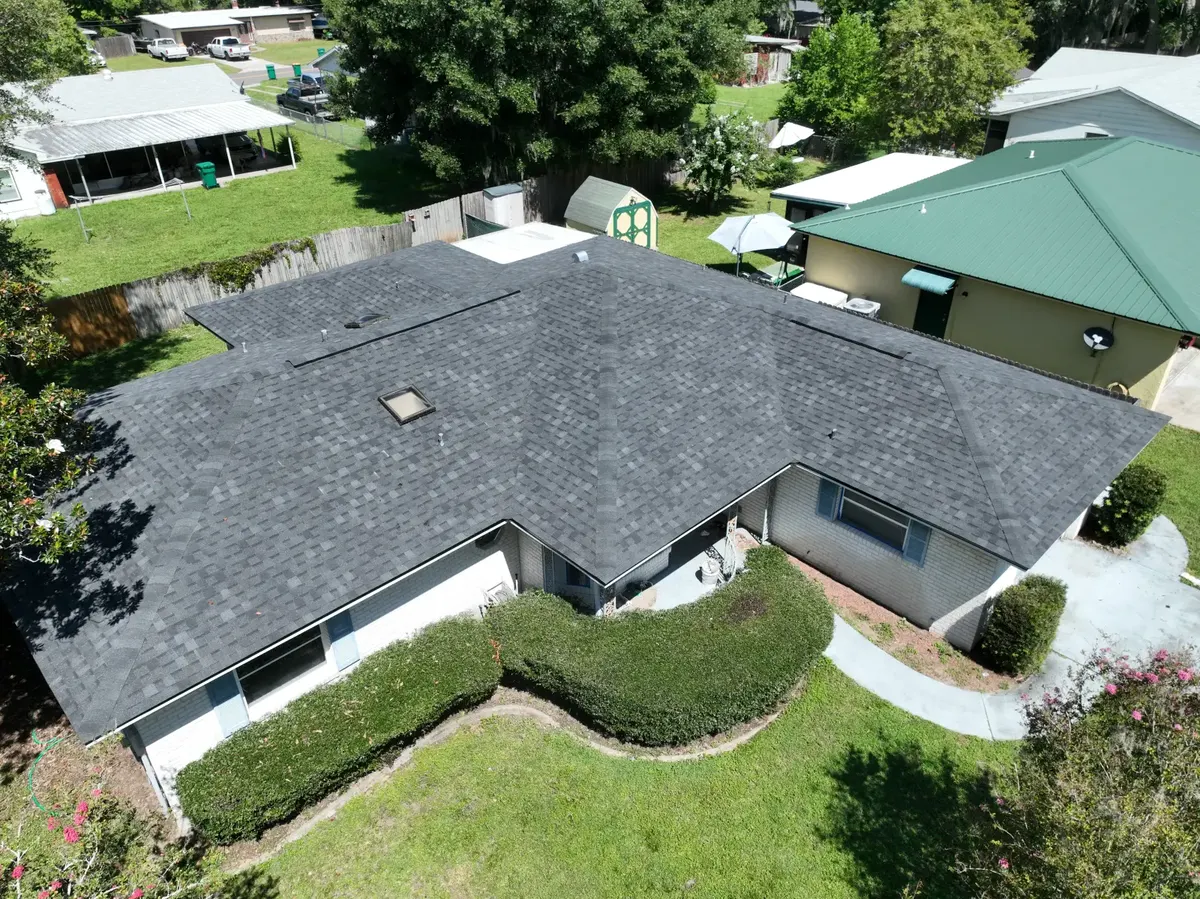
Completed charcoal architectural shingle roof, aerial view, August 2024.
The 15-year insurance line
Florida law bars an insurer from refusing to write or renew a policy only because the roof is under 15 years old. Past 15, you can have the roof inspected at your own expense before the insurer can require a new one, and it can't refuse you on age alone if the inspection shows 5 or more years of life left. It can still charge more for an older roof. A shingle roof reaches 15 with years still in it, so plan for that talk with your agent.
It is if you'll stay long enough to use it. Standing-seam metal lasts about 30 to 50 years and runs coolest in a light color, but it typically costs 2 to 3 times as much as shingles.
The Metal Roofing Alliance puts metal at 30 to 50+ years, partly because it can often be repainted instead of replaced. You pay more once, then you don't reroof for a long time. Move before a shingle roof would have worn out, and the next owner gets that benefit.
Standing seam is held down with hidden clips. Exposed-fastener panels are screwed through the face, and those screws sit on rubber washers that break down in the sun faster than the screw does. As the metal heats and cools, the screws can back out, and every hole is a spot for a leak. Standing seam costs more, and it's the metal in our table.
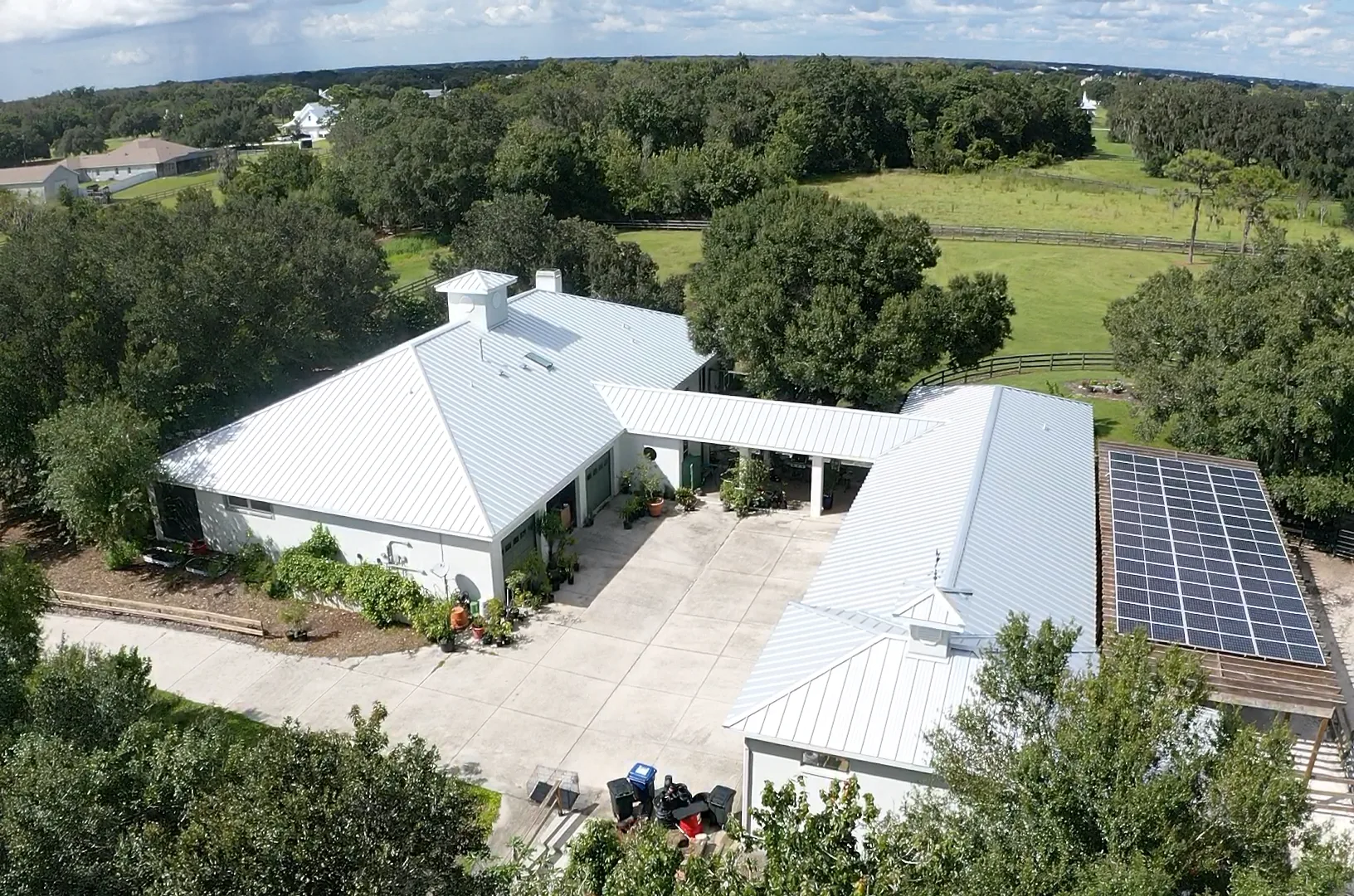
Standing seam metal roof on a Florida country estate, aerial view.
Near salt water, many steel (Galvalume) panel warranties don't apply. One supplier's Galvalume warranty excludes homes within 1,500 feet of breaking surf. Aluminum is the common choice where salt exposure is high. Hardware counts too. After Hurricane Irma, a fastener supplier quoted in Metal Construction News said of metal roofs in Naples: "it wasn't the panels that failed; it was the carbon fasteners."
In a Florida Solar Energy Center test on homes in Fort Myers, white metal cut cooling energy 23% versus dark gray shingles, the most of any roof tested.
Concrete or clay tile: which is better in Florida?
Both last for decades, and on both the underlayment wears out long before the tile. The differences are color and weight: concrete can lighten over the years, glazed clay holds its color, and the heaviest profiles are clay barrel tile.
Concrete tile is sand, cement, water and iron oxide, and Crown, a concrete tile maker, says its color may look lighter over time. Clay is fired in a kiln. Ludowici calls its glazed tile color-permanent, and some clay makers guarantee against fading for 50 years. Weight depends more on the profile than the material.
Switching from shingles to tile? Check the framing first.
Ludowici notes that most building codes require an engineering review of the roof structure. Eagle, a concrete tile maker, says most well-built homes need little or no added bracing. Get that answer before you order tile.
The underlayment is the waterproof layer under the tile, and it's what keeps water out of the house. In our experience it usually needs replacing at around 20 to 25 years, even while the tile still looks good. Plan for that second job when you price tile.
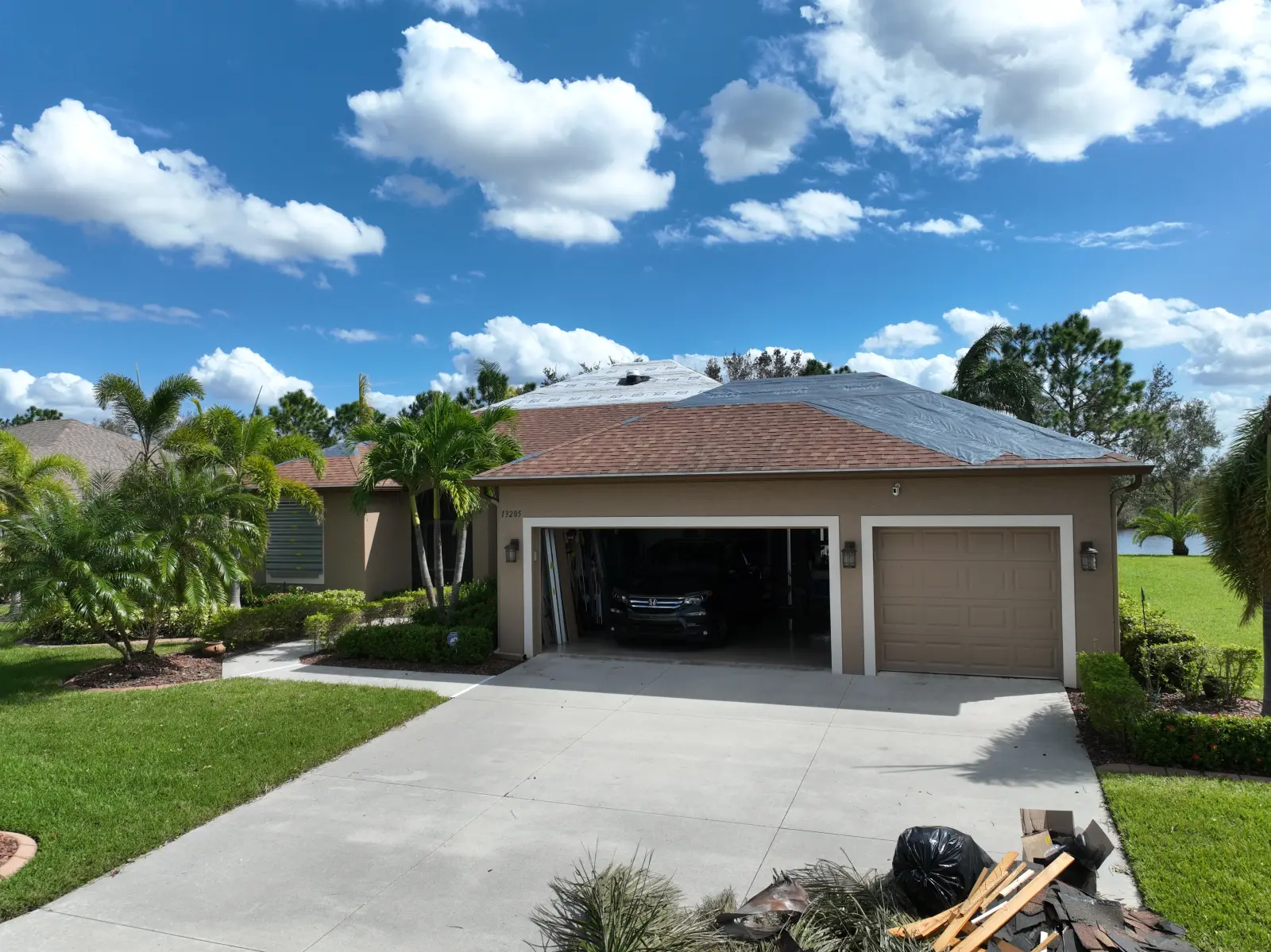
Completed roof replacement, Florida Gulf Coast, October 2024.
Flat and low-slope
What roofing goes on a flat or low-slope roof?
Not shingles. Florida's code allows asphalt shingles only on slopes of 2:12 or steeper, so flatter sections need a low-slope system such as a TPO membrane, modified bitumen or a liquid-applied coating.
A 2:12 slope rises 2 inches for every 12 inches across. Lanais, porches, additions and commercial buildings often have sections flatter than that, and Florida's residential code (in its 2020 edition text) calls for low-slope systems to be designed with at least a quarter inch of fall per foot so water drains.
Expect about 10 to 20 years, depending on the system. InterNACHI lists TPO at 7 to 20 years and modified bitumen at 20. If the main roof and the flat section are both aging, price them together.
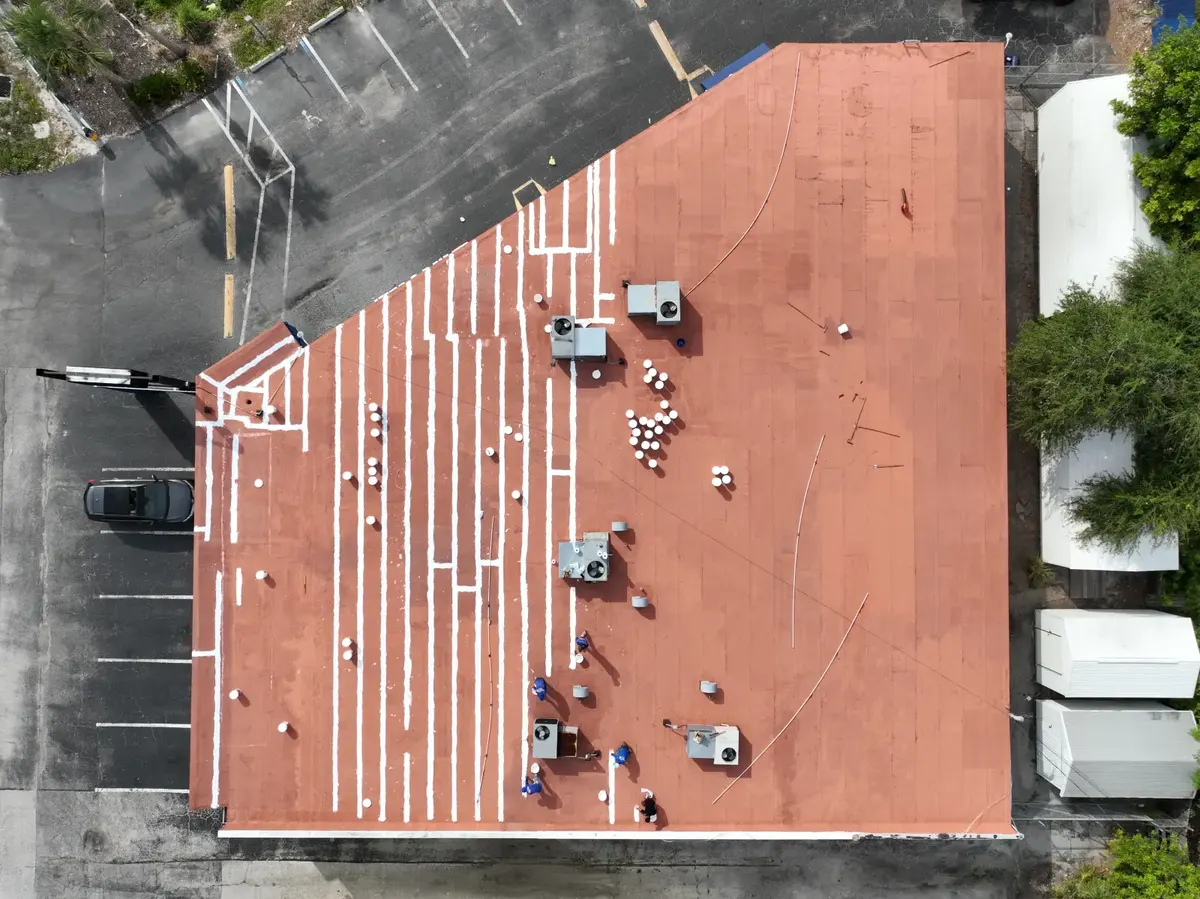
TPO flat roof, aerial view of a completed commercial installation, April 2024.
Which roofing material is best for hurricanes and insurance?
No material wins on paper. On Florida's wind mitigation form, any permitted, code-approved roof covering answers the roof covering question the same way. How the roof is attached, and its shape, move your credit more than the material.
That form is the OIR-B1-1802. Its roof covering question asks whether the roof had a current Florida or Miami-Dade product approval when it went on, or a permit applied for on or after March 1, 2002. Shingle, metal and tile can all check that box. What separates one house from the next is the deck attachment (how the plywood is nailed down), the roof-to-wall connection, a sealed roof deck, and hip versus gable shape.
Start with how long you'll own the house and how close it sits to salt water. Those two answers narrow the field fast.
Tight budget, or selling within about 10 years
A quality architectural shingle rated Class F or Class H. It costs the least, and at 15 to 22 years it should outlast your time in the house.
Staying 15+ years and want to roof once
Standing-seam metal. At 30 to 50 years, it may be the last roof you buy. Tile works too, if the framing can carry it.
On the water, or close to it
Metal with the right panel and salt-rated hardware. On Anna Maria Island and Longboat Key we use stainless steel or coated fasteners and corrosion-rated flashing as standard. Our coastal roofing guide goes further.
In an HOA with a tile look
Tile, or an alternative your association approves. Get its written roof specifications first; the FAQ below covers what Florida law lets an HOA require.
You want lower cooling bills
A light color, on any material. In the Fort Myers test, white tile cut cooling energy 17 to 20%, while terra cotta tile cut it 3%. Color mattered more than material. Here's how roof color plays into resale value.
Part of the roof is nearly flat
Anything under 2:12 needs a membrane or coating system. Not sure which card fits your house? Text us a photo at (941) 345-0072.
Reviews
Homeowners who weighed their roof options with us
★★★★★
"He met me on my lunch break to walk through roof types, gave me pros and cons of each, and once I picked the type and color he took care of everything else. He communicated with me, the lender, and the seller. The roof was done and cleaned up completely in just two days."
Amanda H.Roof replacement before closing (Facebook review)
★★★★★
"Josh and his crew did an incredible job with our roof. Very familiar with the association's requirements, timely and very communicative."
John M.HOA community roof replacement, Florida Gulf Coast
★★★★★
"Coastline Roofing did a great job for us. They replaced all the roof shingles and the flat roof, they did a great job at the best pricing ever."
Oren S.Shingle and flat roof replacement, Florida Gulf Coast
Only within its own written rules. Florida law requires HOAs to adopt hurricane protection specifications, counts code-recognized roof systems that meet the ASCE 7-22 design standard as hurricane protection, and bars the board from denying an application that conforms to its specifications. It can still control color, style and appearance, so it doesn't have to accept any material you want.
Does a lighter roof color really lower my electric bill?
It can. In a Florida Solar Energy Center study, 11 Florida homes had their roofs whitened, and average cooling energy use dropped 19%, ranging from 2% to 43% by house. The U.S. Department of Energy says a reflective roof could stay more than 50°F cooler than a traditional dark roof.
If tile carries a 50-year warranty, why would my tile roof need work sooner?
Because that warranty covers the tile, and the tile usually isn't what fails. Almost all tile makers give a 50-year limited warranty on the tile itself. Underlayment warranties are shorter: Polyglass gives its tile underlayments a 30-year prorated warranty, with coverage dropping 5% a year from year 11.
Do I need a new wind mitigation report after a new roof?
Yes. The OIR-B1-1802 stays valid for up to five years only if no material changes are made to the house, and a new roof is a material change. After every replacement we coordinate with a licensed wind mitigation inspector so you get a completed form to send your insurer. The inspector fills out and signs it; we're the roofing contractor.
We'll inspect your roof with a drone, give you a written photo report, and write your estimate line by line for the material that fits. No trip fee, no diagnostic fee.