How Much Does a Florida Wind Mitigation Inspection Save, and How Do I Get One?
Nobody can promise a number. Florida insurers must credit wind-resistant features, and the credit comes off the hurricane part of your premium, so savings depend on your house and your insurer. To get one, hire a qualified inspector (usually $75 to $150, or free through My Safe Florida Home if you qualify) and send form OIR-B1-1802 to your agent.
By Josh Hildebrand, owner of Coastline Roofing · Florida license CCC1331076 ·
If your premium jumped at renewal, someone has probably told you a wind mitigation report will bring it down. It can help. But the savings get oversold online, the form changed on April 1, 2026, and roofing contractors are not on the list of people the form names to sign it.
It's a check of how well your house is built to resist wind, from the roof and how it's fastened down to what protects the windows and doors. The inspector records the results on form OIR-B1-1802 from the Florida Office of Insurance Regulation, and your insurer uses it to apply wind credits.
The credits are in state law. Section 627.0629 says a home insurer's rate filing must include "actuarially reasonable discounts, credits, or other rate differentials" for features shown to cut windstorm losses. The report is your proof the features are there.
It is not a check on leaks or on how many years your roof has left. Our free roof inspection covers that, with a drone and a written photo report you keep, and it doesn't produce an 1802.
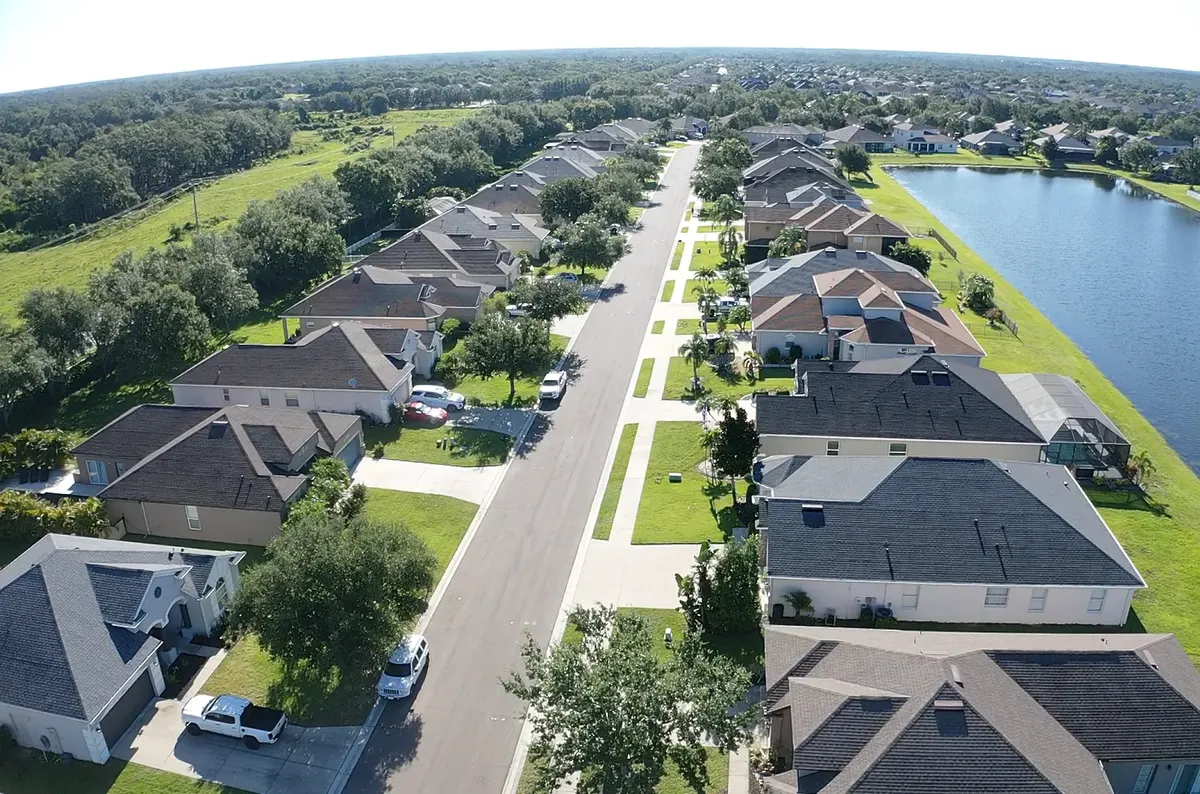
A Florida neighborhood from the air, Manatee County, with a mix of tile and shingle roofs. Roof shape is one of the things a wind mitigation inspector records.
The form
What is the 1802 wind mitigation form, and what changed in 2026?
Form OIR-B1-1802, the Uniform Mitigation Verification Inspection Form, is the state's standard wind mitigation form. Since April 1, 2026, new inspections must use the updated version, Rev. 04/26, which asks 9 questions instead of 7.
The nine are Building Code, Region, Roof Slope, Roof Covering, Roof Deck Attachment, Roof to Wall Attachment, Roof Geometry, Sealed Roof Deck/Secondary Water Resistance, and Opening Protection. Region and Roof Slope are new, and so is a place to record FORTIFIED Roof, Silver and Gold certificates.
The older and current 1802 forms
Form
Rev. 01/12 (older)
Rev. 04/26 (current)
Questions
7
9
When it's used
Inspections done before April 1, 2026
Required for every inspection on or after April 1, 2026
Accepted by Citizens
Yes, if completed within five years before April 1, 2026
Yes
Citizens Property Insurance also says the changes "currently do not affect available credits," so a newer form won't earn a bigger discount on its own. For what each checkbox on your report means, our guide to reading a Florida wind mitigation report goes answer by answer.
What gets credit
Which features earn wind mitigation credits?
These are the main features the form records that can earn credits, and your insurer, not the inspector, decides what each is worth. For the exact answers, see what each line of your report means.
Roof shape
A hip roof slopes down on all four sides, and it's the shape the form rewards. Short of rebuilding, this one is the hand the builder dealt you.
Roof-to-wall connections
How the roof framing is tied to the walls, from nails alone to metal clips, straps or wraps. The inspector checks this from the attic.
Roof deck attachment
The deck is the plywood or boards under your roof, and the form looks at the size and spacing of the nails holding it down. On older homes, a reroof can change this answer.
Sealed deck (secondary water resistance)
A backup waterproof layer under the roof covering that keeps water out if shingles or tiles blow off. The current form credits a few kinds, such as a fully adhered underlayment.
A roof covering that meets code
Shingles, tile or metal with a Florida Building Code or Miami-Dade product approval current at install, or a roofing permit applied for on or after March 1, 2002.
Opening protection
Impact-rated windows and doors, or shutters that cover them. Keep the invoices or labels so the inspector can verify what's installed.
The savings
How much does wind mitigation save on insurance?
There's no set amount. Credits come off only the wind (hurricane) part of your premium, and their size depends on what the inspector finds and what your insurer has filed.
Citizens says its mitigation discounts "apply only to the wind portion of your policy premium," and Florida law requires premium notices to show the hurricane premium separately. Find that hurricane line on your declarations page. It's the pool your credits come out of, and the most a report could ever cut.
The official figure comes from the state's My Safe Florida Home program. Its 2025-26 program page says "last year, on average, thousands of Florida homeowners saved $932," and "your savings will differ." Jimmy Patronis, while serving as the state's Chief Financial Officer, put the average at about $1,000 a year, based on what participants chose to report. Both numbers describe homeowners who finished grant-funded upgrades, not people who only turned in a form.
We haven't found a current public credit table from Citizens or the state, and each insurer files its own discounts. Anyone quoting you a set percentage before seeing your house is guessing.
What tends to move the number
Savings tend to be small on older homes where the roof framing is only toe-nailed to the walls, on gable roofs, and where nothing protects the windows and doors. They tend to be bigger with a hip roof, clips or straps tying the roof to the walls, a sealed roof deck, and impact-rated openings.
Cost and inspectors
How much does a wind mitigation inspection cost, and who can do it?
Usually about $75 to $150, often around $100, and you pay it, not your insurer. It's free through My Safe Florida Home if you qualify. Only the people the form names can sign it.
A 2021 Citizens document put the typical price at $75 to $125, and Angi's 2026 figures say most homeowners spend $85 to $125, with an average of $100. Citizens says the cost "is the homeowner's responsibility."
The free option: My Safe Florida Home
As of September 2026, the program's website says free inspections are available. The house must be a single-family home you live in with a homestead exemption, built on the property rather than in a factory, and either detached or, if attached, no more than three stories. There's no home-value limit. Upgrade grants have stricter rules (insured value of $700,000 or less, built before January 1, 2008, and, currently, income limits), listed on the official My Safe Florida Home website. For the roof side of the grant, see what My Safe Florida Home pays for on a roof.
Who can sign the 1802
A Florida-licensed home inspector with hurricane mitigation training
A certified building code inspector
A general, building or residential contractor licensed under section 489.111
A professional engineer
A professional architect
Anyone else your insurer recognizes as qualified
Roofing contractors aren't named, and that includes us (license CCC1331076). That's why, after a replacement, we bring in a licensed wind mitigation inspector. It matters: Citizens says credits "will not be granted if the form is completed by an unqualified or unlicensed inspector." Check any inspector's license with the state license search at myfloridalicense.com.
Step by step
How do I get a wind mitigation inspection?
Check for a current report, see if you qualify for a free inspection, hire a qualified inspector, and send the finished form to your insurance agent.
Find your current report
Check the date on your last form. If it's under five years old and nothing major on the house has changed, it may still count.
Check My Safe Florida Home
If you qualify, the inspection is free. Apply before you pay for one.
Hire a qualified inspector
Pick someone from the list above, look up the license, and get the price up front.
Get the attic and paperwork ready
Clear a path to the attic hatch so the inspector can see how the roof is fastened. Have the roof permit and product approval paperwork out, plus invoices or labels for impact windows and doors.
Send the form to your agent
Citizens asks you to send the report to your agent, who submits it. With another insurer, ask your agent how they want it.
Ask when the credit starts
Each insurer sets its own rule. Progressive, for one, applies it from the inspection date or your policy start, whichever comes later.
Expiration
How long is a wind mitigation report good for?
Up to five years, as long as nothing major on the house changes and the form has no mistakes.
The form says it's valid "for up to five (5) years provided no material changes have been made to the structure or inaccuracies found on the form," and Citizens uses the same window. A new roof is a material change, so get a fresh inspection after a reroof. Roof age is a separate insurance question, and our post on how old a roof can be before insurance balks covers it.
New roof
Will a new roof improve my wind mitigation credits?
Usually, on more than one answer. A permitted new roof meets the Roof Covering question, and on older homes the code requires deck and water barrier upgrades the form also checks. What each is worth is up to your insurer.
Homes permitted before the Florida Building Code took effect on March 1, 2002, get more out of a reroof, because the code asks more of them. Section 706.7.1 of the Florida Building Code, Existing Building, requires the deck to be re-nailed where the existing nailing falls short, using 8d ring-shank nails (ridged nails that grip the wood) at about 6 inches apart. Section 706.7.2 adds a secondary water barrier. Homes permitted since then are exempt from both sections, but any new roof still gets a better water barrier: on roofs 2:12 and steeper, the current code calls for a fully adhered membrane, taped deck seams under the underlayment, or two layers. Those are the same kinds of secondary water resistance the current form gives credit for.
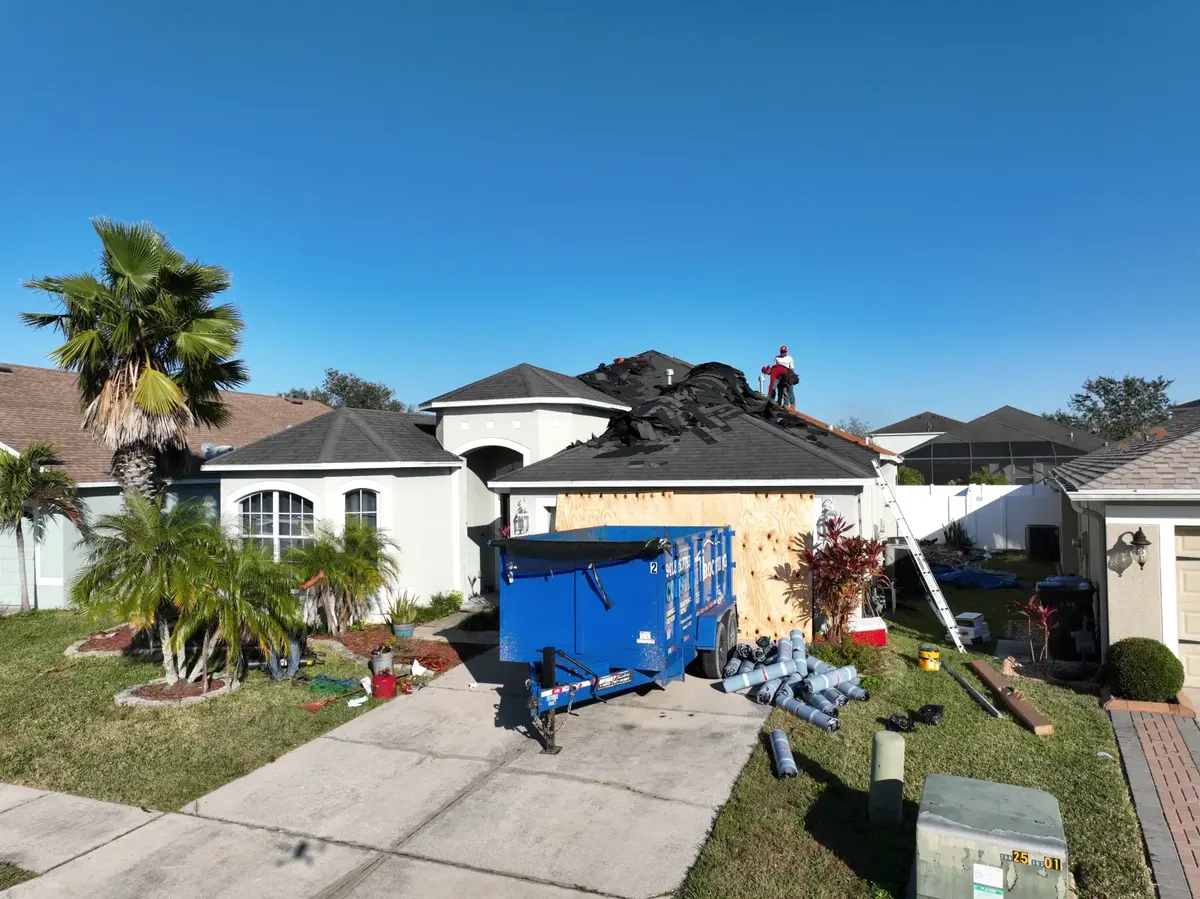
Storm-damaged shingles torn off down to the wood roof deck on a Florida home after Hurricane Ian, January 2023. Any required re-nailing happens while the deck is open like this.
In the part of Florida the code calls the wind-borne debris region (your local building department can tell you if you're in it), the code can also require roof-to-wall connection upgrades on a reroof when the home is insured or valued at $300,000 or more (section 706.8). The code caps that work at 15 percent of the reroof cost. That's a ceiling, not a set charge.
What we hand your inspector after a new roof
After every replacement, we coordinate with a licensed wind mitigation inspector and give them the permit, the product approval numbers and our install photos. You get a completed 1802 to send your insurer, signed by the inspector.
Homeowners on insurance deadlines, paperwork and new roofs
★★★★★
"I chose Coastline mainly due to the excellent customer service and the fact that it is a local company. Other estimates came in lower but they were at least 4 months out. Coastline made my house and my insurance deadline a priority."
TL O.Hurricane Ian roof replacement, Florida Gulf Coast
★★★★★
"Josh was extremely professional and walked me through every aspect of what he found with my roof. He even helped me with the insurance process and saved me thousands. Extremely happy with the final product."
Casey S.Roof replacement and insurance help (Facebook review)
★★★★★
"They did a great job. I needed a roof quickly to sell my house. The roof was in really tough shape. Coastline did all the repairs and a new roof. Also no materials or nails were left behind. Inspection went smoothly."
Is your free roof inspection the same as a wind mitigation inspection?
No. Ours is a roof condition check, drone-assisted, with a written photo report on damage, leaks and remaining life. It doesn't produce an 1802, and roofing contractors aren't among the license types the form names. If we replace your roof, we line up a licensed wind mitigation inspector afterward.
Is a wind mitigation inspection worth it on an older house?
Run the numbers first. Florida insurers must tell you the range of each wind discount when your policy is issued and at every renewal, so ask your agent for that list. Weigh it against your hurricane premium and the $75 to $150 inspection cost before you book.
Do I need a special shingle to get the roof covering credit?
No. The Roof Covering question looks for a product approval that was current at installation or a permit applied for on or after March 1, 2002, not a brand. For picking a shingle on wind rating and algae resistance, see our pick of the best shingles for Florida roofs.
What paperwork from a new roof should I keep?
The roofing permit and the product approval numbers. The inspector records the permit date or product approval number and the year the roof went on. We give these to your inspector after a replacement, but keep your own copy. The report lasts five years at most, and the next inspector will ask for it.
Get a free roof inspection before you pay for a new wind mitigation report
Book a free, drone-assisted roof inspection with a written photo report you keep. No trip fee, no diagnostic fee, and if you replace, we line up the wind mitigation inspector afterward.