
★★★★★
"Replaced the whole roof, plywood and fascia."Munji S.Full roof replacement, Florida Gulf Coast
Sometimes, but it's rarely the better buy. Florida's building code allows one new layer over one existing layer, and only if the old roof is dry and sound. It must come off to the deck if it's water-soaked or worn out, already has two layers, or is tile, slate or wood shake. On most Gulf Coast homes, tear-off wins.
Skipping the tear-off can sound like an easy way to save time and mess. The catch is what stays buried: the wood deck, the old nailing, and any water that got in. Here's what the code allows, how the layer limit works, and the few cases where a roof-over is reasonable.
A roof-over, which the building code calls a recover, puts new roofing on top of the old roof instead of removing it. A tear-off strips everything down to the roof deck, the plywood or boards the roof is nailed to, before the new roof goes on.
You may also hear it called an overlay or a layover. On a shingle roof, it means a new layer of shingles nailed through the old ones and into the deck. Whatever sits under the old shingles, including the deck itself, stays out of sight.
Florida's rule for this lives in the Florida Building Code, Existing Building volume, Section 706.3, titled "Recovering versus replacement." In that section, replacement means a tear-off and recovering means a roof-over.
Section 706.3 says new roofing can't go on "without first removing all existing layers of roof coverings down to the roof deck" when any of five conditions is true. If none of them applies, a single recover is allowed.
| Tear-off is required when | What that means for your roof |
|---|---|
| The roof is wet or worn out | The existing roof or covering is water-soaked, or so deteriorated it can't serve as a base for new roofing. Soaked roofing or shingles that are falling apart rule out a roof-over. |
| It's tile, slate or shake | The existing covering is wood shake, slate, clay tile, cement tile or asbestos-cement tile. Outside the exceptions below, these always come off. |
| It already has two layers | The roof has "two or more applications of any type of roof covering." One roof-over is the limit. |
| Blisters haven't been fixed | Bubbles in the old roofing have to be cut open and secured before anything goes over them. |
| The old roof can't hold the new one | If the old covering would anchor the new roof, and the code's securement rules (how firmly a roof is fastened down, in Section 1504.1 of the Building volume) can't be met, the old roof comes off. |
The same section lists a few exceptions, paraphrased here:
Everything above comes from the 8th edition (2023) of the Florida Building Code, the edition in force today. The Florida Building Commission lists December 31, 2026 as the 9th edition's effective date, and the Florida Roofing and Sheet Metal Contractors Association (FRSA) reports that it changes some of the exceptions in Section 706.3. If your roof will be permitted after that date, ask which edition applies.
Two at most: the existing layer plus one new one. If your roof already has two or more layers, Section 706.3 says all of them come off, down to the deck, before a new roof goes on.
The code counts "two or more applications of any type of roof covering," so it doesn't matter what the older layer is made of. Any roof covering counts toward the limit.
The Asphalt Roofing Manufacturers Association (ARMA), the shingle industry's trade group, says most building codes allow no more than two roof coverings.
Once a roof has been covered over, it has two layers. The next time it needs replacing, a roof-over is off the table and both layers have to come off. The tear-off you skip today just waits for the next roof, and gets bigger.
Yes. Section 706.1.1 of the Existing Building code counts roof area that is repaired, replaced or recovered in any 12-month period, so covering over part of a roof adds to the same running total as a repair.
Under that section, no more than 25% of a roof or roof section can be repaired, replaced or recovered within 12 months "unless the roof covering on the entire existing roof system or roof section is replaced or recovered" to current code.
Florida Statutes section 553.844(5) carves out newer roofs. If yours was built, repaired or replaced under the 2007 Florida Building Code or later, only the "repaired, replaced, or recovered portion" has to meet current code. How the 25% is measured is covered in our post on Florida's 25% roof rule.
Because the old roof hides the part that matters most. A tear-off exposes the deck, brings the code's hurricane upgrades to older homes, and avoids the overlays shingle makers warn about.
With the old roof off, every sheet of plywood is in view, and rotten sheets can be replaced. ARMA notes that a tear-off lets the roofer inspect and repair the deck and improve how it's fastened. On a roof-over, soft wood stays buried. Here's how Florida roof decks get damaged.
Section 706.7 applies when a roof covering on a wood deck "is removed and replaced." On homes permitted before the Florida Building Code, that means re-nailing the deck and adding a secondary water barrier, a backup layer that helps keep water out if the roof covering blows off. Florida Statutes section 553.844(3)(a) says a roof replacement "must incorporate" these steps, and a roof-over skips both. Deck attachment and secondary water resistance are also questions on the wind mitigation form insurers use for discounts.
ARMA says most manufacturers don't recommend installing shingles over existing laminated shingles, the thick, layered kind also called architectural. It also warns that an overlay may affect a shingle's impact-resistance rating. If your current roof is architectural, that caution applies to you.
GAF's installation instructions for its Timberline shingles say that if old shingles stay, every loose, curled or lifted one gets nailed down or cut away. Nails should reach at least 3/4 inch into a wood deck, or just through a plywood deck, after passing through the old layer. That's more prep, not less, and the deck still goes unseen.
In a few narrow cases. The code makes exceptions for a complete and separate system such as standing-seam metal and for certain coatings, and on flat roofs an overlay or coating can go over a dry, sound base.
The Section 706.3 limits still apply to flat roofs: a soaked roof or one with two layers comes off, and blisters get cut and secured first. And no coating rescues a worn-out roof. GAF's liquid-applied roofing manual puts it plainly: "a coating cannot add life back to a roof already beyond its service life." Our flat roofing service page covers overlays, coatings and when a low-slope roof needs replacing instead.
A full tear-off to the deck in nearly every case, with the deck checked and photographed before the new roof goes on. And if your roof still has good years left, a repair may be the better buy. We'll tell you so.
Start with a free, drone-assisted roof inspection and a written photo report you keep, with no trip fee and no diagnostic fee.
If a new roof makes sense, you get an itemized estimate. Replacement quotes are good for 30 days.
The old roof comes off down to the wood, so every sheet of the deck is in view. Every job follows a crew checklist and gets a photo report, and Josh reviews every job's photo report.
Most single-family replacements take 1 to 3 days, weather permitting, and you get the exact timeline before the job starts. The full sequence is in what to expect during a roof replacement.
After every replacement, we coordinate with a licensed wind mitigation inspector so you get a completed OIR-B1-1802 to send your insurer. The roof carries our 5-year workmanship warranty.
Want a first opinion before anyone climbs a ladder? Text a few photos of your roof to (941) 345-0072.
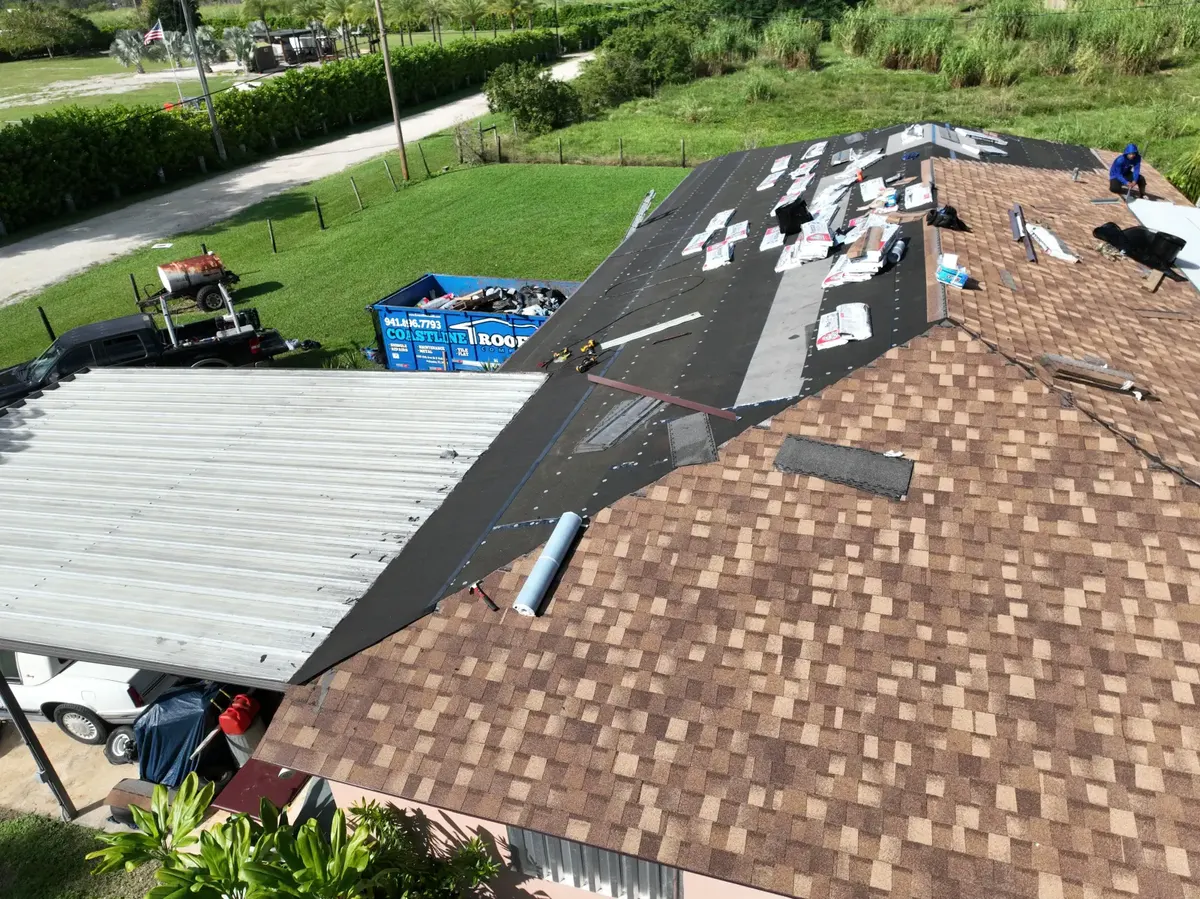
"Replaced the whole roof, plywood and fascia."Munji S.Full roof replacement, Florida Gulf Coast
"Professional service, they put my new roof on the right time. Thanks Coastline Roofing."Amilcar A.Roof installation, Florida Gulf Coast
"Coastline roofing did a great job installing our new roof and gutter system. They were fast, clean and the resulting roof and gutters look great. All were very helpful and respectful."Kyle D.Roof and gutter install, Florida Gulf Coast
The upfront quote can be lower, since nobody tears off and hauls away the old roof. What you give up is a look at the deck, the hurricane upgrades that come with a tear-off on older homes, and your one allowed recover. The next roof then has two layers to remove. Compare written quotes line by line, and ask each roofer what happens to the deck.
Usually because one of the five conditions in Section 706.3 applies. The roof may already have two layers, the old roof may be water-soaked or too deteriorated to build on, the roof may be tile, slate or wood shake, or the old roof may not be able to anchor a new one to code. Ask them to show you which one in the inspection photos.
Only on a roof that's still sound. The code allows elastomeric or maintenance coatings over asphalt shingles when they're applied per the shingle manufacturer's instructions. A coating doesn't fix a worn-out roof, though, and it doesn't reach the deck.
Free drone-assisted inspection with a written photo report you keep. No trip fee, no diagnostic fee, and if a repair will do the job, we'll say so.
Leave your name and number. We typically call back the same day during business hours. Consent to texts is not required.