What Is Alligatoring on a Flat Roof, and What Should I Do About It?
Alligatoring is a web of alligator-hide cracks in the asphalt surface or old coating of an aging flat roof. Years of sun and heat cycling dry the oils out of the asphalt until it turns brittle and cracks. Shallow cracking can often be repaired and recoated. Cracks through the membrane, or widespread wet insulation underneath, usually mean replacement.
By Josh Hildebrand, owner of Coastline Roofing · Florida license CCC1331076 ·
It usually turns up on the flat roof over a lanai, a porch, an addition, or a commercial building, and it looks alarming from the top of a ladder. Some of it is surface wear you can seal. Some of it means water is already getting in. Here's how to tell which one you have, and why waiting narrows your options.
Alligatoring is a pattern of small, connected cracks in the asphalt surface of a flat roof, shaped like the scales on an alligator's back. It's a sign of age. The asphalt has dried out and gone stiff, and the cracks may or may not go all the way through that top layer.
The glossary of the Roofing Contractors Association of British Columbia (RCABC) calls it cracking of the surfacing bitumen (the top layer of asphalt) on a built-up roof, in a pattern like alligator hide, and notes the cracks may or may not extend through that surfacing layer. InterNACHI, a home inspectors' association, defines it as aged asphalt that has oxidized and lost its volatile oils from exposure to the sun, the end result of asphalt's limited tolerance for expanding and contracting.
Because it's an asphalt problem, you'll find it on built-up roofs (the older layered tar and gravel kind), modified bitumen roofs (rolled sheets of rubberized asphalt), and old asphalt-based coatings. Around here, that means the flat roof over a lanai, porch, addition, or carport, and plenty of commercial buildings.
The cause
What causes alligatoring on Florida flat roofs?
Sun and heat, over years. Sunlight and the swing from hot afternoons to cooler nights dry the asphalt out, so it loses its flex and cracks as it expands and contracts.
Sunlight oxidizes the asphalt and drives off its oils, while the roof heats up and cools down every day (thermal cycling). InterNACHI's roof inspection manual describes what follows: as the asphalt dries out, it loses its flexibility and cracks from thermal expansion and contraction. RCABC's glossary names the same usual causes, oxidizing from weathering and shrinkage stress.
A flat roof faces straight up at the sky, and on the Gulf Coast the sun and heat run most of the year. The question that matters is how deep the cracking goes.
Why waiting narrows your options
Cracks that reach the reinforcement inside the membrane let water in. Wet insulation has to be replaced before any coating goes on, and once enough of the roof is wet, coating is off the table (GAF's cutoff is in the coating section below). Acting while the cracks are shallow keeps more choices open.
How serious is it
Is alligatoring just cosmetic, or is my roof failing?
Fine cracks in the top layer are weathering, and the roof may still keep water out. Cracks that reach the reinforcement let water in, and that's how a membrane starts to fail. These signs tell the two apart.
Fine cracks on the surface only
Lexis Coatings, a coatings maker, calls the tiniest cracking "checking" and says it comes from the sun drying out the exposed asphalt. It doesn't mean a leak on its own, but the surface is aging and worth a closer look.
Cracks you can fit a fingernail into
If a fingernail slips in, they're past light checking. GAF's coating manual treats gaps of 1/16 inch or more, in width or depth, on built-up or modified bitumen roofs as significant cracks that must be repaired before coating.
Cracks down to the fabric
Asphalt roof membranes have a fiberglass or felt reinforcing layer inside. Lexis Coatings warns that untreated cracks let water into the roof system, and once the reinforcement is exposed it turns brittle and membrane failure follows. If you can see that layer in a crack, treat the roof as leaking, even if the ceiling looks fine.
Stains or drips inside
A ceiling stain under the lanai or a drip in the storeroom means water is already getting through. If it's leaking now, call us. We respond the same day on active leaks.
Soft or spongy spots underfoot
A spot that gives underfoot can mean wet insulation or a wet deck below. That changes the fix, because wet material has to come out before anything goes on top.
Blisters and lifting seams nearby
Raised bubbles, open laps, and lifting edges are separate problems, but they often show up on the same aging roof and get fixed in the same visit.
Know what you're looking at
How is alligatoring different from splits, blisters, and ponding?
Alligatoring is a web of small cracks spread across the surface. A split is one long tear, a blister is a raised bubble, and ponding is water that sits long after the rain. One roof can have several, and each points to a different fix.
Common flat roof problems, side by side
Problem
What you see
What's going on
Alligatoring
A web of small, connected cracks across the surface, like alligator hide
The asphalt surface has dried out and gone brittle with age
Split
One long crack or tear, often in a line
The membrane has pulled apart
Blister
A raised bubble or pocket in the surface
The top layer has lifted off what's under it
Ponding
Puddles still sitting there long after the rain
Water isn't draining the way the roof was built to
Sometimes. A coating can seal a roof whose cracking is shallow and whose insulation is dry. It can't rescue a roof that's worn out or wet underneath.
GAF's Liquid-Applied Roofing Manual puts it plainly: "a coating cannot add life back to a roof already beyond its service life." It also says coatings generally won't find or fix existing leaks. A coating is a new skin for a sound roof, not a patch for a failing one.
What GAF's manual requires before a coating goes on
All wet insulation removed.
A complete tear-off if a moisture survey (infrared, nuclear gauge, or core cuts, which are small samples cut from the roof) finds moisture in 25% or more of the roof.
A completely dry surface to coat.
Significant cracks repaired, and blistered or wet membrane removed.
Alligatored areas treated before the coating goes on.
Positive drainage, with no water ponding for more than 48 hours after rain stops.
A reflective elastomeric coating, completed on a flat commercial roof.
The right coating depends on the roof
Not every coating handles standing water. Gaco markets its GacoFlex S20 and GacoRoof GR16 silicone coatings as able to withstand permanent ponding. Its GacoFlex A47 acrylic data sheet says that product isn't meant for slopes under 2:12 (2 inches of rise per foot) or surfaces prone to ponding. If your roof holds puddles, find out what's causing the ponding before you pick a coating.
We apply elastomeric acrylic, silicone, and aluminum-reflective coatings, matched to the membrane already on your roof.
Replacement
When does an alligatored flat roof need to be replaced?
When cracks go through the membrane across large parts of the roof, when much of the insulation or deck below is wet, when leaks keep coming back after repairs, or when the roof has reached the end of its life.
Age is part of the picture. InterNACHI's life expectancy chart estimates about 30 years for a built-up roof and about 20 for modified bitumen. Those are estimates, and InterNACHI notes that real life depends on weather, design, materials, and maintenance. A roof near those ages with deep alligatoring is a poor bet for a coating.
Replacement doesn't always mean tearing everything off. On an older built-up roof with a sound base, we can sometimes install a modified bitumen or TPO overlay on top. If the deck or insulation is wet, there's no shortcut: the wet material comes out.
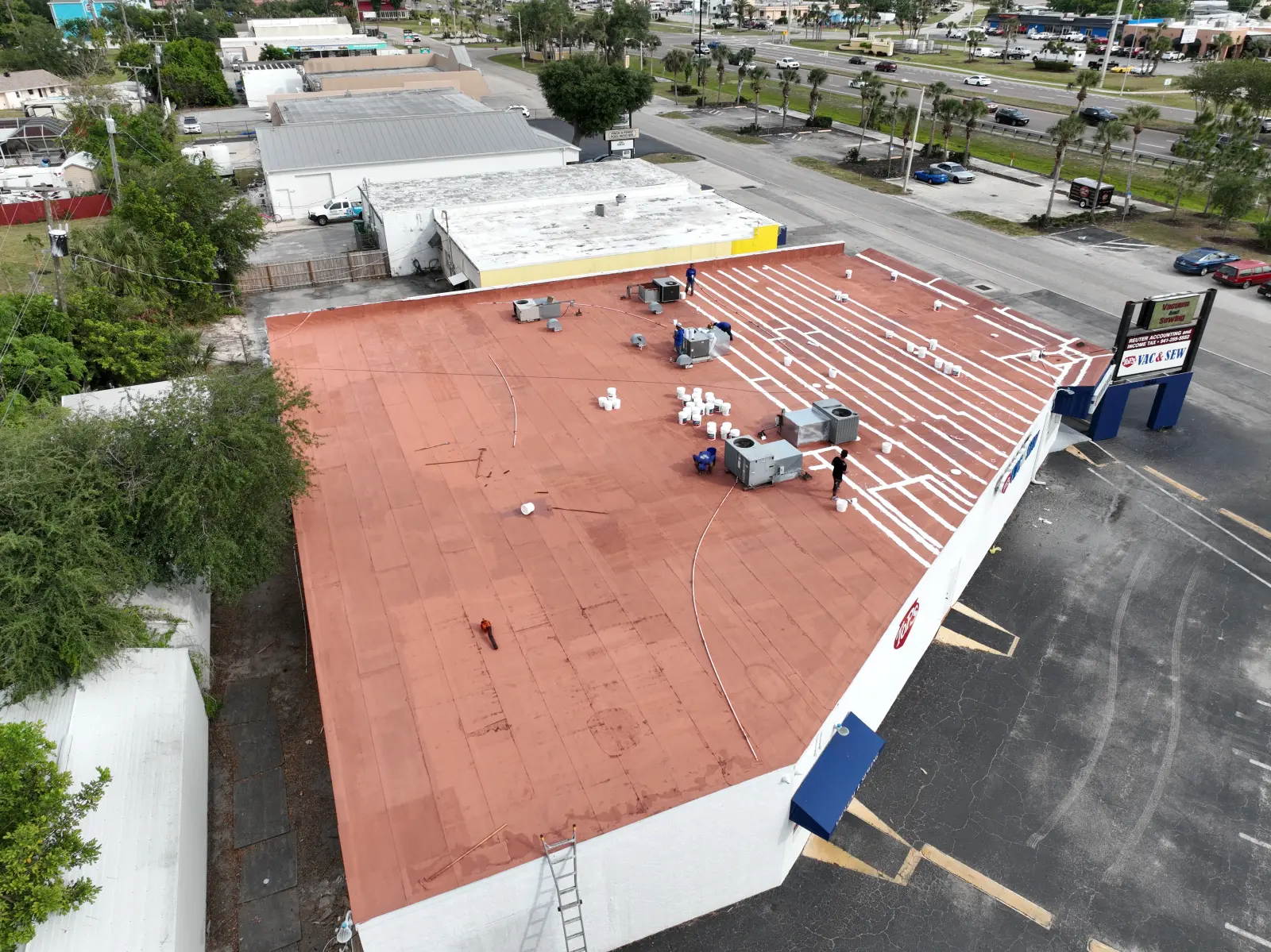
A completed TPO flat roof on a commercial building, seen from the air, April 2024.
For a new roof we install 60-mil TPO with heat-welded seams, and modified bitumen in both SBS and APP types. Our guide to choosing a new flat roof system helps you pick. On commercial roofs, we schedule the work to keep disruption low, with early starts, weekends, or phased installs.
Free inspection
What does Coastline check on a free flat roof inspection?
How deep the cracking goes and how much of the roof it covers, plus the seams, flashing, ponding spots, and signs of water under the surface. You get a written photo report and a written price to repair, recoat, or replace.
A drone-assisted look at the whole roof
We photograph where the cracking is and how far it spreads, so you see it yourself instead of taking our word for it.
How deep the cracks go
Surface checking and cracks into the reinforcement call for different fixes, so we look closely at the worst areas.
Seams, laps, and flashing
The overlaps between sheets, and the flashing at walls and around pipes, vents, and equipment.
Ponding spots
Low areas that hold water change which coating can work, or whether one makes sense at all.
Signs of water under the surface
Soft spots, blisters, and any stains you've noticed inside can point to wet material that has to come out before anything goes on top.
A written report and a line-by-line price
You keep the photo report. The estimate is written line by line, and if a repair is all the roof needs, we'll say so. No deposit on repairs.
What customers say about our inspections and repairs
★★★★★
"Exceptional and professional service from start to finish. Loved how Josh used his drone to identify cracked and slipped roof tiles and sent us the photos. Photos also taken of completed work. Highly recommend for all roof repairs."
Not necessarily. RCABC's glossary notes that alligator cracks may or may not go all the way through the top layer of asphalt, and shallow checking can sit on a roof that's still dry inside. Stains, drips, soft spots, or cracks deep enough to show the reinforcement are the signs water is getting in.
Can I roll a store-bought roof coating over the cracks myself?
Only if the roof passes the prep list above, and the hard part of that list is confirming the roof is dry, replacing wet insulation, and repairing cracks first. Rolled over a wet or cracked-through roof, a coating covers the problem instead of fixing it.
What's the difference between a recoat and an overlay?
A recoat is a liquid coating, such as acrylic or silicone, applied over the existing roof once it's repaired and dry. An overlay is a new membrane, such as modified bitumen or TPO, installed on top of an older built-up roof whose base is still sound.
Do roof coatings come with a warranty?
Many do. GAF, for example, offers coating warranties of 10, 15, or 20 years, depending on the system. Those are warranty terms, not a promise of how long the coating lasts. We pass manufacturer warranties through to you in full.
How much does it cost to fix an alligatored flat roof?
The price follows the fix, and the fix follows how deep the cracks go. Treating a few areas, recoating the whole roof, and replacing it are three very different quotes. The free inspection tells you which one your roof needs, in writing.
Book a free, drone-assisted flat roof inspection with a written photo report you keep. No trip fee, no diagnostic fee, and a plain answer on repair, recoat, or replace.