Almost every tile homeowner asks us some version of the same question: if your guys go up there, are they going to break more tiles than they find? It is a fair question. Tile is brittle, and plenty of roofs in Florida have cracked tiles that came from somebody stepping in the wrong place. So here is the honest answer, straight from what our crews are trained to do. There is a specific spot to put your foot on a concrete tile roof, and if you walk there, you almost never crack a tile.
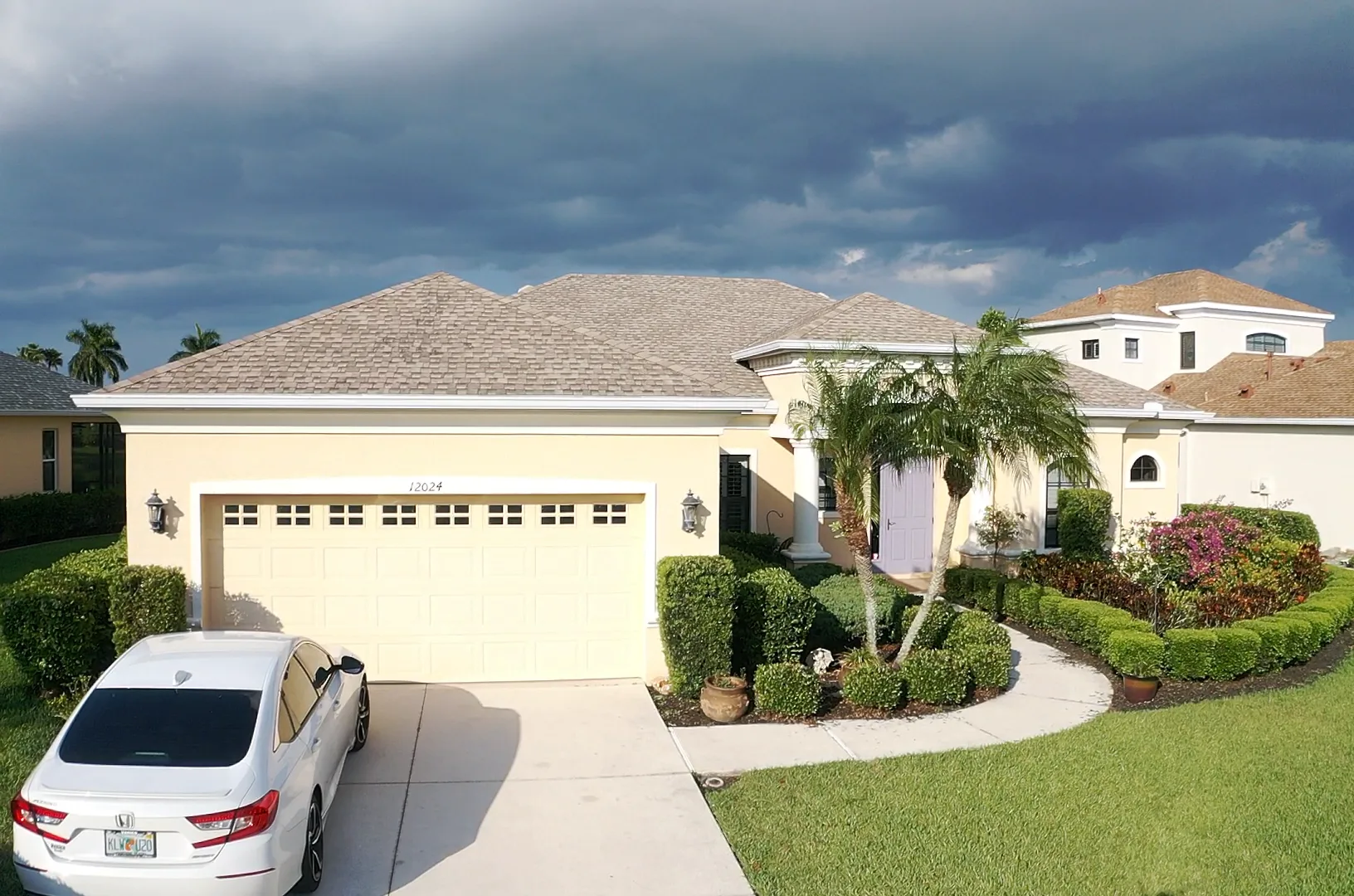
A concrete tile roof in Bradenton. From the driveway you cannot tell a cracked tile from a shadow, which is why somebody usually ends up walking the roof.
Homeowners rarely say it directly, but it sits underneath a lot of tile calls. You have watched a satellite tech, a solar installer, an AC guy, or a pressure washer climb up there, and afterward you found pieces of tile in the gutter. So when a roofer offers to come look, the honest reaction is that the inspection itself might cost you tiles.
That fear is not paranoia. Foot traffic really is one of the top ways roof tiles break in Florida. But it is not walking on tile that cracks tile. It is walking on the wrong part of the tile. There is a specific way to walk on a concrete tile roof, and the difference between the right spot and the wrong spot is about six inches.
Why tile breaks under a foot at all
Look at a concrete tile roof in profile and you will see the shape: each tile has a raised barrel or rib and a low channel, and the courses lap over each other going up the slope. Under a big part of every tile there is nothing but air. That open span is the hollow spot. It is engineered to shed water and take wind uplift, not to carry a 200-pound person standing on it. Put your weight there and the tile flexes across an unsupported gap until it splits.
Now look at where two courses overlap. In that band the tile is doubled: the bottom of the upper tile is sitting directly on the top of the tile beneath it, which in turn is fastened and bearing on the batten or deck. That is a completely different load path. The tile is not spanning anything. It is stacked.
The actual technique
Walk where the tile is double. That is where the support is.
Josh put it about as plainly as it can be put: walk where the tiles overlap each other, and never walk in the hollow spot of the tile. Your foot goes on the bottom of the tile, low in the course, where the piece is lapped over the one below it. Two thicknesses of concrete, backed by the tile underneath, backed by the batten. Do that on every step and you are walking on the strongest part of the roof instead of the weakest.
It sounds small. It is the entire difference between a clean inspection and a repair bill. A crew that knows tile moves across the roof in that low overlap band the whole time, foot placement first, then weight. A crew that does not know tile walks it like a shingle roof, straight across the middle of every piece, and leaves a trail of hairline cracks that nobody notices for a year.
Be clear about what this buys you, though. Correct foot placement makes cracking very unlikely, not impossible. Tile that is thirty years old and sun-baked can still split under a careful step. Anyone who promises zero breakage on an aged Florida tile roof is selling you something. What we will tell you is what Josh says: walk the tile roof where it is double and you will almost never crack a tile.
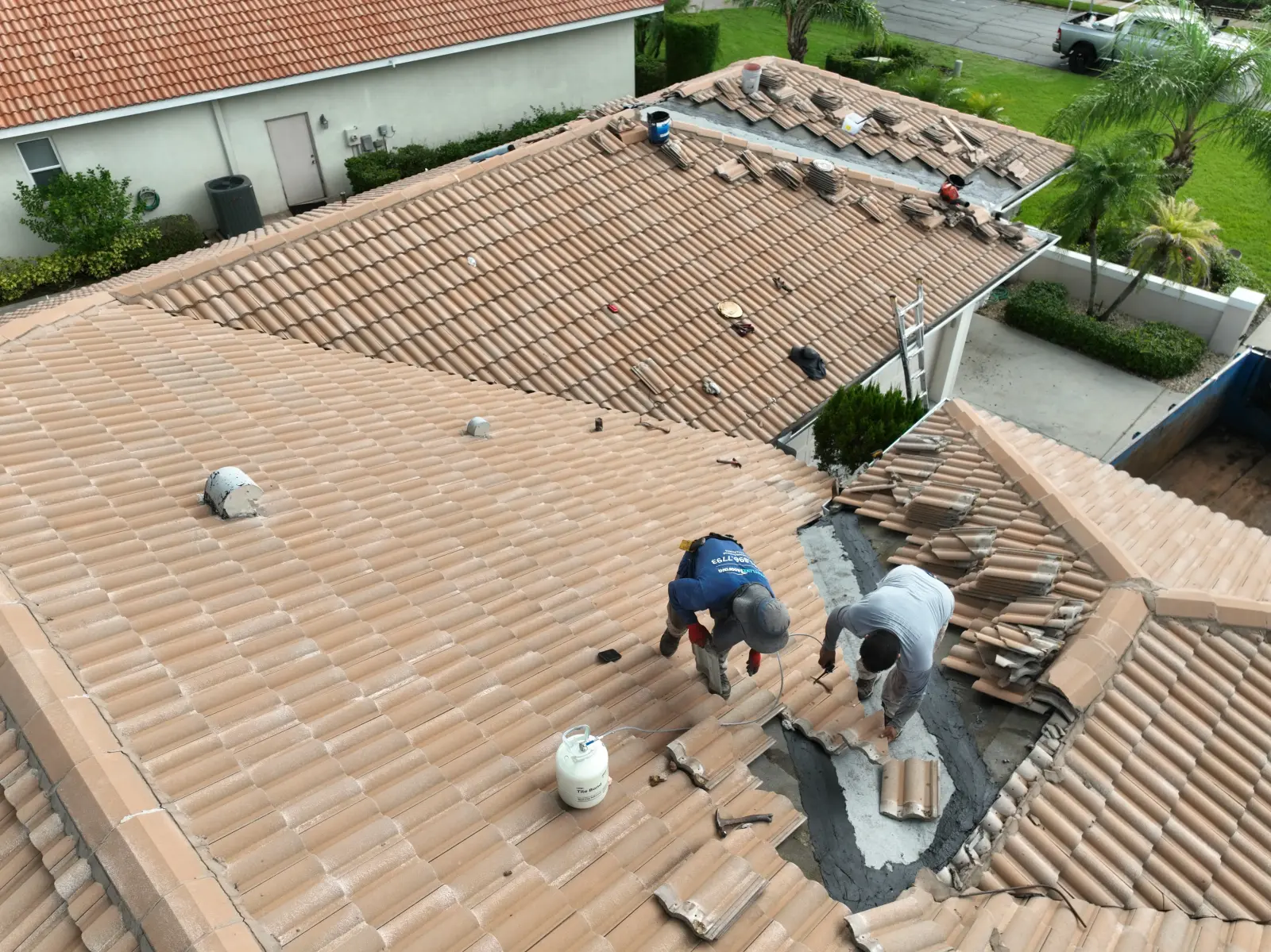
Crew on a Florida tile roof, August 2024. On tile, foot placement is part of the job, not an afterthought.
Right spot, wrong spot
What separates a safe step from a cracked tile
Four things worth knowing before anyone, us included, sets foot on your concrete tile roof.
Right: the overlap, low on the tile
Weight goes on the bottom section of the tile, in the band where it laps the course below. The tile is double thickness there and the load carries straight down through the tile underneath. This is the spot, and on a tile roof it is the only spot.
Wrong: the hollow spot
The middle of the tile, where it arches over open air, has nothing under it. Step there and the tile has to carry your full weight across an unsupported span. That is where broken roof tiles come from, and that lone crack in the middle of an otherwise clean field is usually the signature of somebody who did not know better.
Some cracks were already there
Wind breaks tile too. On most roofs we survey we find cracks that predate anyone's visit, some from storms and some from an earlier tech in the wrong spot. A cracked tile discovered during an inspection is not automatically new, and we photograph and date everything so you can see the difference.
Do not try this yourself
Knowing where the support is does not make a tile roof safe to climb. Tile is slick, the pitch is often steep, and a piece that breaks underfoot takes your footing with it. Call us, or text a photo, and let the drone do the looking.
Why we fly first
The best way to not crack a tile is to not step on one
Correct technique is the backup plan. The first plan is to stay off the roof entirely. Most of the time our crew flies a drone over the tile roof and photographs every slope, valley, ridge, and penetration in high resolution without a single footstep. For a straightforward tile roof inspection, that is the whole visit. Nobody touches the tile.
We only get up close and physically on the roof when the drone has taken us as far as it can. Some answers live under the tile, not on top of it. If we need to lift a few tiles and see what is going on with the underlayment, the batten, or a flashing, somebody has to be up there with hands on the roof. That is when the overlap rule matters, and that is when it gets used.
The photos come back as a written report. Josh reviews the photo report from every job, so the same eye is on your roof whether the crew flew it or walked it. You see the same images we do, including any cracked tiles we found and where they are.
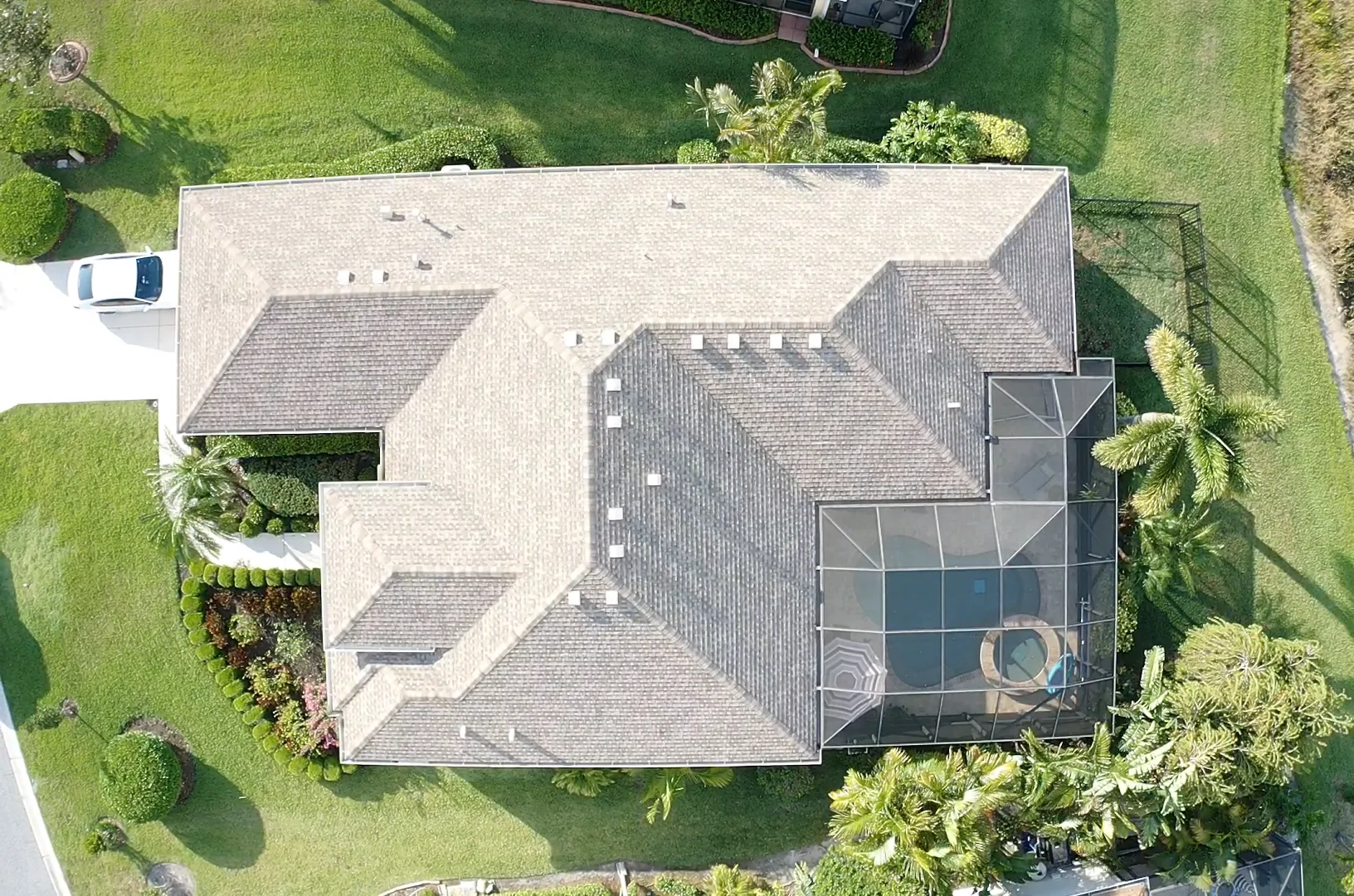
Drone aerial of a Florida tile roof. Every slope on camera, zero foot traffic, and the tile is exactly as we found it.
Recent tile work
What we find, and what the fix looks like
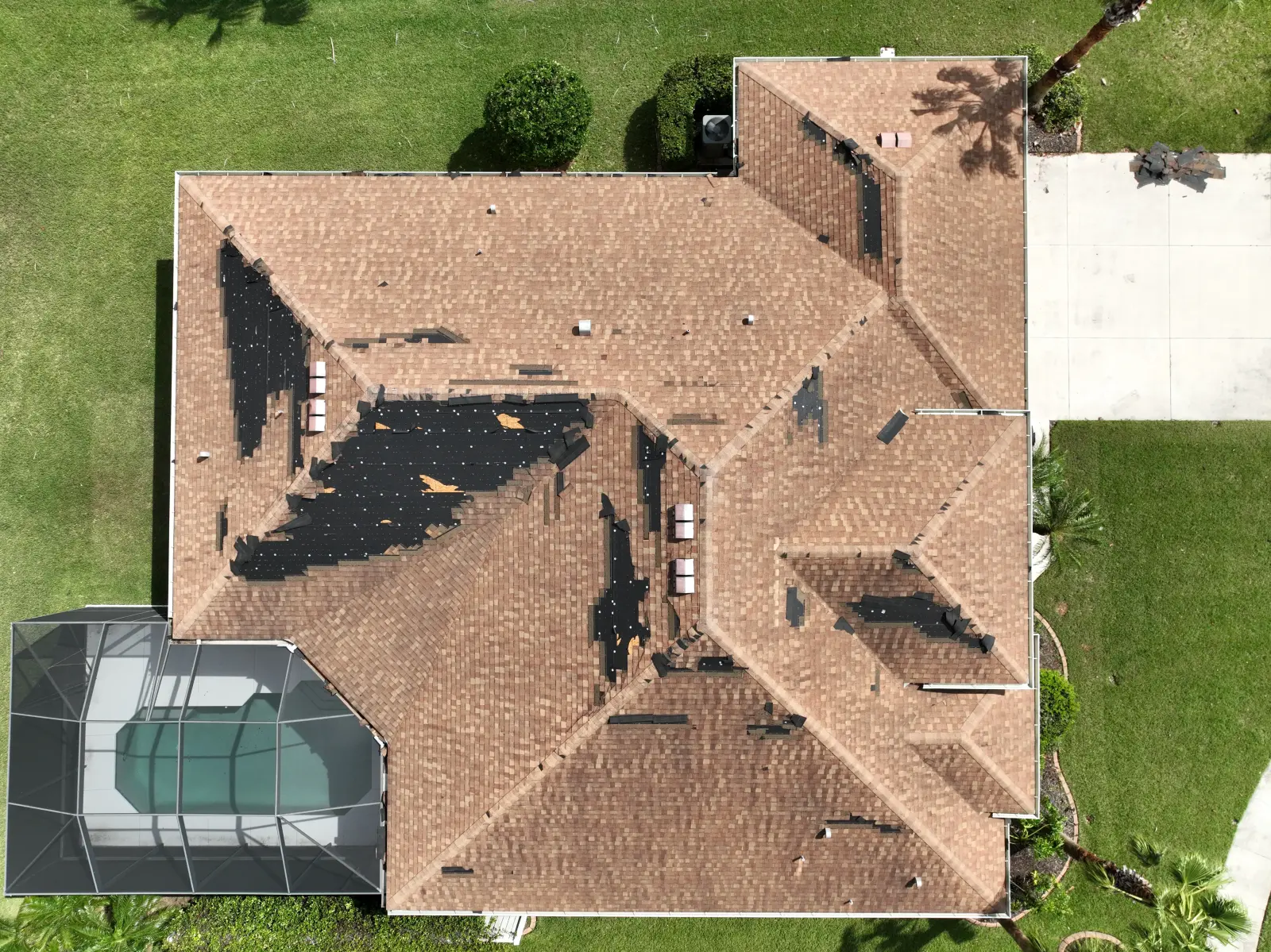
Storm-damaged tile roof, Florida Gulf Coast, October 2024. Wind cracked and shifted tiles across the windward slope. None of this came from foot traffic, and the drone survey proved it before anyone climbed up.Tile install in progress, Florida Gulf Coast, October 2024. On a working roof the crew moves along the overlapped courses all day, which is how a job this size finishes without a field of hairline cracks.
Reviews
What tile homeowners say about how we inspect
★★★★★
"Exceptional and professional service from start to finish. Loved how Josh used his drone to identify cracked and slipped roof tiles and sent us the photos. Photos also taken of completed work."
"Josh was very thorough diagnosing a hard-to-find leak on a tile roof, after 2 other roofing companies tried but failed to catch the problem. ... I was introduced to the team on work day, they were on time, polite and did a fantastic job. ... Great work at a fair price, great service."
Mark R.Tile roof leak repair, Florida Gulf Coast
★★★★★
"Quick response. Great customer service & quality of work. Very knowledgeable of tile roofs which is a plus in our neighborhood. Very good pricing."
Yes, but only in specific spots. A concrete tile roof is strong where the tiles overlap each other and weak in the hollow middle of the tile. Step on the overlap, where the tile is double thickness, and the tile holds because that is where the support is. Step in the hollow and the tile cracks. That is the whole technique, and it is why a trained tile crew can walk a roof that a homeowner should not.
Will a roofer crack my tiles?
This is the number one worry we hear from tile homeowners, and it is a fair one. Somebody who walks the double-thickness overlaps will almost never crack a tile. Somebody who does not know tile, and plants a foot in the hollow of every piece, will crack several. Our crews are trained to walk the overlaps, and most of our tile inspections involve no foot traffic at all because we fly the roof with a drone first.
Where is it safe to step on a tile roof?
Step where the tiles overlap each other. On a concrete tile roof the courses lap over one another, so the lower portion of each tile sits doubled up on the tile beneath it. Put your weight on that bottom, doubled section and the load carries straight through to the tile below. Never step in the hollow spot in the middle of a tile, because that section spans open air and has nothing under it.
Why do you use a drone to inspect a tile roof?
Because the surest way to avoid cracking tiles is to not walk on them. Most of the time our crew flies a drone over the roof and captures every slope, valley, ridge, and penetration in high resolution with zero footsteps. We only get up close and on the tile when we need to physically lift tiles and see what is going on underneath them, which the drone cannot do. Josh reviews the photo report from every job.
What if a tile cracks during the inspection?
If our crew breaks a tile while we are up there, we replace it. We will also be straight with you about something else: plenty of tile roofs in Bradenton already have cracked tiles before we arrive, from wind or from an earlier tech who stepped in the wrong spot. A broken roof tile found during an inspection is not automatically the inspector's fault. That is exactly why every inspection comes with dated photos, so you can see the condition of the roof the day we looked at it.
Let the drone look before anyone climbs up
Free tile roof inspection, no trip fee, no diagnostic fee. Written photo report either way, and 5-year workmanship warranty on replacements, 1-year on repairs.