Emergency Tarping · Florida Gulf Coast

FEMA Tarp Replacement: Your Storm Tarp Has an Expiration Date

Updated July 2026

If a tarp went on your roof after Hurricane Milton, it has been up there through nearly two Florida summers. Tarps are not built for that. They rip, they go brittle, they shred, and they quietly stop doing the one job they were put up to do. We are pulling shot tarps off roofs right now, rainy season is already here, and the next round of storms is not going to wait for your claim. Here is how to tell yours has failed, why it failed, and what a re-tarp actually involves.

Licensed & InsuredFlorida CCC1331076
4.7 stars57 Google reviews
10 yearsFlorida-licensed
2,000+Roofs completed
The problem nobody warned you about

A tarp was always temporary. Yours has been permanent for 21 months.

Hurricane Milton came ashore on October 9, 2024. That means a tarp put on right after the storm has now been baking on a Florida roof for roughly 21 months. It has been through two summers of full sun, an entire wet season, and every afternoon thunderstorm in between. Nobody who installed those tarps thought they would still be the only thing between the house and the sky in the summer of 2026, and the material was never built to hold up that long.

So the tarps are failing, and they are failing on schedule. We are on roofs right now where the tarp is ripped open along the seams, brittle enough to crumble at the edges when you handle it, and flapping loose in a way that tells you it stopped sealing a long time ago. From the driveway it still reads as a blue tarp roof, so the homeowner assumes the house is covered. It is not. Water is going straight past it into the decking underneath.

That gap between what the tarp looks like and what it actually does is the dangerous part. A roof with no cover at all gets attention. A roof with a shredded cover gets ignored until a ceiling stains, and by then water has been working on the plywood, the insulation, and the framing for months. Rainy season is here and the next named storm is coming whether the tarp is ready or not.

How to tell yours is done

Four signs your storm tarp has failed

It is ripping and shredding

The clearest sign, and the one you can usually see from the ground with a phone camera zoomed in. Tears running along a seam, ragged strips lifting at a corner, a hole where the fabric let go. Once a tarp starts tearing it does not stop, because every gust pulls on the tear it already has. A shredded tarp is not a tarp anymore.

It has gone brittle

Florida sun and roof-surface heat break the material down from the day it goes on. A tarp that started out flexible turns stiff and chalky, and it cracks instead of bending. Brittle plastic tears at the smallest stress, so a tarp in this condition can look intact one week and be split wide open after one storm.

It is flapping and loose

Wind cycling is what kills tarps that the sun has not gotten to yet. Every gust lifts the fabric and drops it, thousands of times, and that constant working loosens the fasteners and enlarges every hole they made. Once an edge lifts, wind-driven rain gets underneath it and runs down the roof under the tarp instead of over it.

Water is getting in again

A new stain on a ceiling, a drip that came back, a musty smell in a closet under the tarped slope. If the leak stopped when the tarp went up and it has started again, the tarp is the thing that changed. That is the sign to act on the same week, because water reaching the decking is what turns a tarp problem into a plywood and framing problem.

What a re-tarp involves

Pull the old one, see what is under it, cover it properly

A re-tarp is not complicated work, but it is worth knowing what should happen when someone shows up, and what you should have in your hands when they leave.

If you are still fighting your insurer

Some of these houses have been waiting almost two years, and it is not the homeowner's fault.

A good share of the tarps we replace are on homes where the claim never got resolved. The homeowner is still in litigation with the insurance company. There are still shingles missing across the slope. The tarp that was supposed to hold things together for a few weeks has been up since Milton. We wish the insurance company had just taken care of these people, and it is hard to watch a house sit open while lawyers work.

We cannot move your case along and we are not going to pretend otherwise. What we can do is keep the house covered while it plays out. A re-tarp is its own piece of work: it does not wait on a settlement, it does not require anyone's approval, and it stops the roof from getting worse while the legal side takes as long as it takes. Every month a shredded tarp stays up is another month of water reaching wood that will cost more to fix later.

Coastline is not a public adjuster and we do not negotiate claims for a fee. Public adjusters are licensed separately under Florida Statute 626.854, and if you need one, hire one. What we do is document the roof with a written photo report and work alongside your adjuster with facts about what is actually up there. If the claim side is where you are stuck, our roof insurance claim help page walks through how we support that process without stepping outside our lane.

Straight answers on the claim clock

Where the Milton and Ian deadlines actually stand

One year to file, 18 months for a supplemental

Under Florida Statute 627.70132, you have one year from the date of loss to file a new or reopened claim and 18 months from the date of loss to file a supplemental claim, windows shortened by SB 2-A effective December 16, 2022. Hurricane Milton's date of loss was October 9, 2024 and Hurricane Ian's was September 28, 2022, so as of July 2026 both of those filing windows have closed. We are telling you that plainly because you deserve a straight answer, not a sales pitch.

An open claim is a different situation

A closed filing window is not the same as a closed claim. If your Milton or Ian claim is already open, under review, or in litigation, that matter can still be moving and your attorney is the person to ask about it. Meanwhile the roof does not care what stage the paperwork is at. Re-tarping protects the house either way, and the photo report we leave you documents the condition on the date we were there.

Temporary repair, done right

Getting in front of the next storm instead of cleaning up after it.

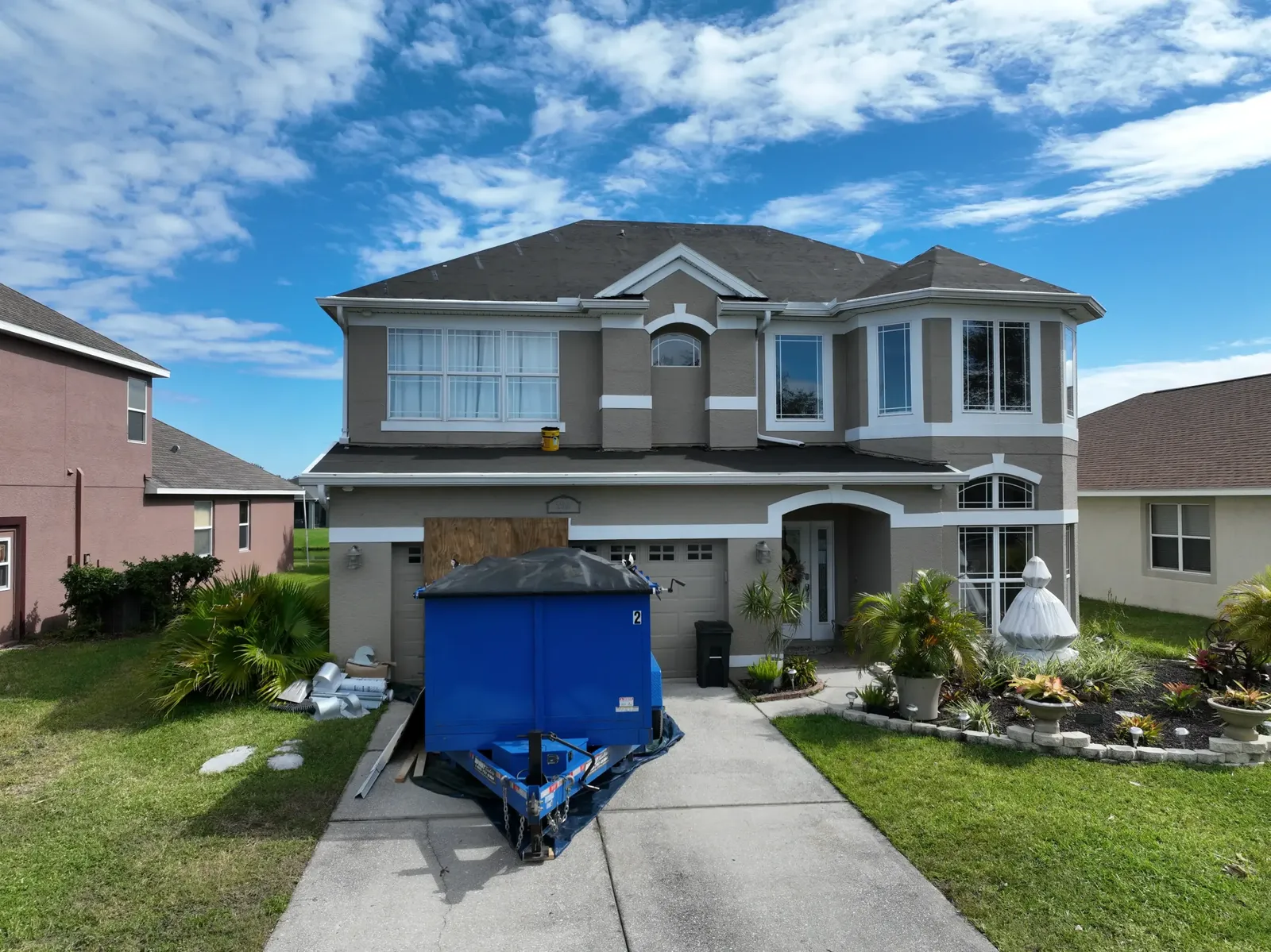
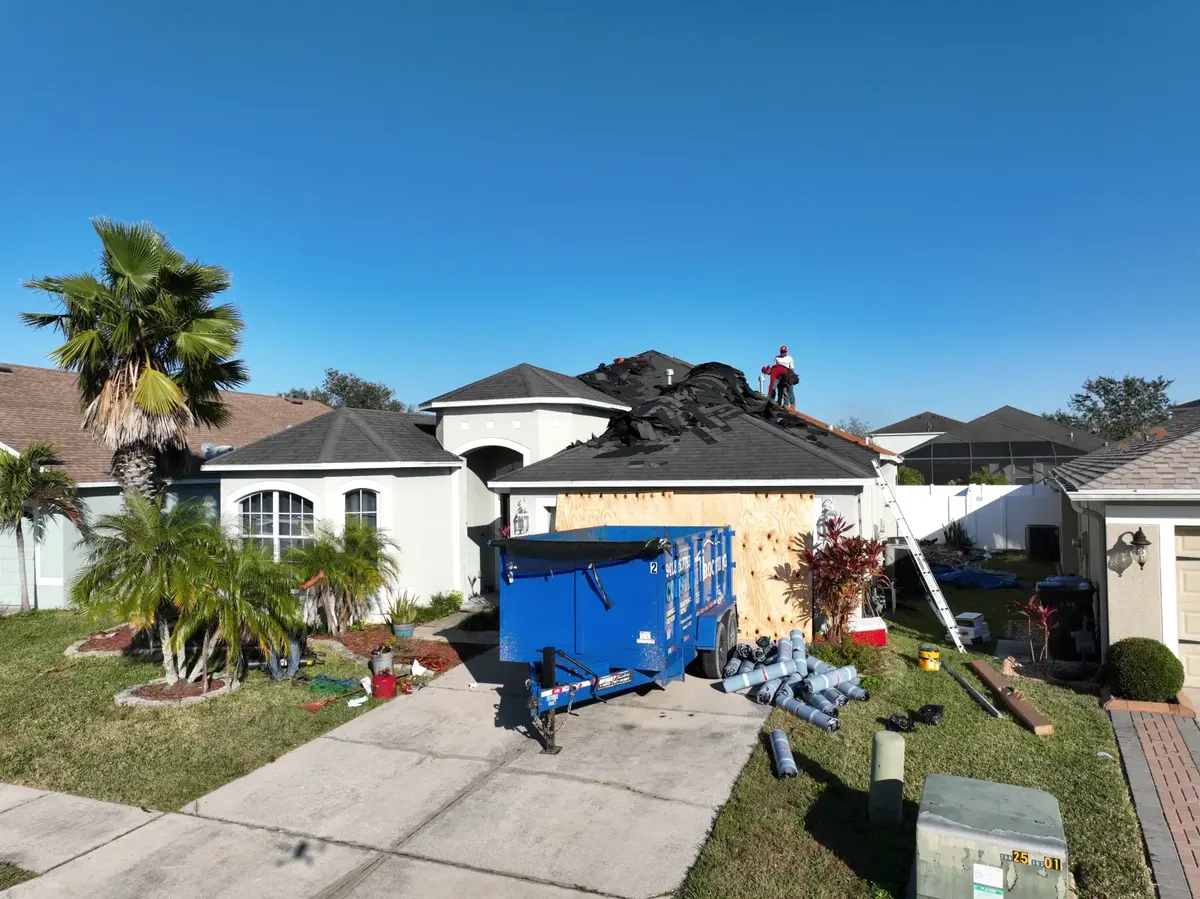
Not every call is an old FEMA tarp. We were out in Palmetto recently on a house that lost shingles to a microburst a few days earlier. The homeowner called that morning, and the job was a temporary repair with synthetic underlayment over the open area so the roof was covered before the next system rolled through. Same idea, different starting point: get a real cover on it now, sort out the permanent work after.

That timing is the whole game. Emergency roof tarp work in Florida is worth far more before the storm than after it, when every roofer in Manatee and Sarasota County is buried and you are one of hundreds of calls. If you have shingles missing right now, or a tarp that will not survive the next blow, the week to handle it is this one. If you want the fuller picture on what to do when wind takes shingles off, read our guide on missing shingles after a storm, and if you are still working through Milton damage, what to do after Hurricane Milton covers the rest of it.

Coastline covers Manatee County, South Pinellas, South Hillsborough, and the Sarasota corridor, from Bradenton and Palmetto out to Parrish, Ellenton, and the beaches. Inspections are free and there is no trip fee, so having someone look at a questionable tarp costs you nothing but the phone call.

Storm work on the Gulf Coast

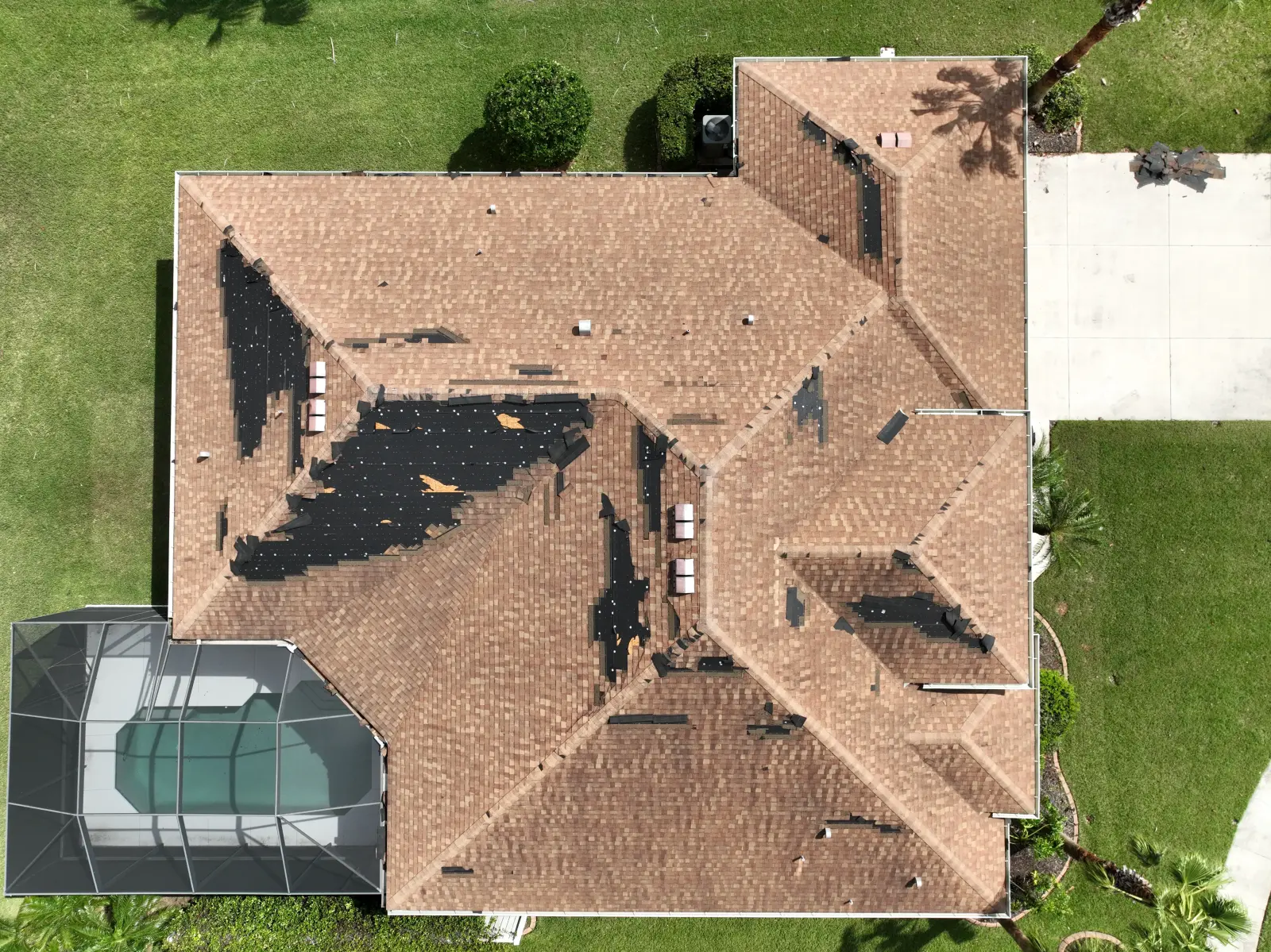
What an open roof looks like when we get there

Hurricane-damaged Florida tile roof with displaced tile and exposed underlayment
Hurricane-damaged tile roof, October 2024. Displaced tile and exposed underlayment, the kind of opening a tarp is meant to cover. Florida Gulf Coast.
Ground-level view of Florida storm damage documented after Hurricane Ian
Ground-view storm damage documentation, October 2022. Photos like these are what goes in the written report. Florida Gulf Coast.
Storm-damaged shingles being torn off down to the roof deck on a Florida home
Shingle teardown on a post-storm replacement, January 2023. Manatee County, FL.
Free inspection

Find out if your tarp will make it through this season.

We will get up there, tell you straight whether the tarp is still doing anything, show you what is underneath it, and send a written photo report. Free inspection, no trip fee, no diagnostic fee. If it needs a re-tarp we will say so, and if it has another season in it we will say that too.

Schedule your free inspection
Reviews

Storm response Coastline has delivered for Florida homeowners

★★★★★
"Coastline did a great job re-roofing our home. Then serious flying debris from both Hurricanes Ian and later Milton damaged the shingles twice. Each time, company owner Josh sent out a skilled crew to do repairs. We are happy that our roof still looks brand new."
Jim S.Repeat storm repairs, Florida Gulf Coast
★★★★★
"Received new roofing. Coastline was able to start my work within a week after Ian. Very professional and great quality work. Work was complete in less than a week."
Anthony S.Post-hurricane response, Florida Gulf Coast
★★★★★
"I really lucked out. My inspection and resolution was performed all in the same day. I'm grateful."
Sekina F.Same-day emergency repair, Florida Gulf Coast
FAQ

Common questions about tarp replacement

How long does a roof tarp last?

Long enough to get you through the emergency, not long enough to live with. A tarp is a temporary cover, and Florida is hard on it. UV, heat, and constant wind cycling make the material brittle and work it loose at the fasteners until it tears. The roofs we are on right now make the point better than any number could: the tarps that went up after Hurricane Milton in October 2024 are roughly 21 months old, and the ones we are pulling off are ripping, brittle, and no longer sealing. If your tarp has been up since Milton, treat it as expired.

My FEMA tarp is shredded. What do I do now?

Get it replaced before the next storm rather than after. A shredded tarp is worse than knowing you have no cover, because it looks like protection while water runs straight past it into the decking and down into the ceiling. Coastline does re-tarp work across Manatee County, South Pinellas, South Hillsborough, and the Sarasota corridor. We pull the failed tarp, look at what is underneath, re-cover the open area, and document the condition with a written photo report while we are up there. Call (941) 896-7793 or text (941) 345-0072.

Can you re-tarp my roof while my insurance claim is in litigation?

Yes. Being stuck in litigation does not mean the house has to stay open to the weather. We meet homeowners who still have shingles missing and a tarp that shredded months ago, waiting on an insurer while rainy season runs. Re-tarping is separate work from your claim and it does not depend on the claim being settled. We are not a public adjuster and we do not negotiate claims for a fee. What we can do is re-cover the roof and document the condition with dated photos your adjuster or attorney can use.

Does homeowners insurance cover emergency tarping?

Most Florida homeowner policies cover emergency tarping after a covered loss, because a policy generally expects you to prevent further damage once the damage happens. Keep every receipt and every photo. Coastline documents the damage with a written photo report you can hand to your adjuster. We are not a public adjuster, we do not negotiate your claim for a fee, and public adjusters are licensed separately under Florida Statute 626.854.

Can I still file a Hurricane Milton claim?

No. Under Florida Statute 627.70132 you have one year from the date of loss to file a new or reopened claim and 18 months to file a supplemental claim, windows shortened by SB 2-A effective December 16, 2022. Hurricane Milton's date of loss was October 9, 2024 and Hurricane Ian's was September 28, 2022, so as of July 2026 both filing windows have closed. A claim you already have open, or one in litigation, is a different situation and can still be moving. This is general information and not legal advice, so questions about your own claim belong with your attorney.

Shredded tarp? Get it covered before the next storm.

Re-tarps and temporary repairs across Manatee County, South Pinellas, South Hillsborough, and the Sarasota corridor. Free inspection, written photo report, licensed CCC1331076.

Call Text